Photonics simulation software

Design. Simulate.
Understand.

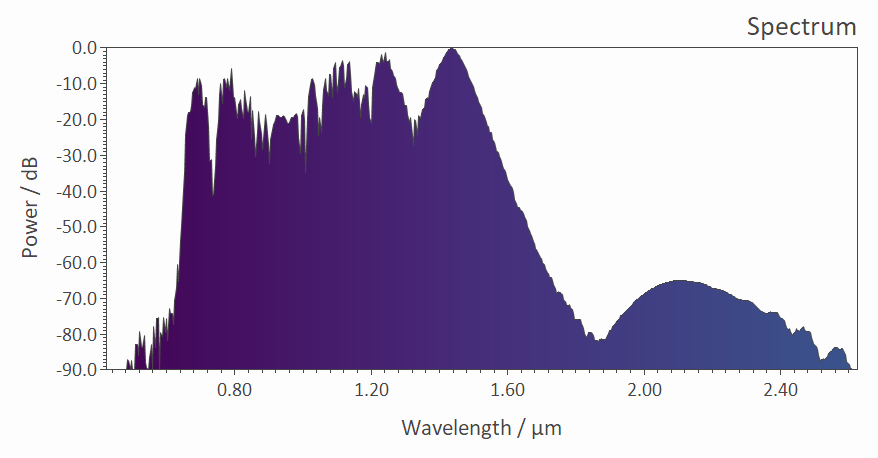
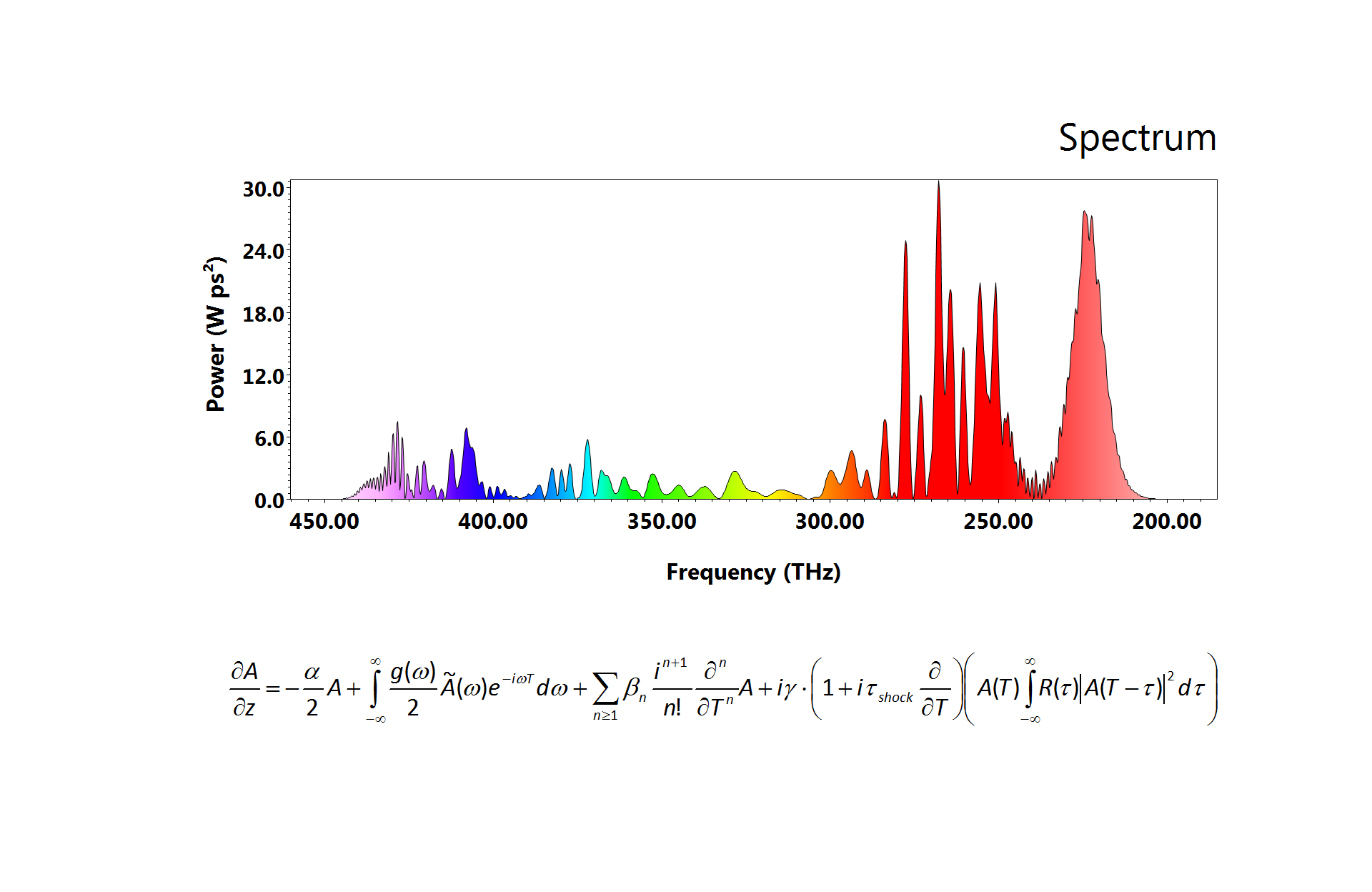
fiberdesk combines mode solving, gain modelling and nonlinear optical simulation in a single package — from waveguide design to ultrafast pulse propagation.

Explore fiberdesk

See fiberdesk in action

Explore.

From waveguide design to ultrafast pulse propagation — pick a topic to see it in action.

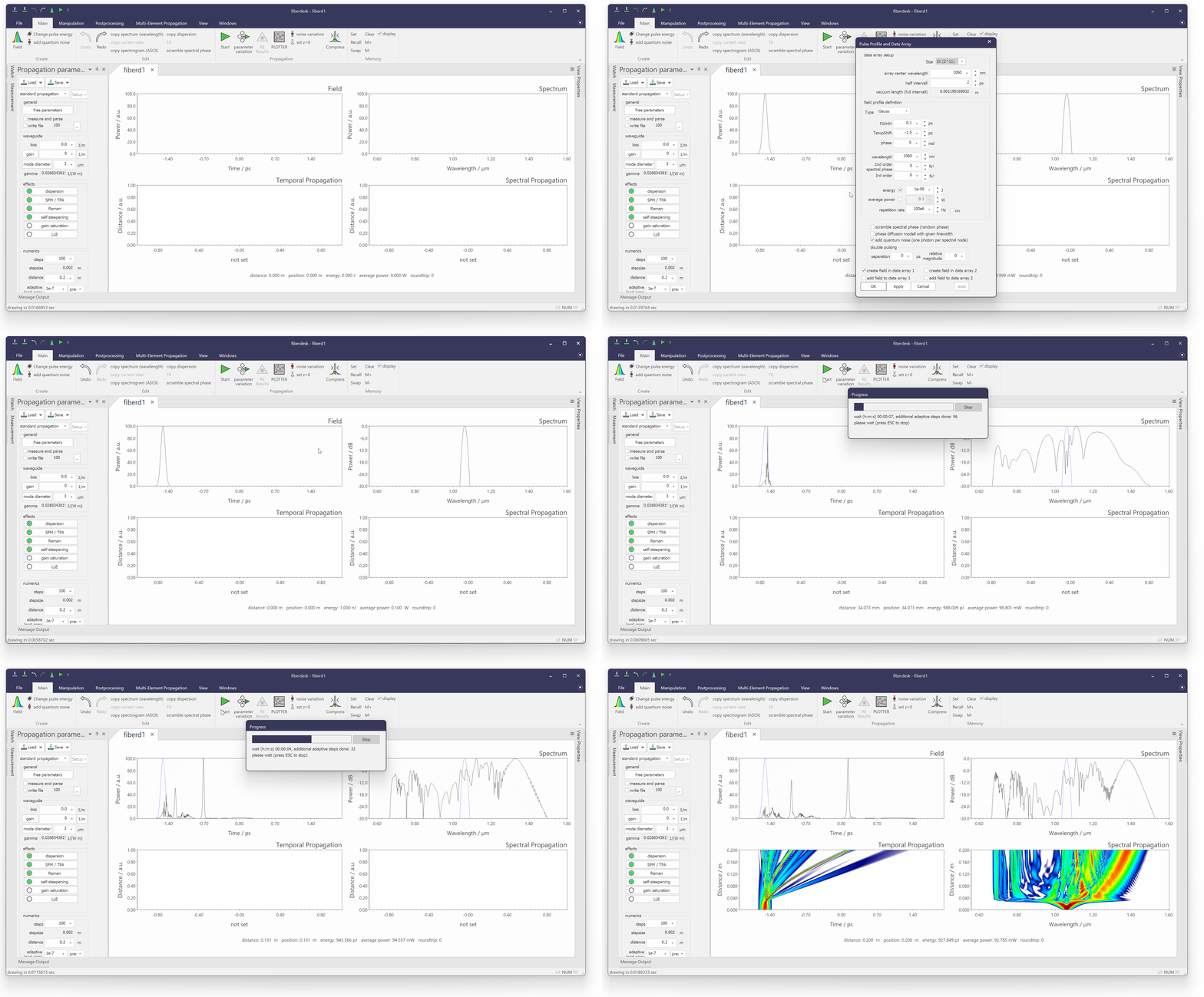
fiberdesk first steps tutorial
fiberdesk first steps
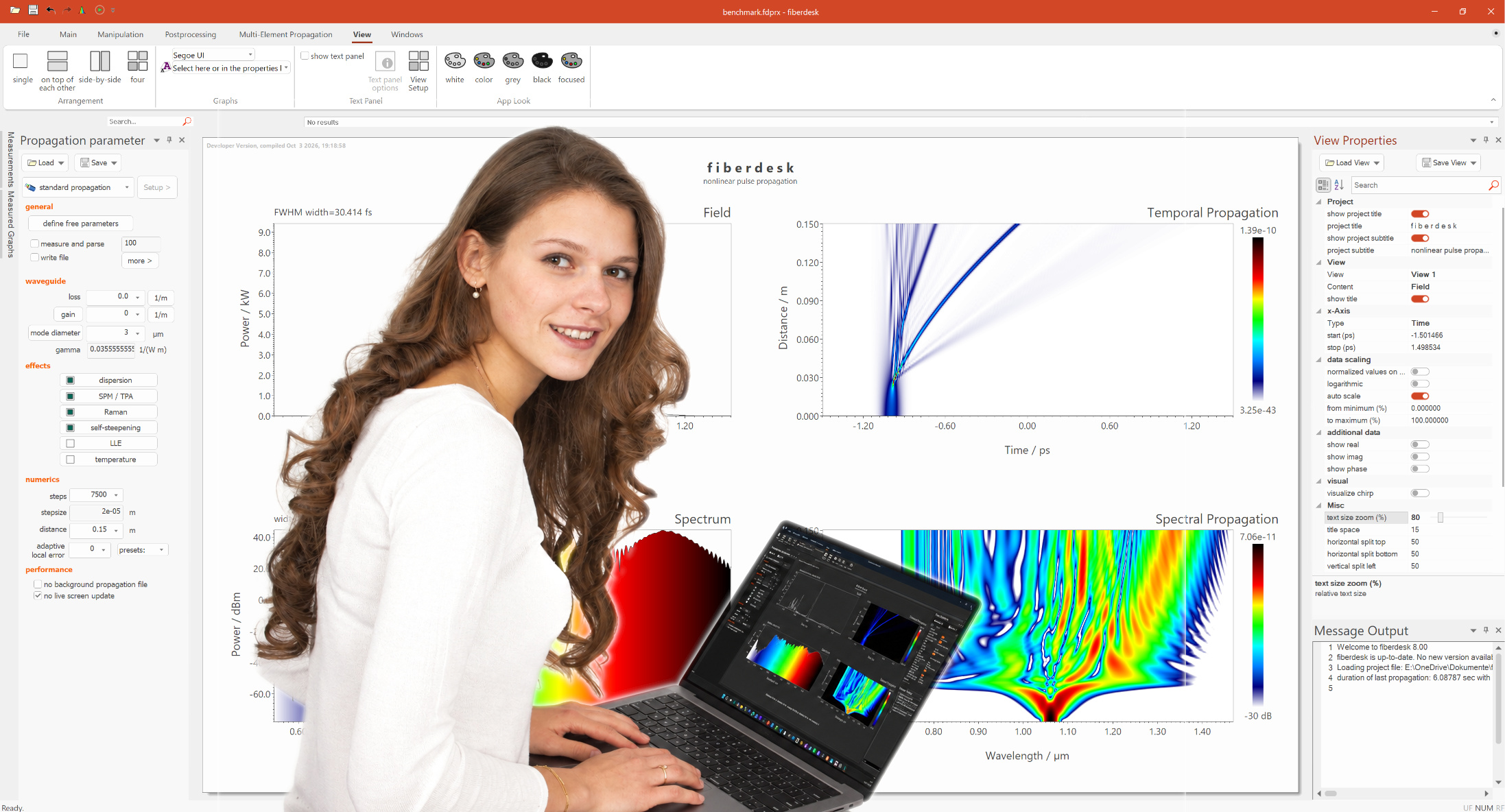
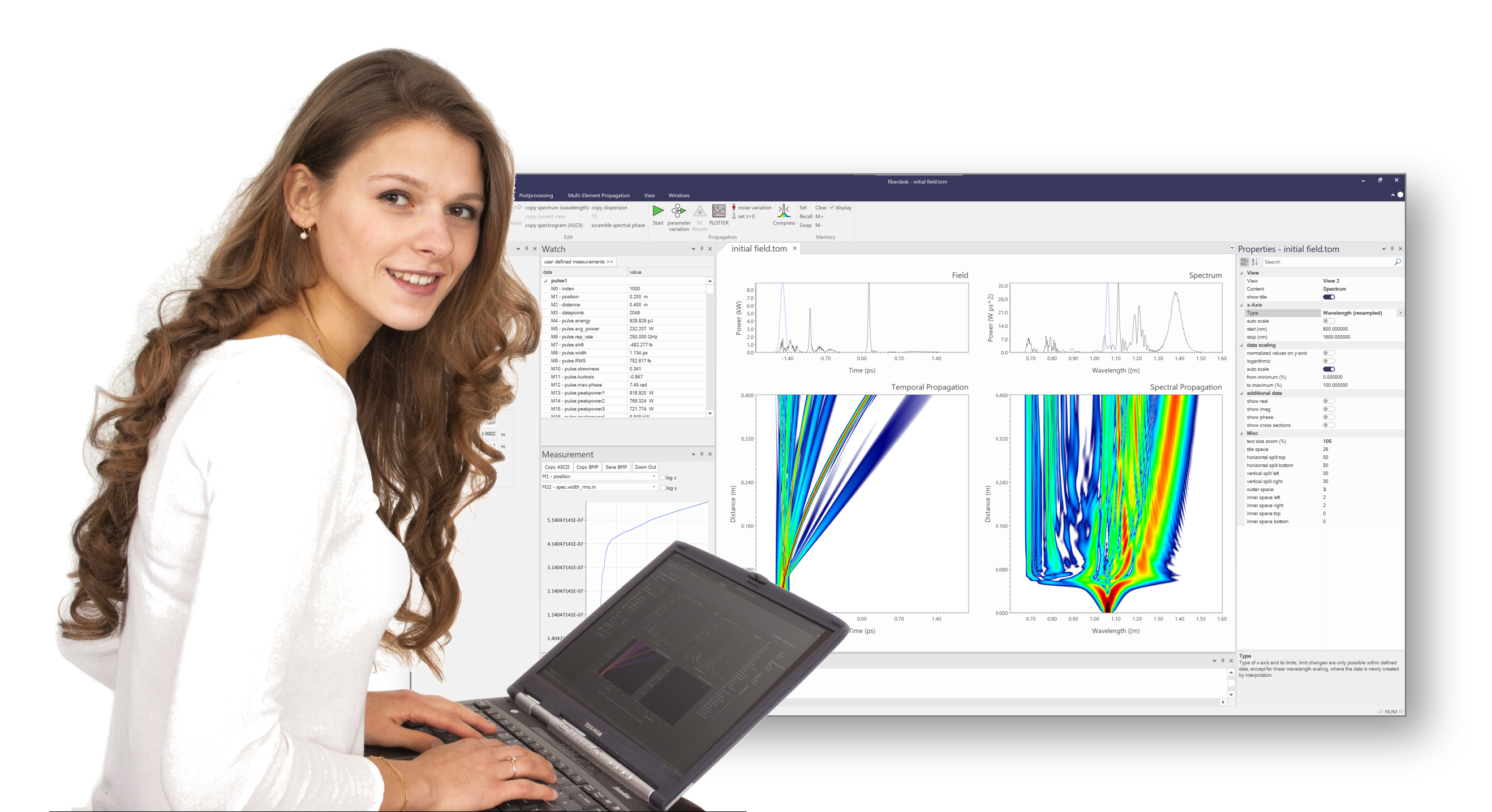
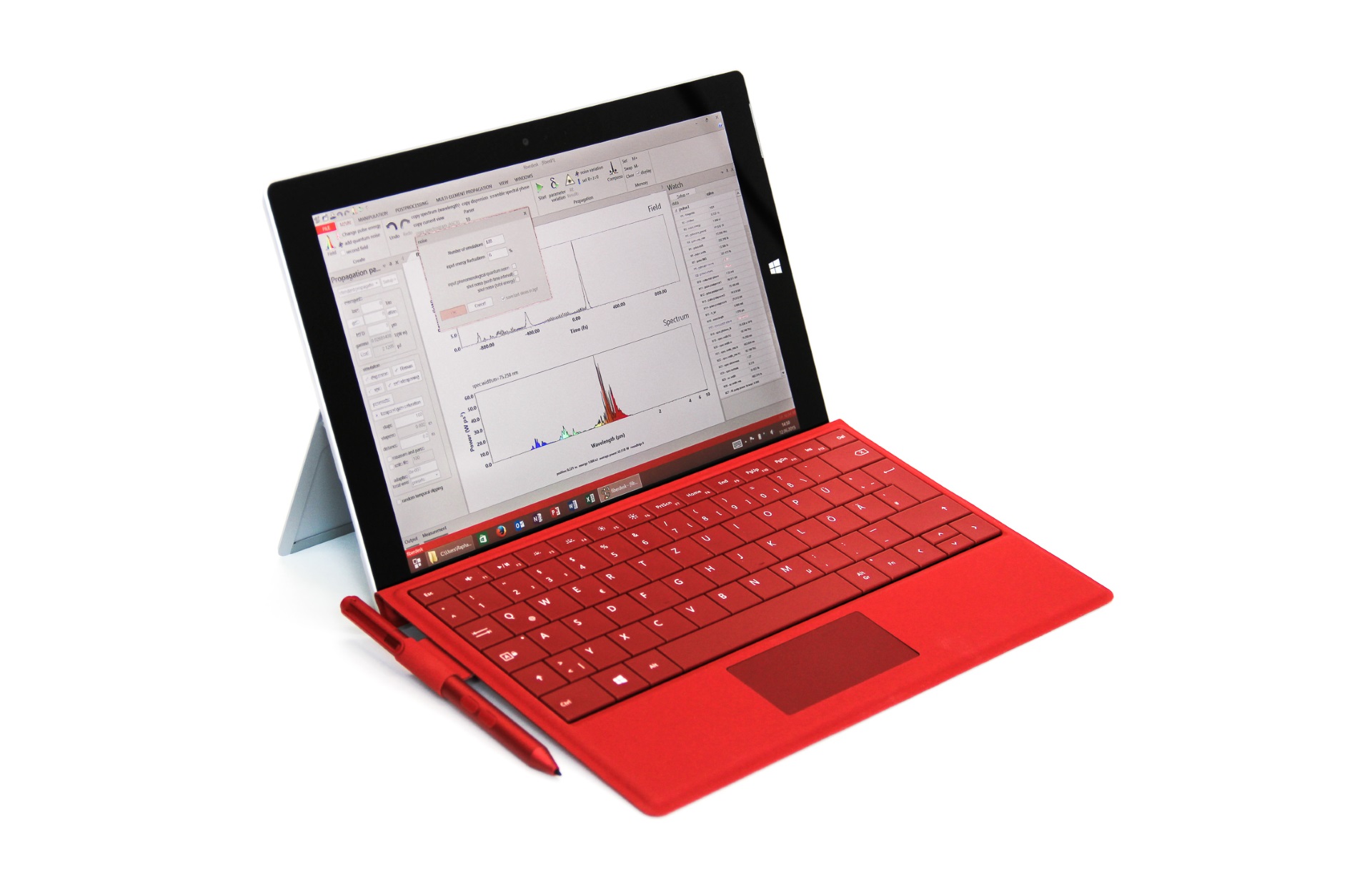
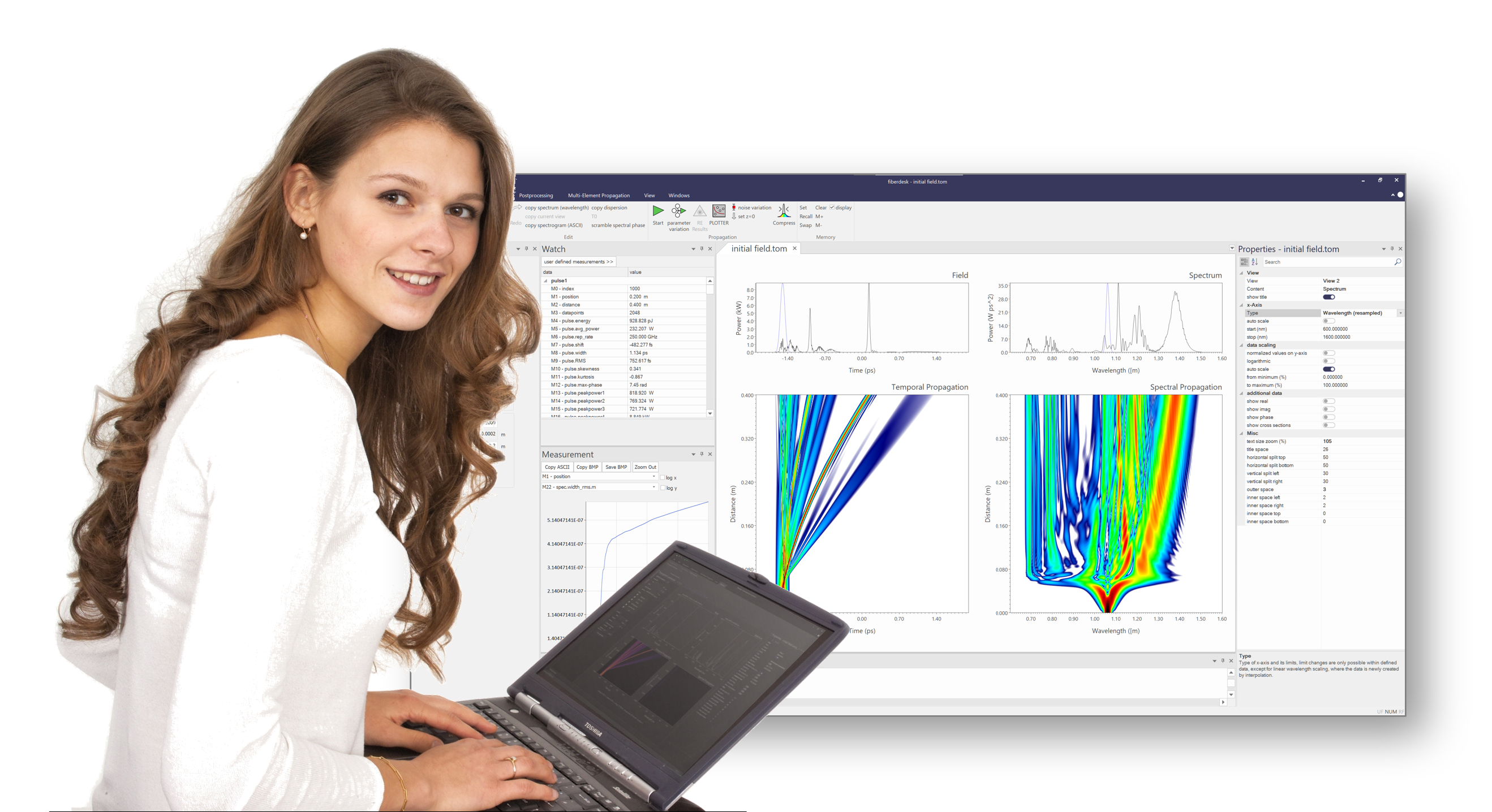
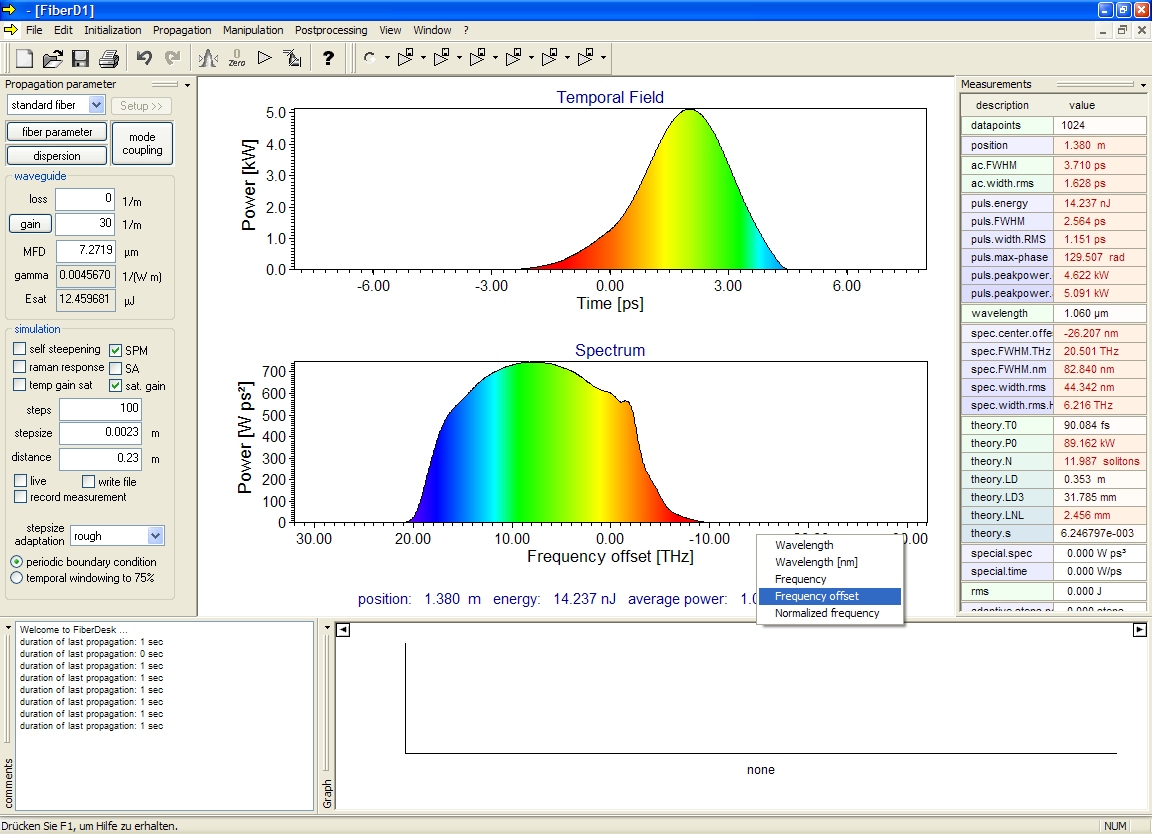
fiberdesk showing nonlinear pulse propagation results, with a user working on a laptop
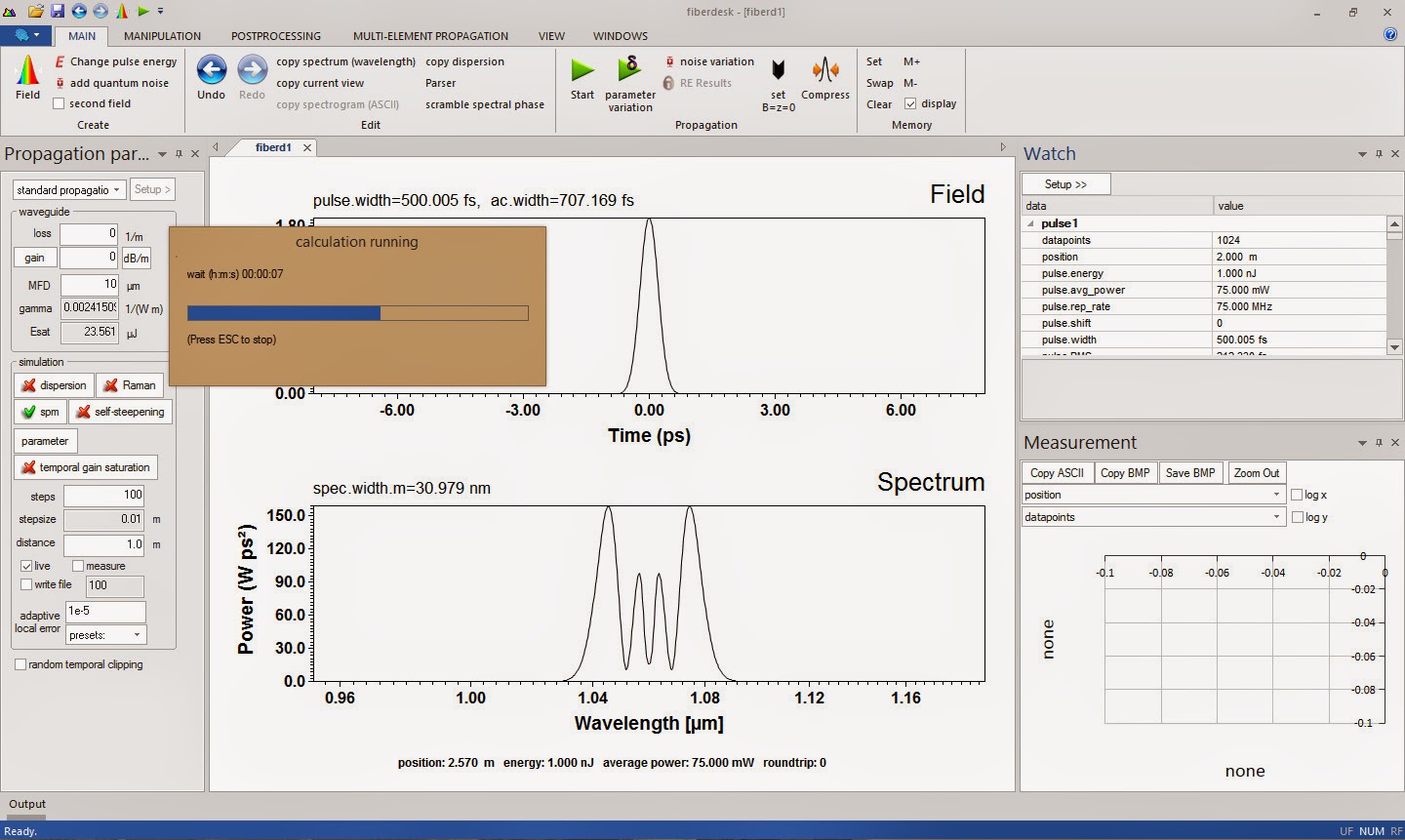
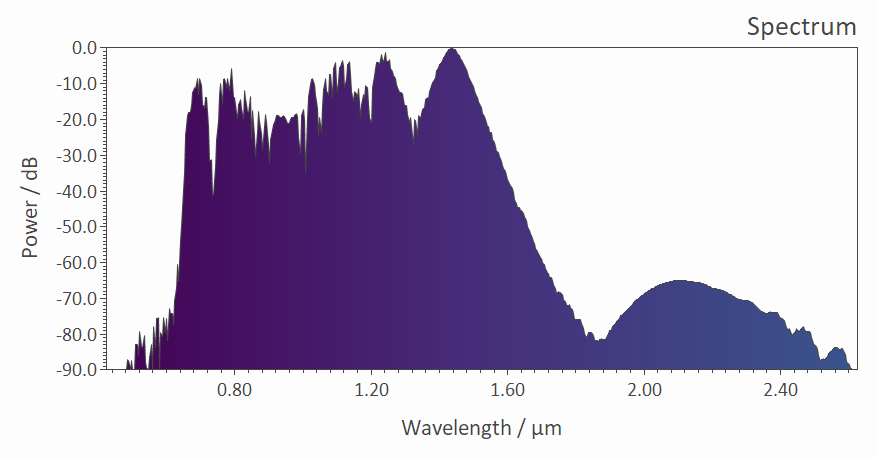
Nonlinear pulse propagation in fiberdesk
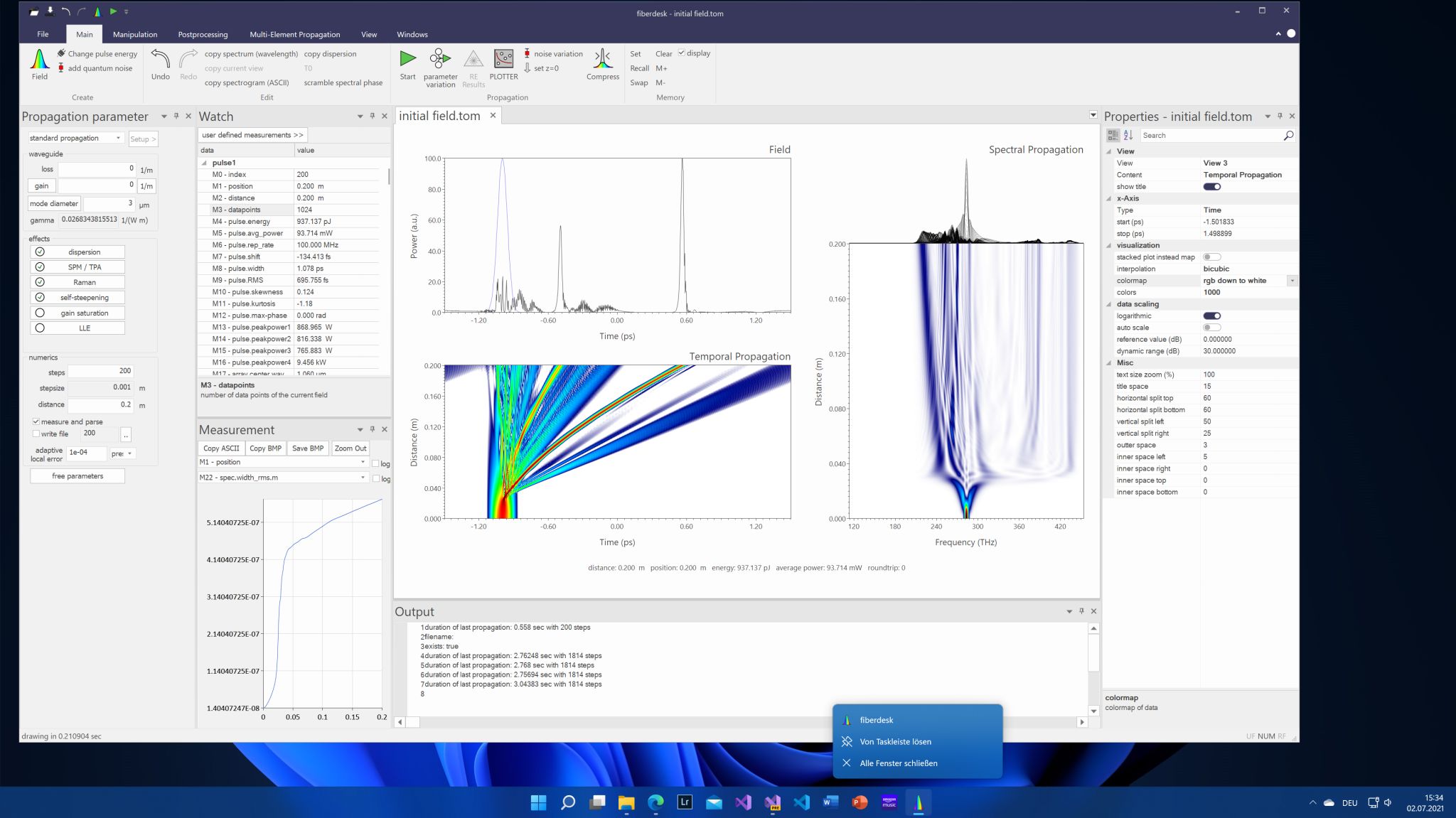
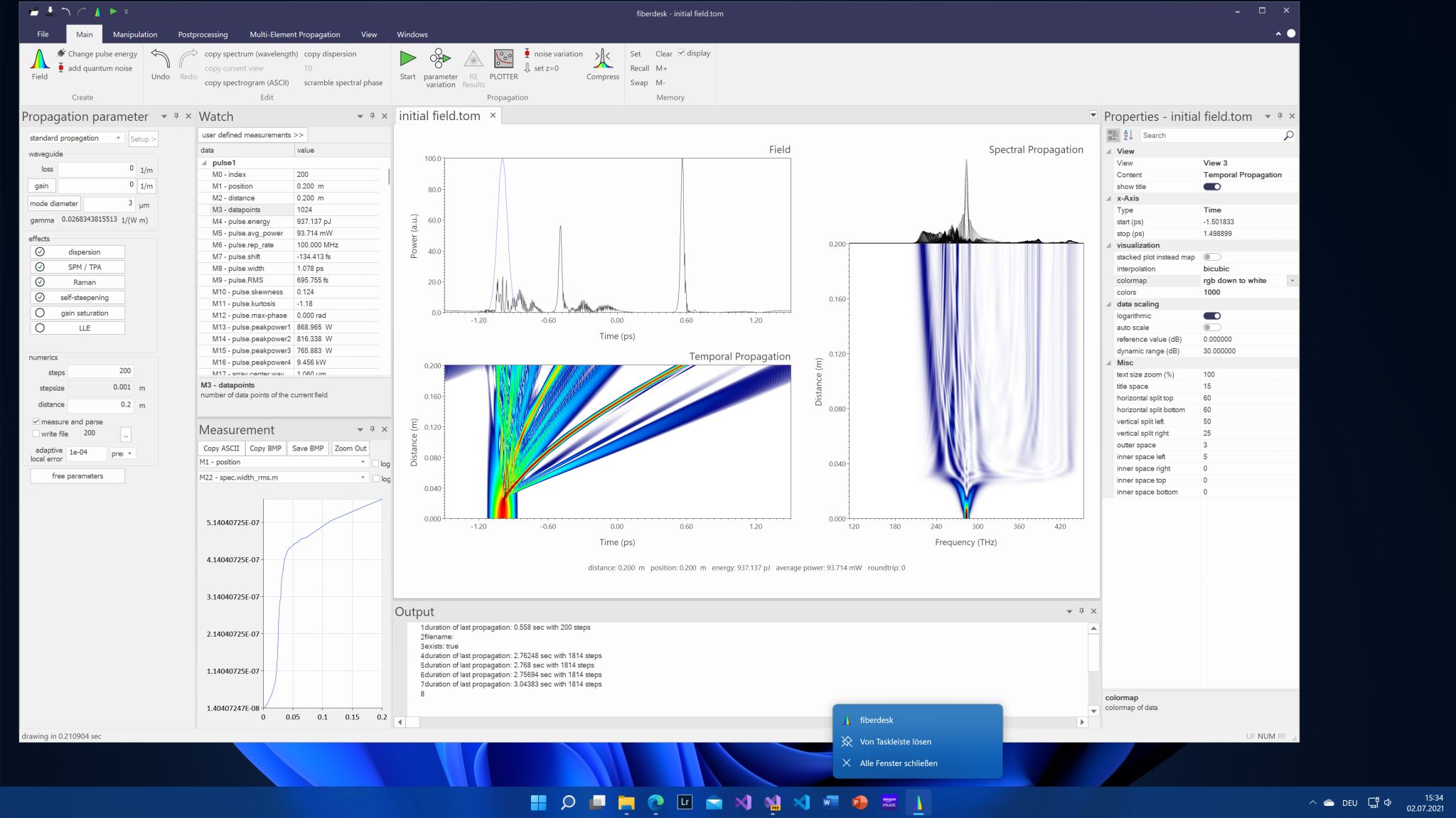
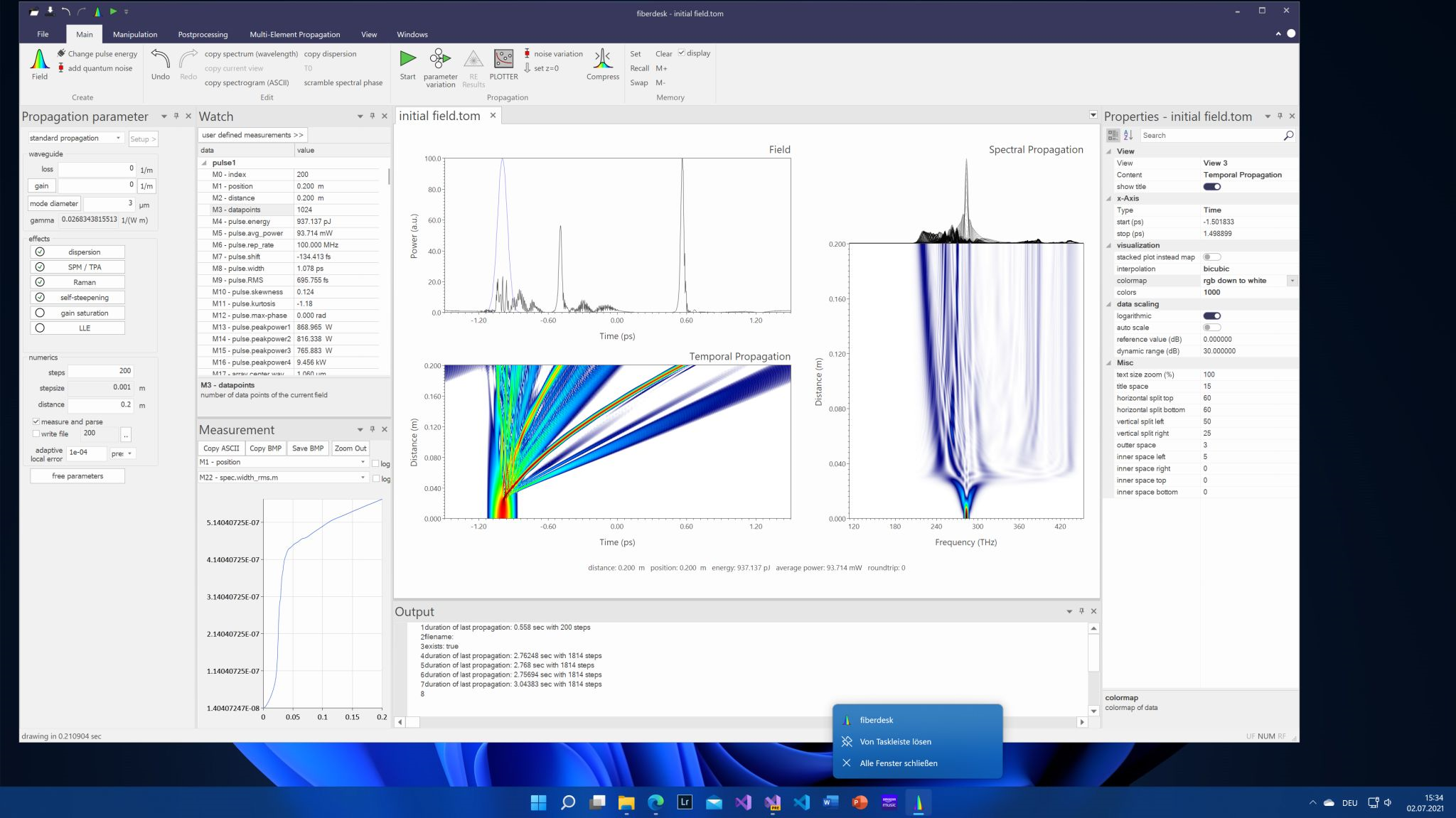
fiberdesk running on Windows
fiberdesk on Windows
fiberdesk propagation view
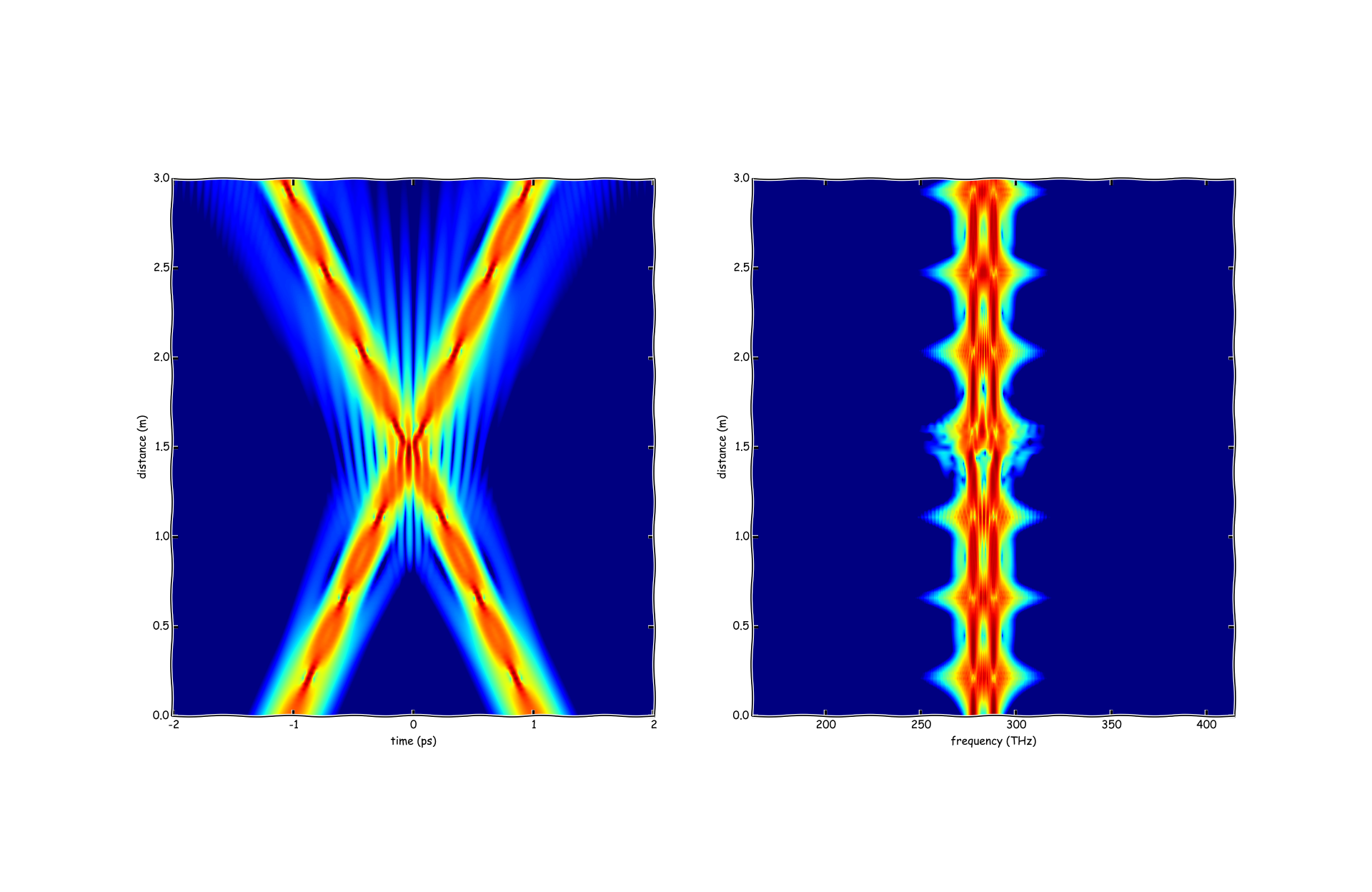
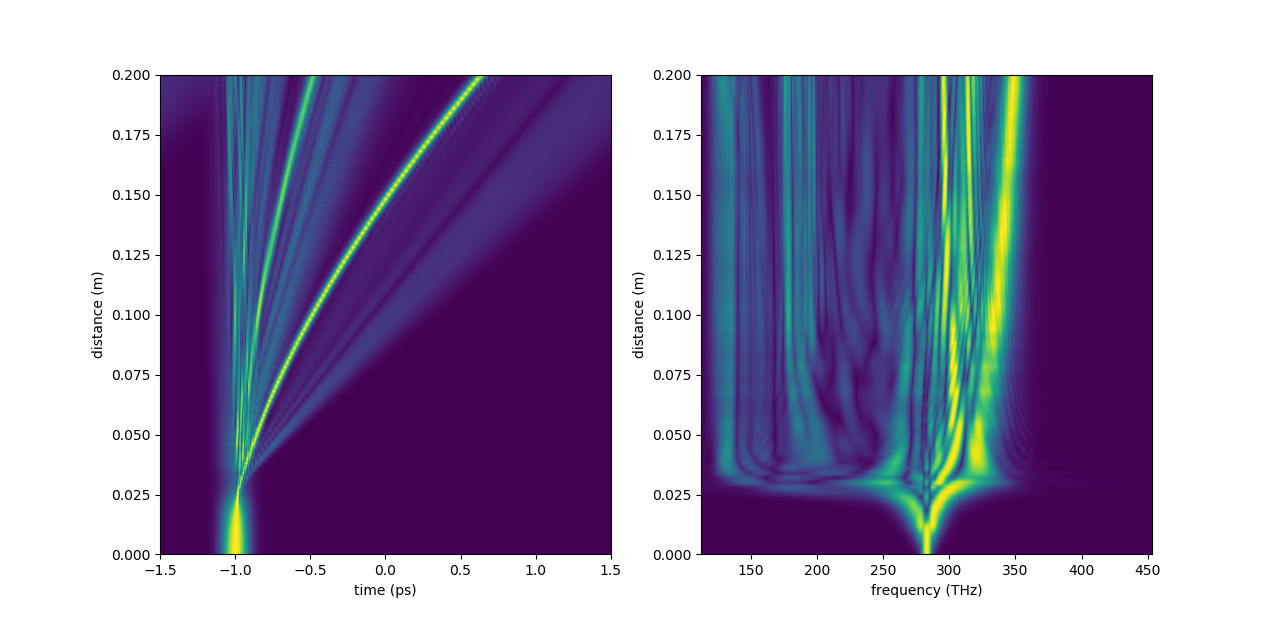
Propagation analysis using Python
Mode solver dialog
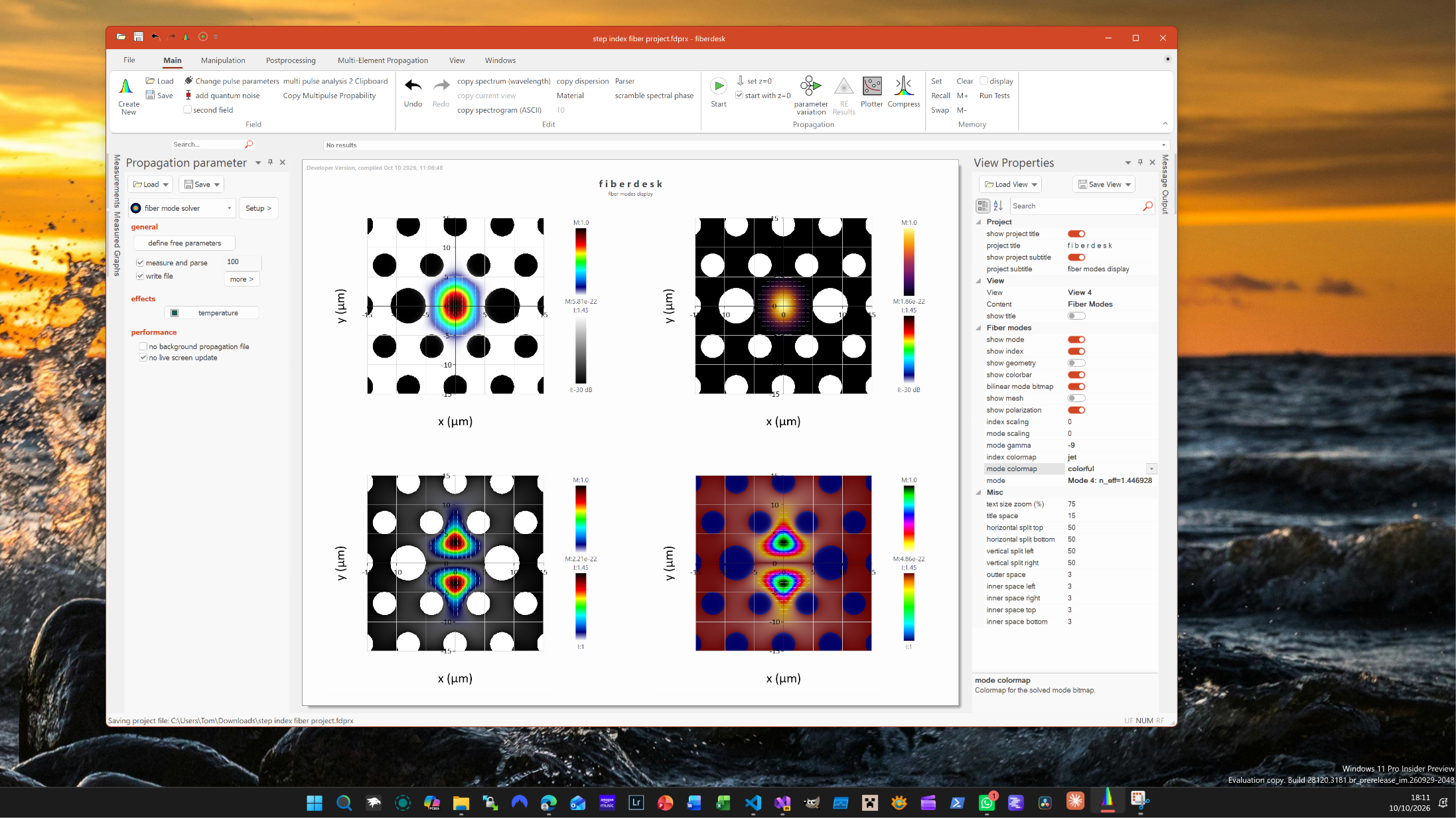
fiberdesk 8 beta on Windows 11 showing photonic crystal fiber modes in different colormaps
Fiber modes in different colormaps
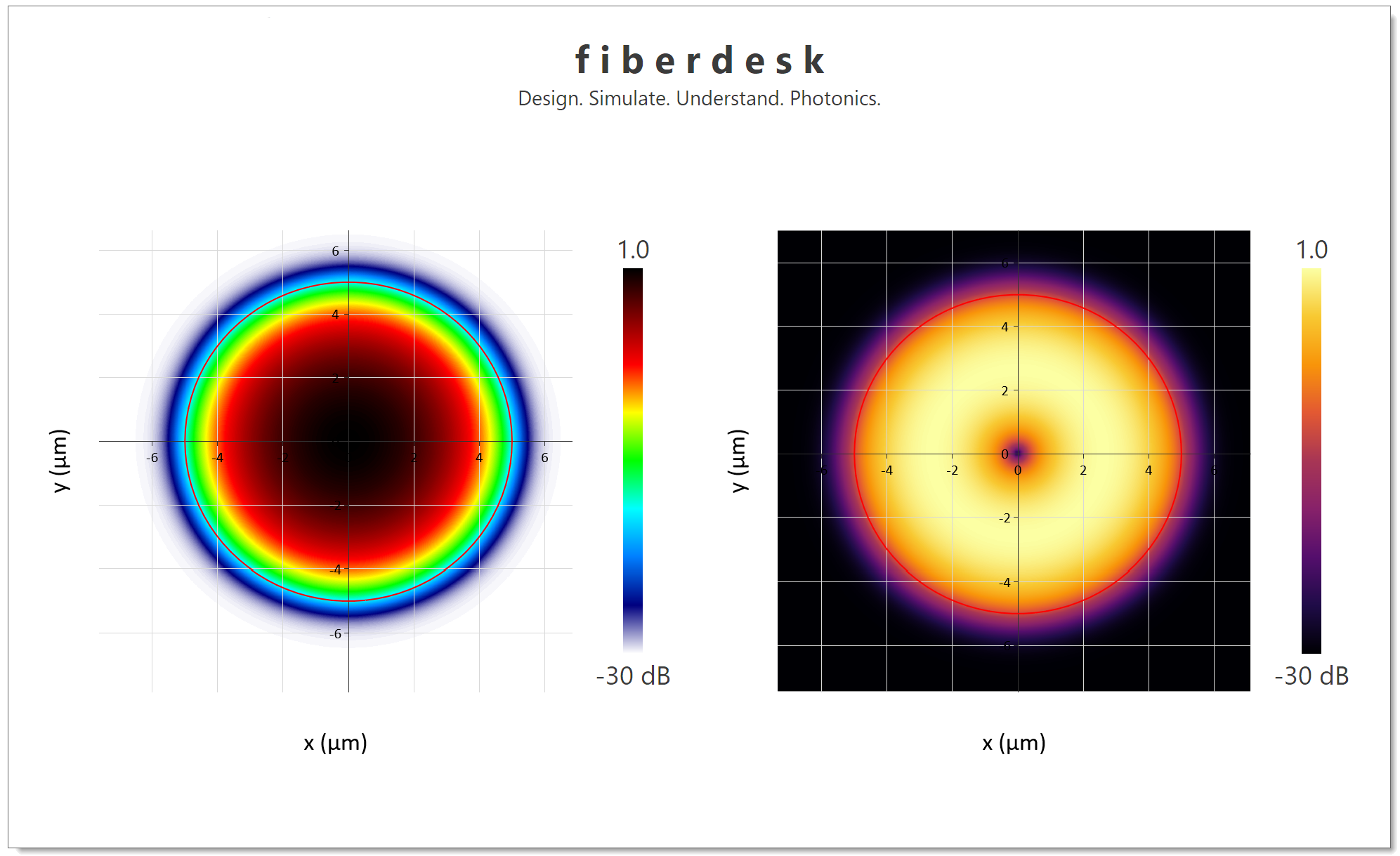
Hollow-core fiber mode blended with its refractive index profile
Hollow-core fiber mode and index profile
Mode solver view
Mode solver view
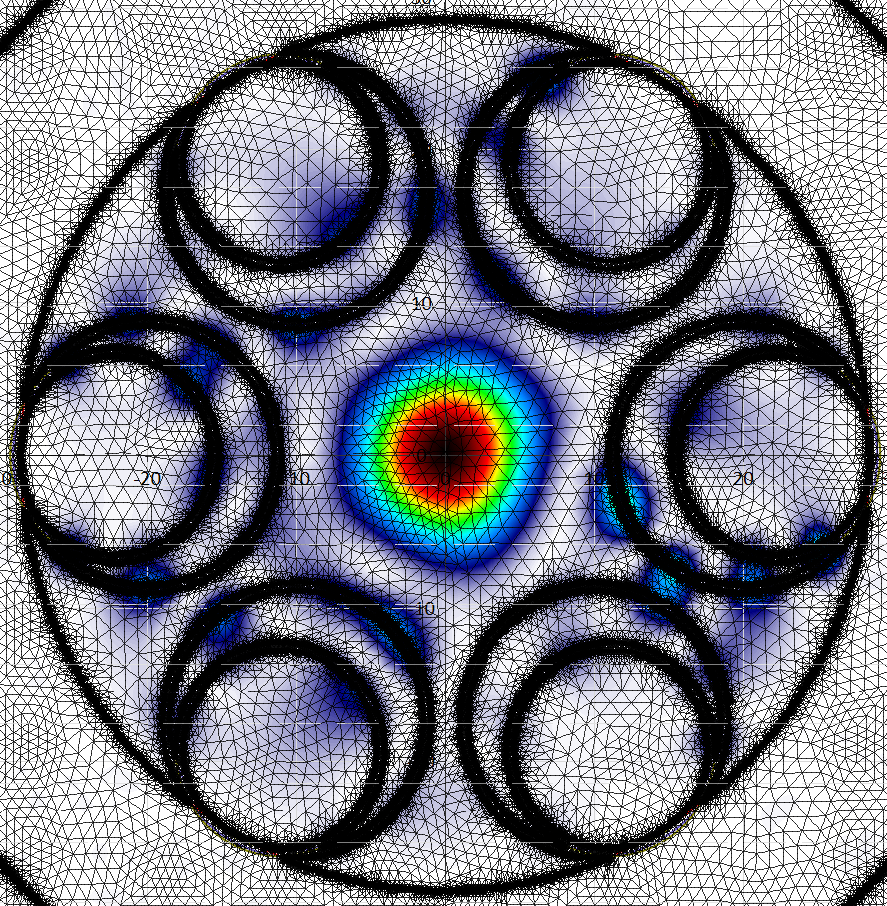
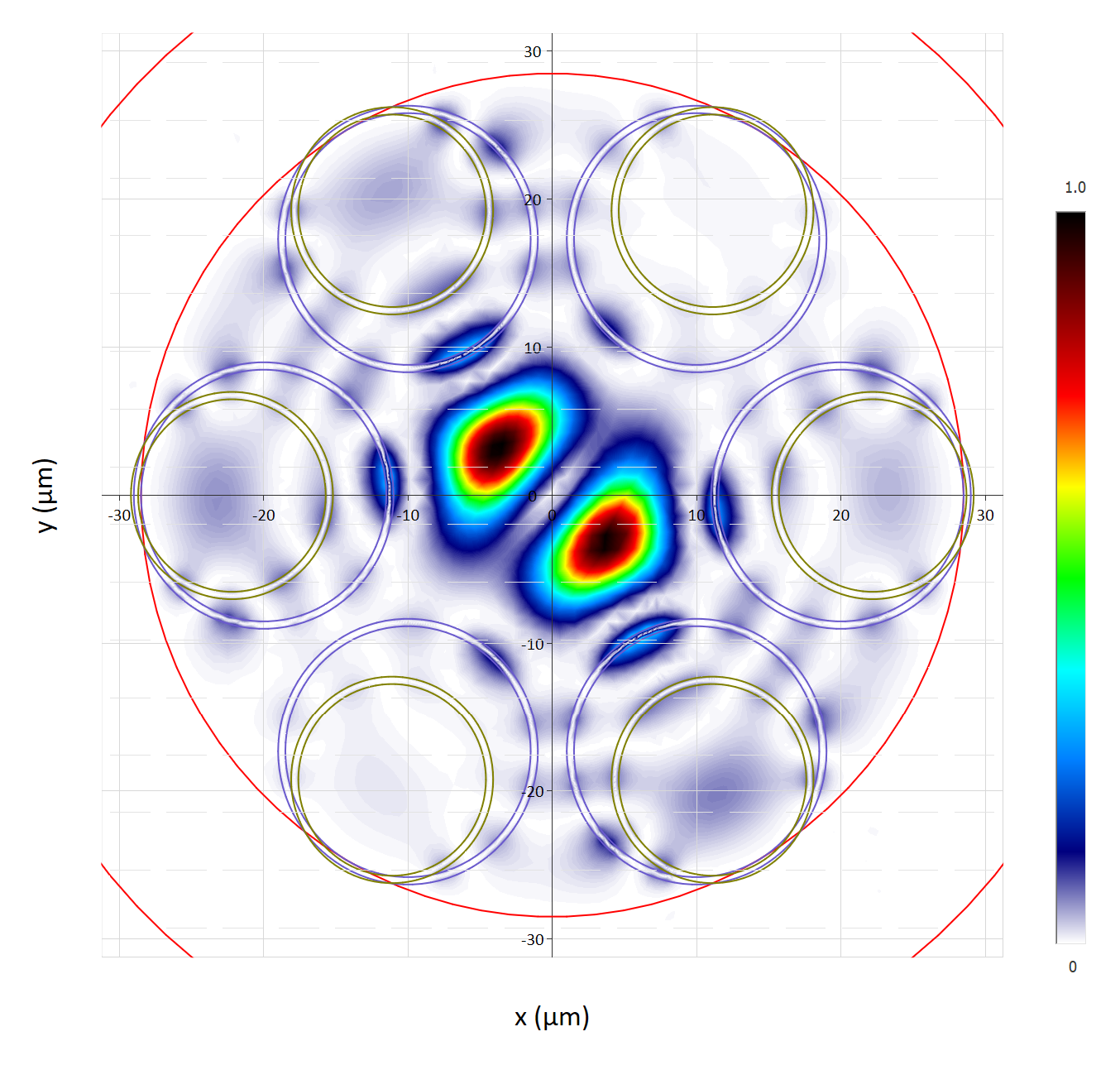
FEM solved mode
FEM solved mode
FEM solved mode 2
FEM solved mode
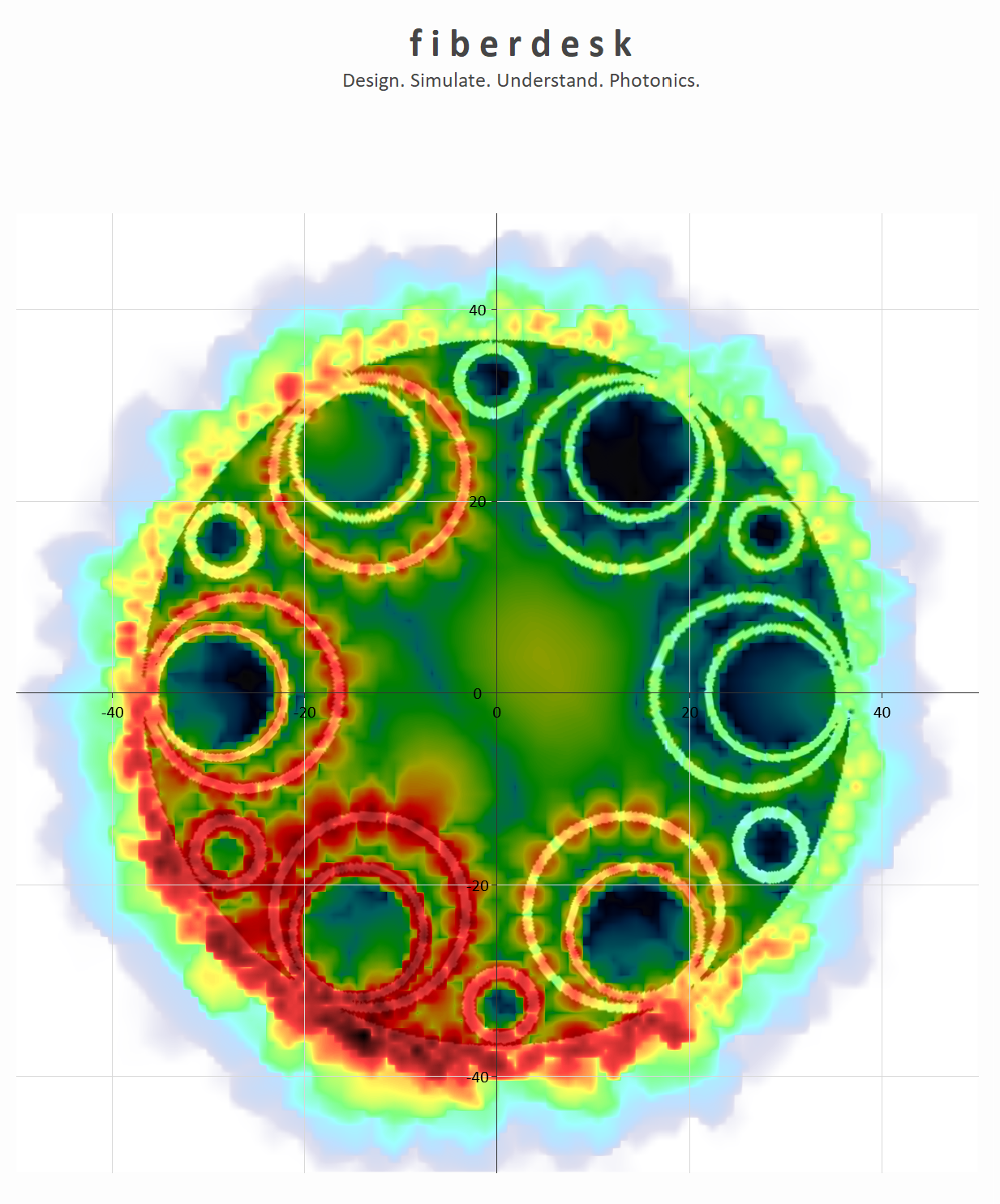
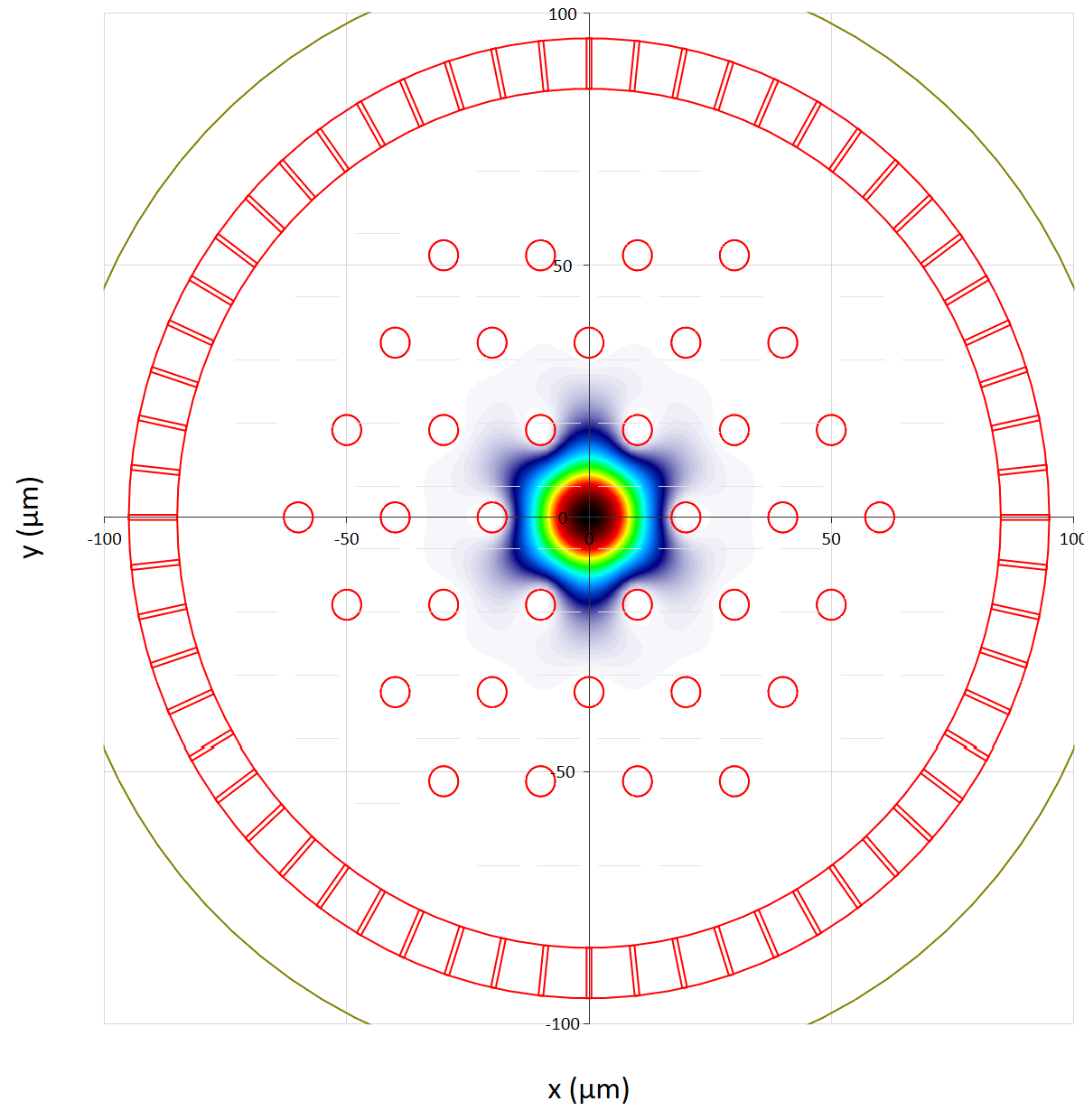
Solved mode double clad PCF
Double clad PCF mode
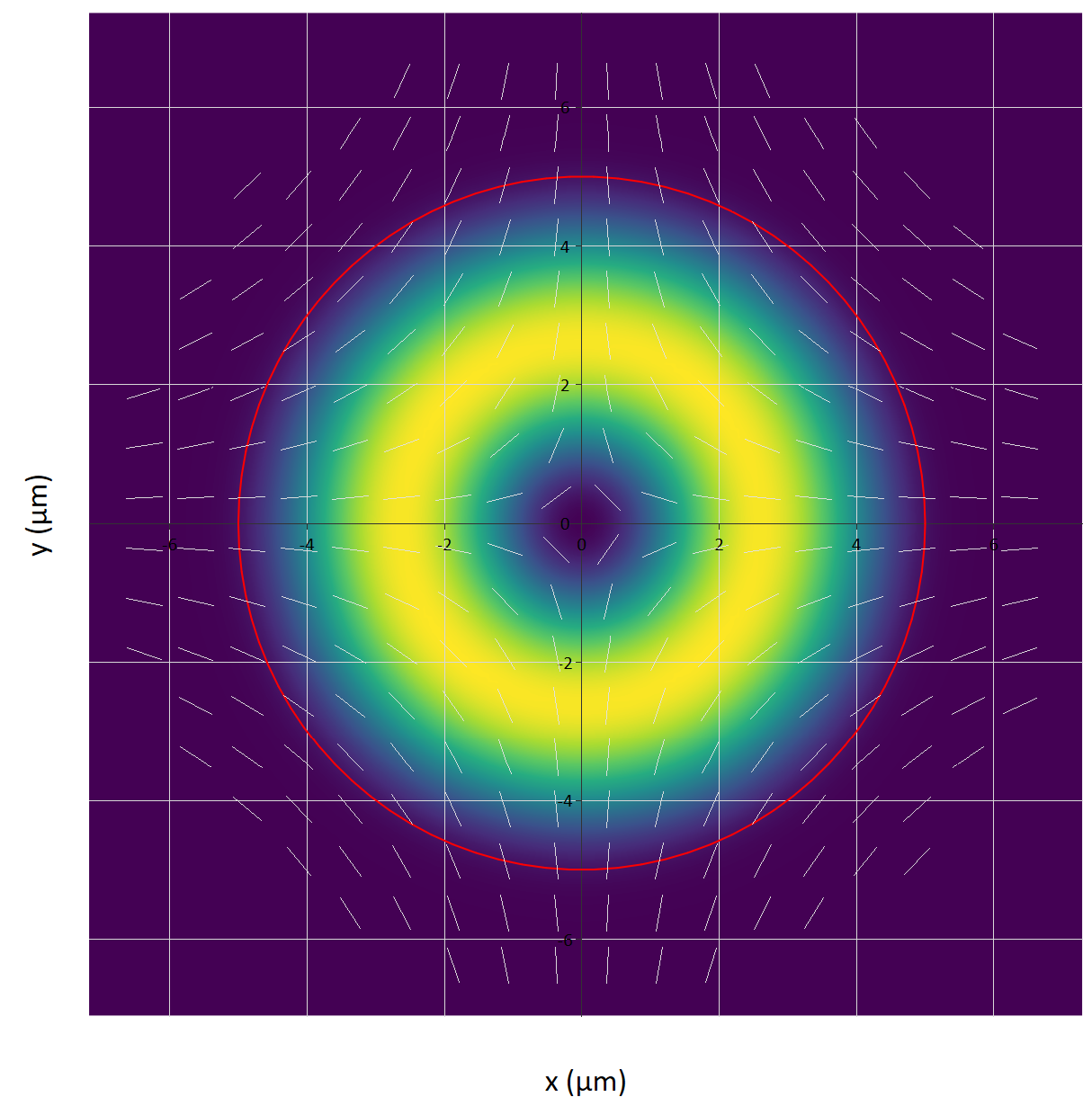
Solved mode vectorial with polarization display
Vectorial mode with polarization
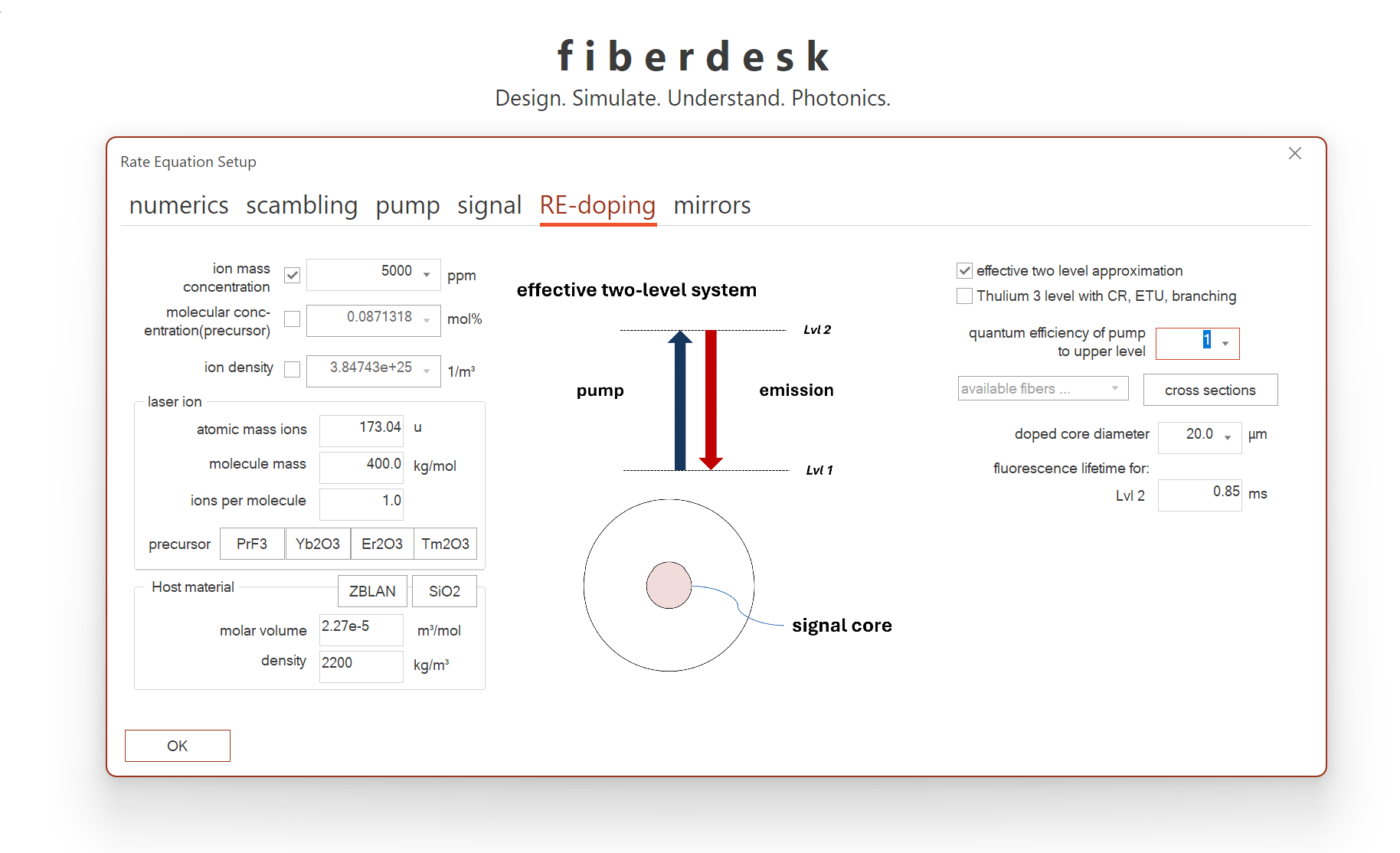
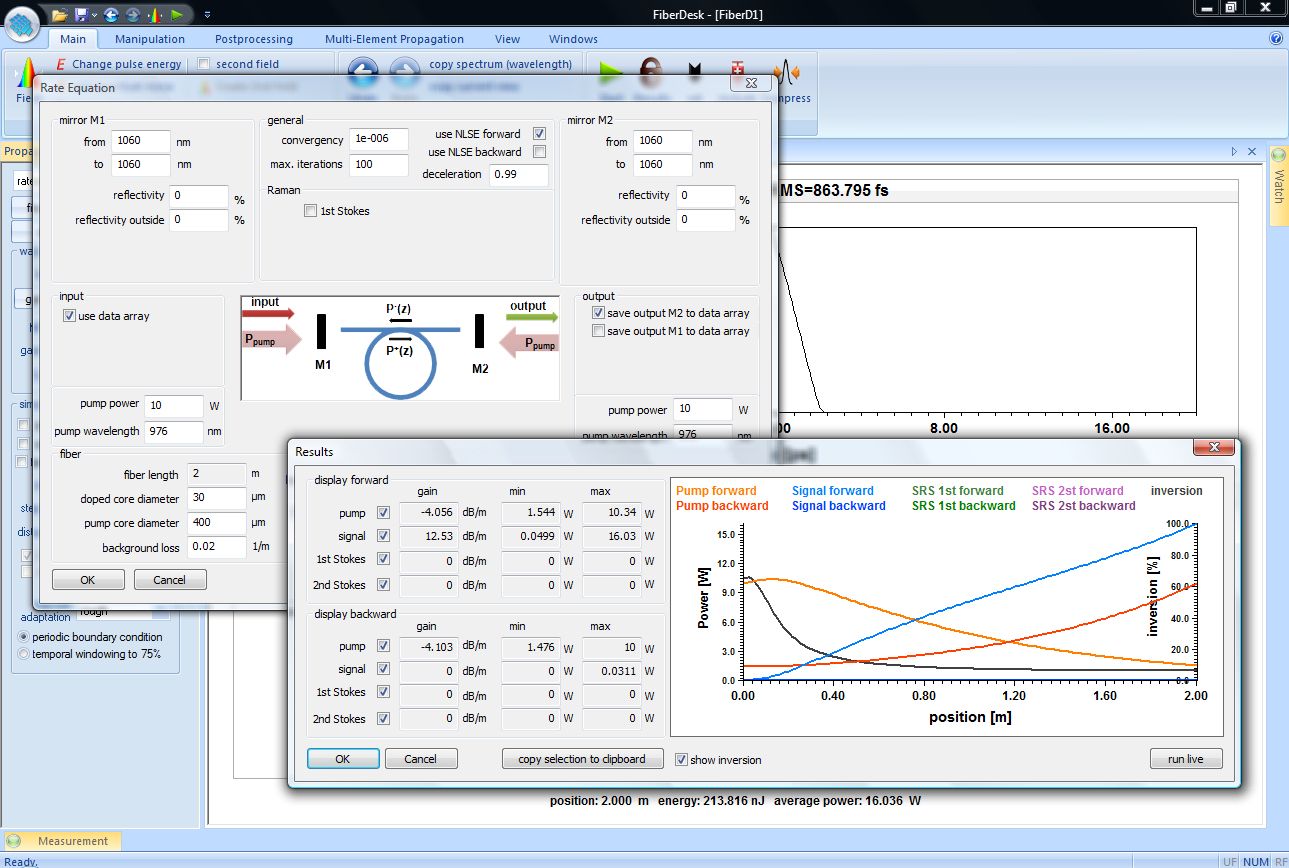
Rate equation setup
Rate equation setup
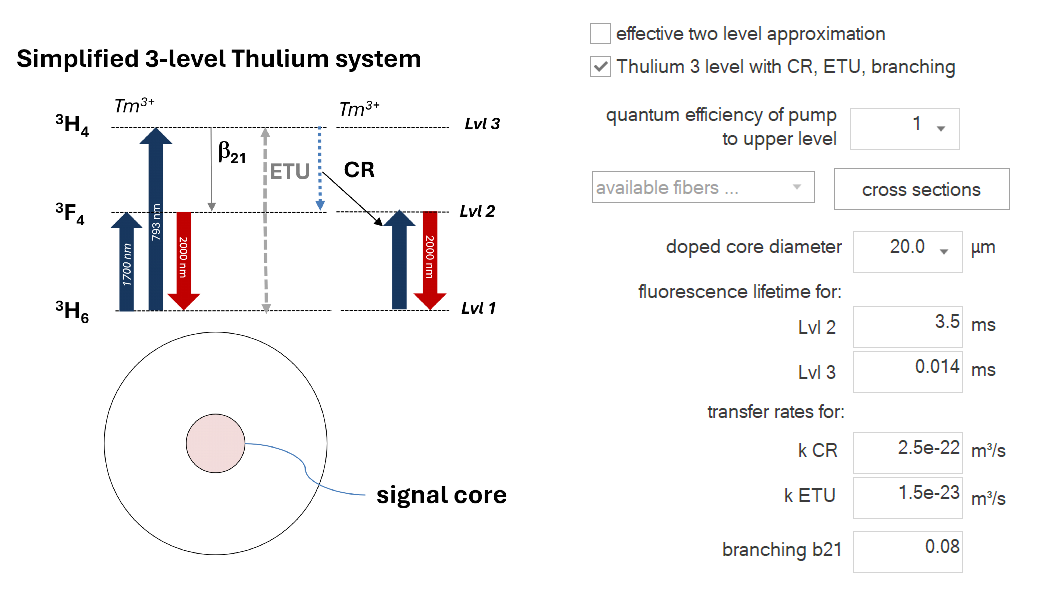
Rate equation thulium
Thulium rate equations

fiberdesk first steps

Explore tutorials

Learn fiberdesk

Tutorials.

Step-by-step guides with PDFs and ready-to-run project files.

Tutorial 00

Graphical User Interface

Graphical User Interface and access to all parameters of the Nonlinear Schrödinger Equation and/or rate equation solver.

Tutorial 01

Getting started

Learn the most simple workflow.

  • Measure parameter along the propagation
  • User defined measures (e.g. B-Integral)

Tutorial 07

Field Manipulation

  • Introduction
  • A simple spectral filter function
  • Phase modulation

Tutorial 10 · coming soon

Mode Solver

coming soon

Discover downloads

Get started with fiberdesk

Download.

Insert your fiberdesk dongle. Download the latest package and simply run the executable file.

Latest package

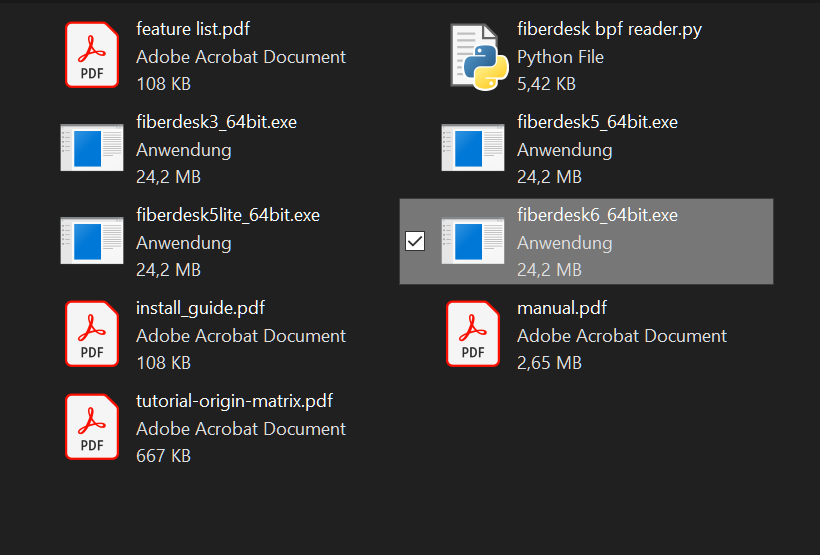
Includes 64-bit versions of fiberdesk 7. Run the executable after downloading.

  • Full package includes fiberdesk 7, Python tools, manual and license
  • DEMO version — nonlinear effects and additional elements restricted
  • Python tools on GitHub — dispersion & cross section fitting, reading propagation files

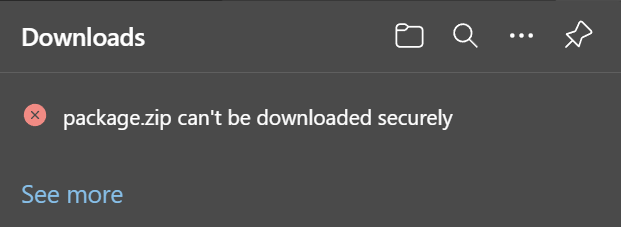
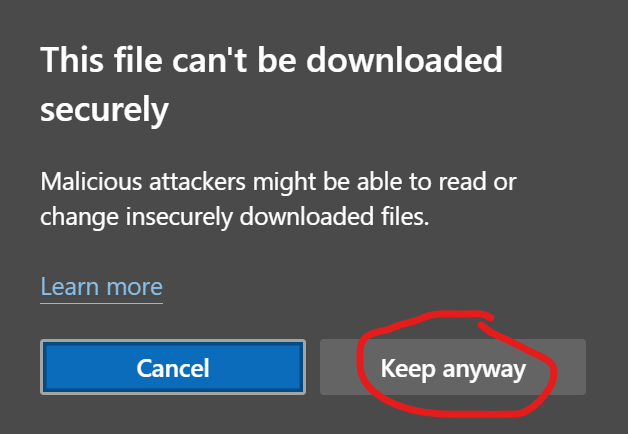
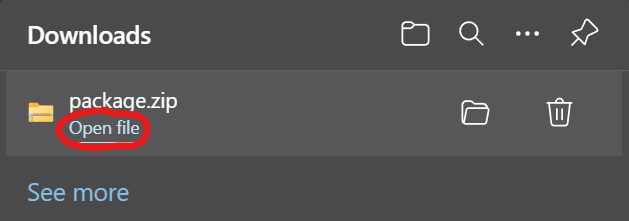
If your browser warns about the download, select Keep and then Keep anyway to trust it and start fiberdesk.

Edge — keep download Edge — keep anyway Edge — open file

HASP Driver

  • Required only for dongles shipped before 2019
  • Recent dongle versions are driverless — no driver installation needed

Legacy versions

Includes fiberdesk versions 3, 5 lite, 5, and 6 — with old manual and tutorials.

Get in touch

Let's talk photonics

Contact.

Request a quote or support

Use the button below to open your e-mail client, or write directly to the address shown.

nospam@

Get a quote

Each fiberdesk license is protected by a hardware dongle — a local, driverless USB key for an arbitrary computer that must stay plugged-in while running fiberdesk.

A net key is also available for network use. Specify the number of simultaneous logins required (each counted as one license).

Please tell us how many licenses you need and we will respond with a quote. For PR China and Japan, a dedicated local supplier is available.

Request an online course

Online courses can be booked. Please indicate how many participants and your preferred content. We will reply with a quote.

Technical support

If you have problems using the software, please describe the issue in detail and include screenshots. Please also consult the FAQ section first, which lists the information we typically need for technical problems.

Research with fiberdesk

Research with fiberdesk

Publications.

102 papers, theses and conference contributions since 2002 contain simulations performed with fiberdesk.

2026 7 publications

  1. Low peak-power pulse compression in gas-filled Herriott cells in the 2 µm wavelength range

    Johann Gabriel Meyer, Felix Ritzkowsky, Fatemehsadat Ghaffari, Kevin Schwarz, Nazar Kovalenko, Christian Franke, Andrea Trabattoni, Oleg Pronin

    arXiv:2604.26585arXiv Scholar

  2. Tailoring EUV high-harmonic spectra via nonlinear propagation in MgO crystals

    A. Mikhneva, S. Idlahcen, J. Houard, T. Godin, I. Blum, F. Amrani, F. Gérôme, F. Benabid, D. Gauthier, W. Boutu, H. Merdji, A. Hideur, A. Vella

    APL Photonics 11 (4): 046110 (1 April 2026)Scholar

  3. Designing high-contrast fiber front ends for scalable laser systems

    Daniel Morris, Athanasios Lekosiotis, Irina Trifanov, Martin Engelbrecht

    Proc. SPIE 13874, Fiber Lasers XXIII: Technology and Systems, 1387413 (4 March 2026)Scholar

  4. Sub-10-nJ femtosecond mode-locked oscillator based on a double-clad thulium-doped fluoride fiber

    Nur Atikah Azali and Takao Fuji

    Opt. Express 34, 7030-7037 (2026)Scholar

  5. Up-chirped nonlinear thulium fiber amplifier delivering sub-100 fs high-energetic pulses

    Benedikt Schuhbauer, Joe Pius, Alessandro Favia, Frithjof Haxsen, Uwe Morgner, Jörg Neumann, and Dietmar Kracht

    Opt. Lett. 51, 1160-1163 (2026)Scholar

  6. Generation of 98-W, 392-µJ, 35-fs pulses from double-pass Yb‑fiber CPA system incorporating CFBG‑enabled spectral pre‑shaping and nonlinear post-compression

    Li, Zhong-Chao and Liu, Yang and Zhuang, Li-Xia and Zhu, Ze-Xiu and Chang, Guo-Qing and Liu, Wei

    Chinese Physics B, 1674-1056, 2026Scholar

  7. Research progress on high-power fiber laser simulation software (invited)

    Duan Lei, Tang Qiuyan, Tan Shudan, et al.

    Scholar

2025 8 publications

  1. Fiber lasers - Sources, technology and applications

    Marc Hanna

    Techniques de l’Ingénieur, October 10, 2025Article Scholar

  2. High-Stability Sub-200 fs Diode-Fiber Hybrid Laser With Continuously Tunable and Programmable Repetition Rate

    J. Wu et al.

    Journal of Lightwave Technology, vol. 43, no. 24, pp. 11037-11042, 15 Dec.15, 2025Scholar

  3. Optimized Compensation of High Third Order Dispersion of Few-Meters-Long Commercially Available Hollow Core Fibres

    A. Villa, B. Siwicki, I. Tempra and M. Engelbrecht

    2025 Conference on Lasers and Electro-Optics Europe & European Quantum Electronics Conference (CLEO/Europe-EQEC), Munich, Germany, 2025, pp. 1-1Scholar

  4. Ultrafast thulium-doped fibre laser for healthcare applications

    Srisamran, Panuwat

    University of Southampton, Doctoral Thesis, 161pp, (2025)Scholar

  5. Two-photon microscopy using picosecond pulses from four-wave mixing in a Yb-doped photonic crystal fiber

    Bartosz Krawczyk, Alexandre Kudlinski, Robert T. Murray, Simon R. Schultz, Amanda J. Foust, and Timothy H. Runcorn

    Biomed. Opt. Express 16, 2327-2336 (2025)Scholar

  6. Enhanced four-wave mixing in the normal dispersion regime of a Yb-doped photonic crystal fiber

    Bartosz Krawczyk, Alexandre Kudlinski, Ronan A. Battle, Robert T. Murray, Timothy H. Runcorn

    Proc. SPIE 13347, Nonlinear Frequency Generation and Conversion: Materials and Devices XXIV, 133470N (21 March 2025)Scholar

  7. High-harmonic generation in solids from a high-energy fiber laser system

    D. Boukhaoui, A. Mikhneva, S. Idlahcen, J. Houard, T. Godin, L. Guiramand, I. Blum, F. Amrani, F. Gérôme, F. Benabid, D. Gauthier, W. Boutu, H. Merdji, A. Vella, A. Hideur

    APL Photonics 10 (2): 026106 (1 February 2025)Scholar

  8. Femtosecond high power Tm:Ho fiber laser at 2050 nm

    Adrian Grande

    PhysicsScholar

2024 1 publication

  1. Numerical investigation of a wideband supercontinuum source based on a large-mode-area photonic crystal fiber pumped at 1.3 μm

    Yu Xin Jin, Qian Qian Hao, Jing Jing Liu, Jie Liu and Qian Qian Peng

    Laser Phys. 34, 045701 (2024)Scholar

2023 1 publication

  1. Design and Implementation of a High-Contrast, Millijoule-Level Ultrafast Optical Parametric Amplifier for High-Intensity Lasers

    Zobus, Yannik

    Technische Universität Darmstadt, Dissertation, Erstveröffentlichung, Verlagsversion (2023)Scholar

2022 10 publications

  1. Multipass spectral broadening and compression in the green spectral range

    Victor Hariton, Ammar Bin Wahid, Gonçalo Figueira, Kilian Fritsch, and Oleg Pronin

    Opt. Lett. 47, 1246-1249 (2022)Scholar

  2. Direct f-3f self-referencing using an integrated silicon-nitride waveguide

    Atsushi Ishizawa, Kota Kawashima, Rai Kou, Xuejun Xu, Tai Tsuchizawa, Takuma Aihara, Koki Yoshida, Tadashi Nishikawa, Kenichi Hitachi, Guangwei Cong, Noritsugu Yamamoto, Koji Yamada, and Katsuya Oguri

    Opt. Express 30, 5265-5273 (2022)Scholar

  3. Sub-100 fs all-fiber polarization maintaining widely tunable laser at 2 µm

    Grande, Adrian, et al.

    Opt. Lett 47 (2022): 1545Scholar

  4. Fabrication of Step− Index Fluorotellurite Fibers with High Numerical Aperture for Coherent Mid—Infrared Supercontinuum

    Li, Yu, et al.

    Crystals 12.11 (2022): 1649Scholar

  5. Reaching the Performance of State-of-the-Art Fiber-Pumped Systems

    Nagl, Nathalie

    A New Generation of Ultrafast Oscillators for Mid-Infrared Applications. Cham: Springer International Publishing, 2022. 71-93Scholar

  6. Humidity Resistant Carbon Nanotubes-Styrene Methyl-Methacrylate Polymer Composite for Ultrafast Laser

    Y. Bao, L. Dai, J. Jiang, Z. Huang, Q. Huang, A. Rozhin, C. Mou

    Adv. Optical Mater. 2022, 2200461Scholar

  7. Agile femtosecond synchronizable laser source from a gated CW laser

    William Renard, Clément Chan, Antoine Dubrouil, Jérôme Lhermite, Giorgio Santarelli and Romain Royon

    Laser Phys. Lett. 19, 075105, (2022)Scholar

  8. Control of nonlinear processes using versatile random photonic sources: Application to the energy deposition in a dielectric material

    D. Marion, G. Duchateau, and J.-C. Delagnes

    Phys. Rev. A 105, 013525 (2022)Scholar

  9. High pulse energy, narrow-linewidth all-fiber 1064 nm picosecond master oscillator power amplifier system

    Yu Zhang, Yaoyao Qi, Song Yang, Nannan Luan, Zhenxu Bai, Jie Ding, Yulei Wang, Zhiwei Lu

    Optics & Laser Technology 147, 107636 (2022)Scholar

  10. Yb-doped polarization…

    Xuzhuo Jia, Yuanqi Song, Li Yan, Qimeng Lin, Lei Hou, Xiaoqiang Feng and Jintao Bai

    Scholar

2021 5 publications

  1. Experimental analysis of Raman-induced transverse mode instability in a core-pumped Raman fiber amplifier

    Victor Distler, Friedrich Möller, Benjamin Yildiz, Marco Plötner, César Jauregui, Till Walbaum, and Thomas Schreiber

    Opt. Express 29, 16175-16181 (2021)Scholar

  2. High-efficiency picosecond mode-locked laser using a thulium-doped nanoengineered yttrium-alumina-silica fiber as the gain medium

    Y. W. Lee, J. Y. Chuang, C. C. Lin, M. C. Paul, S. Das, and A Dhar

    Opt. Express 29, 14682-14693 (2021)Scholar

  3. Highly efficient mode-locked and Q-switched Er3+-doped fiber lasers using a gold nanorod saturable absorber

    Y. W. Lee, C. M. Chen, W. H. Chuang, et al.

    Sci. Rep. 11, 20079 (2021)Scholar

  4. Compact OPCPA system seeded by a Cr:ZnS laser for generating tunable femtosecond pulses in the MWIR

    Pia Fuertjes, Lorenz von Grafenstein, Dennis Ueberschaer, Chao Mei, Uwe Griebner, and Thomas Elsaesser

    Opt. Lett. 46, 1704-1707 (2021)Scholar

  5. Generation of High-Energy Pulses by Managing the Kerr-Nonlinearity in Fiber-Based Laser Amplifiers

    Paul Repgen

    Dissertation (2021)Scholar

2020 6 publications

  1. Distributed Spectral Filtering for Ultrafast Fiber Lasers

    T. Zhou, Q. Du, D. Li, E. Esarey, C. Schroeder, C. Geddes, and R. Wilcox

    Laser Congress 2020 (ASSL, LAC), P. Schunemann, C. Saraceno, S. Mirov, S. Taccheo, J. Nilsson, A. Petersen, D. Mordaunt, and J. Trbola, eds., OSA Technical Digest (Optical Society of America, 2020), paper JTu5A.11Scholar

  2. High-energy normal-dispersion fiber optical parametric chirped-pulse oscillator

    Rezki Becheker, Mohamed Touil, Saïd Idlahcen, Mincheng Tang, Adil Haboucha, Benoit Barviau, Frédéric Grisch, Patrice Camy, Thomas Godin, and Ammar Hideur

    Opt. Lett. 45, 6398-6401 (2020)Scholar

  3. A fully stabilized low-phase-noise Kerr-lens mode-locked Yb:CYA laser frequency comb with an average power of 1.5 W

    Z. Zhang, H. Han, W. Tian, et al.

    Appl. Phys. B 126, 134 (2020)Scholar

  4. Transverse mode instability in a passive fiber induced by stimulated Raman scattering

    Victor Distler, Friedrich Möller, Maximilian Strecker, Gonzalo Palma-Vega, Till Walbaum, and Thomas Schreiber

    Opt. Express 28, 22819-22828 (2020)Scholar

  5. Highly customized 1010 nm, ns-pulsed Yb-doped fiber amplifier as a key tool for on-demand single-photon generation

    Oliver de Vries, Marco Plötner, Florian Christaller, Hao Zhang, Annika Belz, Benjamin Heinrich, Harald Kübler, Robert Löw, Tilman Pfau, Till Walbaum, Thomas Schreiber, and Andreas Tünnermann

    Opt. Express 28, 17362-17373 (2020)Scholar

  6. Mode-locked pulses from a Thulium-doped fiber Mamyshev oscillator

    Paul Repgen, Benedikt Schuhbauer, Moritz Hinkelmann, Dieter Wandt, Andreas Wienke, Uwe Morgner, Jörg Neumann, and Dietmar Kracht

    Opt. Express 28, 13837-13844 (2020)Scholar

2019 8 publications

  1. High precision measurement of optical absorption in low-OH fused silica at 2 micron

    Craig Ingram, Huy Tuong Cao, Sebastian Ng, Daniel D. Brown, David Ottaway, Peter Veitch, Adam Gambell, Nikita Simakov, Alexander Hemming

    Proc. SPIE 11200, AOS Australian Conference on Optical Fibre Technology (ACOFT) and Australian Conference on Optics, Lasers, and Spectroscopy (ACOLS) 2019, 1120031 (30 December 2019)Scholar

  2. Fiber lasers: a power-scalable coherent light source for applications in space

    O. de Vries, M. Plötner, T. Schreiber, R. Eberhardt, A. Tünnermann

    arXiv:1910.11562arXiv Scholar

  3. Multi-octave spanning, Watt-level ultrafast mid-infrared source

    T. P. Butler, N. Lilienfein, J. Xu, N. Nagl, C. Hofer, D. Gerz, K. F. Mak, C. Gaida, T. Heuermann, M. Gebhardt, J. Limpert, F. Krausz and I. Pupeza

    Journal of Physics: Photonics 1 (4) (2019)Scholar

  4. Suspended-core fluoride fiber for broadband supercontinuum generation

    Yu Li, Longfei Wang, Meisong Liao, Long Zhang, Wanjun Bi, Tianfeng Xue, Yinyao Liu, Renli Zhang, Yasutake Ohishic

    Optical Materials, Volume 96, October 2019, 109281Scholar

  5. All-normal-dispersion nonlinear polarization rotation mode-locked Tm:ZBLAN fiber laser

    Masaki Tokurakawa, Hiromu Sagara, and Henrik Tünnermann

    Opt. Express 27, 19530-19535 (2019)Scholar

  6. Efficient femtosecond mid-infrared generation based on a Cr:ZnS oscillator and step-index fluoride fibers

    Nathalie Nagl, Ka Fai Mak, Qing Wang, Vladimir Pervak, Ferenc Krausz, and Oleg Pronin

    Opt. Lett. 44, 2390-2393 (2019)Scholar

  7. High-power fiber laser materials: influence of fabrication methods and codopants on optical properties

    S. Kuhn, S. Hein, C. Hupel, J. Nold, F. Stutzki, N. Haarlammert, T. Schreiber, R. Eberhardt, A. Tünnermann

    Proc. SPIE 10914, Optical Components and Materials XVI, 1091405 (27 February 2019)Scholar

  8. Nanotube mode-locked, wavelength and pulsewidth tunable thulium fiber laser

    Ruihong Dai, Yafei Meng, Yao Li, Jiarong Qin, Shining Zhu, and Fengqiu Wang

    Opt. Express 27, 3518-3527 (2019)Scholar

2018 11 publications

  1. A new generation of high-power, waveform controlled, few-cycle light sources

    Marcus Seidel

    Dissertation, LMU München, Fakultät für Physik (2018)Scholar

  2. Solid-Core Fiber Spectral Broadening at Its Limits

    M. Seidel, X. Xiao and A. Hartung

    IEEE Journal of Selected Topics in Quantum Electronics, vol. 24, no. 5, pp. 1-8, Sept.-Oct. 2018Scholar

  3. Nonlinear compression of ultrashort-pulse laser to 36fs with 556MW peak power

    Li, F., Yang, Z., Wang, Y., Lv, Z., Wei, Y., Wang, X., ... & Zhao, W

    IEEE Photonics Technology Letters (2018)Scholar

  4. Low-repetition-rate all-fiber integrated optical parametric oscillator for coherent anti-Stokes Raman spectroscopy

    Yang, K., Zheng, S., Wu, Y., Ye, P., Huang, K., Hao, Q., & Zeng, H

    Optics Express, 26(13), 17519-17528 (2018)Scholar

  5. Low Noise High-Energy Dissipative Soliton Erbium Fiber Laser for Fiber Optical Parametric Oscillator Pumping

    Tang, M., Becheker, R., Hanzard, P. H., Tyazhev, A., Oudar, J. L., Mussot, A., ... & Hideur, A

    Applied Sciences, 8(11), 2161 (2018)Scholar

  6. High-energy dissipative soliton-driven fiber optical parametric oscillator emitting at 1.7 µm

    Becheker, R., Tang, M., Hanzard, P. H., Tyazhev, A., Mussot, A., Kudlinski, A., Hideur, A

    Laser Physics Letters, 15(11), 115103 (2018)Scholar

  7. High-power widely tunable ps source in the visible light based on four wave mixing in optimized photonic crystal fibers

    Delagnes, J. C., Royon, R., Lhermite, J., Santarelli, G., Muñoz, H., Grosz, T., Cormier, E

    Opt. Expr. 26(9), 11265-11275 (2018)Scholar

  8. Two micron All-normal-dispersion NPR mode-locked Tm:ZBLAN fiber laser

    H. Sagara, A. Suzuki, S. KItajima, and M. Tokurakawa

    Laser Congress 2018 (ASSL), OSA Technical Digest (Optical Society of America, 2018), paper ATu2A.25Scholar

  9. Fiber-Based High-Energy Femtosecond Pulses Tunable From 920 to 1030 nm for Two-Photon Microscopy

    Niu, F., Li, J., Yang, W., Zhang, Z., & Wang, A

    IEEE Photonics Technology Letters, 30(16), 1479-1482 (2018)Scholar

  10. Nearly fully compressed 1053 nm pulses directly obtained from 800 nm laser-seeded photonic crystal fiber below zero dispersion point

    Zaharit Refaeli, Yariv Shamir, Atara Ofir, Gilad Marcus

    Proc. SPIE 10516, Nonlinear Frequency Generation and Conversion: Materials and Devices XVII, 1051607 (15 February 2018)Scholar

  11. Multi-mW, few-cycle mid-infrared continuum spanning from 500 to 2250 cm−1

    Jinwei Zhang, Ka Fai Mak, Nathalie Nagl, Marcus Seidel, Dominik Bauer, Dirk Sutter, Vladimir Pervak, Ferenc Krausz & Oleg Pronin

    Light: Science & Applications 7, 17180 (2018)Scholar

2017 7 publications

  1. Design optimization of fiber amplifiers exposed to high gamma-radiation doses

    O. de Vries, T. Schreiber, R. Eberhardt, A. Tünnermann, M. Windmüller, J. Riedel, M. Rößler, F. Kolb

    Proc. SPIE 10562, International Conference on Space Optics — ICSO 2016, 105620M (25 September 2017)Scholar

  2. All-Fiber Generation of Sub-30 fs Pulses at 1.3-μm via Cherenkov Radiation With Entire Dispersion Management

    Hao Luo, Li Zhan, Zhiqiang Wang, Liang Zhang, Cheng Feng, and Xuehao Shen

    J. Lightwave Technol. 35, 2325-2330 (2017)Scholar

  3. Temporal contrast enhancement of energetic laser pulses by filtered self-phase-modulation-broadened spectra

    Joachim Buldt, Michael Müller, Robert Klas, Tino Eidam, Jens Limpert, and Andreas Tünnermann

    Opt. Lett. 42, 3761-3764 (2017)Scholar

  4. Mode-locked Ho-doped laser with subsequent diode-pumped amplifier in an all-fiber design operating at 2052 nm

    Moritz Hinkelmann, Dieter Wandt, Uwe Morgner, Jörg Neumann, and Dietmar Kracht

    Opt. Express 25, 20522-20529 (2017)Scholar

  5. High power sub-ps pulse generation by compression of a frequency comb obtained by a nonlinear broadened two colored seed

    Marco Plötner, Victor Bock, Tim Schultze, Franz Beier, Thomas Schreiber, Ramona Eberhardt, and Andreas Tünnermann

    Opt. Express 25, 16476-16483 (2017)Scholar

  6. High-energy few-cycle Yb-doped fiber amplifier source based on a single nonlinear compression stage

    L. Lavenu, M. Natile, F. Guichard, Y. Zaouter, M. Hanna, E. Mottay, and P. Georges

    Opt. Express 25, 7530-7537 (2017)Scholar

  7. High average power nonlinear compression to 4 GW, sub-50 fs pulses at 2 μm wavelength

    M. Gebhardt, C. Gaida, F. Stutzki, S. Hädrich, C. Jauregui, J. Limpert, and A. Tünnermann

    Opt. Lett. 42, 747-750 (2017)Scholar

2016 3 publications

  1. Energetic sub-2-cycle laser with 216 W average power

    Steffen Hädrich, Marco Kienel, Michael Müller, Arno Klenke, Jan Rothhardt, Robert Klas, Thomas Gottschall, Tino Eidam, András Drozdy, Péter Jójárt, Zoltán Várallyay, Eric Cormier, Károly Osvay, Andreas Tünnermann, and Jens Limpert

    Opt. Lett. 41, 4332-4335 (2016)Scholar

  2. Self-compression to 24 MW peak power in a fused silica solid-core fiber using a high-repetition rate thulium-based fiber laser system

    Martin Gebhardt, Christian Gaida, Fabian Stutzki, Steffen Hädrich, Cesar Jauregui, Jens Limpert, Andreas Tuennermann

    Proc. SPIE 9728, Fiber Lasers XIII: Technology, Systems, and Applications, 97282H (March 11, 2016)Scholar

  3. 2µm all-fiber dissipative soliton master oscillator power amplifier

    D. Gaponov, L. Lavoute, S. Février, A. Hideur, N. Ducros

    Proc. SPIE 9728, Fiber Lasers XIII: Technology, Systems, and Applications, 972834 (March 11, 2016)Scholar

2015 5 publications

  1. Widely tunable optical parametric oscillator based on four-wave mixing

    T. Gottschall, J. Limpert, and A. Tünnermann

    Advanced Solid State Lasers, OSA Technical Digest (online) (Optical Society of America, 2015), paper ATu4A.9Scholar

  2. Self-compression in a solid fiber to 24 MW peak power with few-cycle pulses at 2 μm wavelength

    C. Gaida, M. Gebhardt, F. Stutzki, C. Jauregui, J. Limpert, and A. Tünnermann

    Opt. Lett. 40, 5160-5163 (2015)Scholar

  3. High-power passively mode-locked dissipative soliton fiber laser featuring cladding-pumped non-CVD thulium-doped fiber

    D. A. Gaponov, R. Dauliat, D. Darwich, T. Mansuryan, R. Jamier, S. Grimm, K. Schuster, and P. Roy

    J. Opt. Soc. Am. B 32, 1656-1659 (2015)Scholar

  4. Four-wave-mixing-based optical parametric oscillator delivering energetic, tunable, chirped femtosecond pulses for non-linear biomedical applications

    Thomas Gottschall, Tobias Meyer, Michael Schmitt, Jürgen Popp, Jens Limpert, and Andreas Tünnermann

    Opt. Express 23, 23968-23977 (2015)Scholar

  5. Nonlinear compression of an ultrashort-pulse thulium-based fiber laser to sub-70 fs in Kagome photonic crystal fiber

    M. Gebhardt, C. Gaida, S. Hädrich, F. Stutzki, C. Jauregui, J. Limpert, and A. Tünnermann

    Opt. Lett. 40, 2770-2773 (2015)Scholar

2014 8 publications

  1. Sub-200 fs, nJ-level stretched-pulse thulium-doped fiber oscillator at 23MHz repetition rate

    M. Gebhardt, C. Gaida, F. Stutzki, C. Jauregui, J. Limpert, and A. Tünnermann

    Advanced Solid State Lasers, OSA Technical Digest (online) (Optical Society of America, 2014), paper AM5A.43Scholar

  2. 1009 nm continuous-wave ytterbium-doped fiber amplifier emitting 146 W

    F. Beier, H.-J. Otto, C. Jauregui, O. de Vries, T. Schreiber, J. Limpert, R. Eberhardt, and A. Tünnermann

    Opt. Lett. 39, 3725-3727 (2014)Scholar

  3. Tapered photonic crystal fiber for simplified Yb:fiber laser frequency comb with low pulse energy and robust fceo singals

    Tongxiao Jiang, Aimin Wang, Guizhong Wang, Wei Zhang, Fuzeng Niu, Chen Li, and Zhigang Zhang

    Opt. Express 22, 1835-1841 (2014)Scholar

  4. Design and fabrication of tapered photonic crystal fiber for astro-combs applications

    Niu, F., Jiang, T., Wang, A., Wang, G., Li, C., & Zhang, Z

    Optical Fibre Technology, 2014 OptoElectronics and Communication Conference and Australian Conference on (pp. 709-711). IEEE (2014)Scholar

  5. Green-enhanced super-continuum generation in a tapered photonic crystal fiber for efficient ƒ ceo detection

    Niu, F., Jiang, T., Wang, G., Li, C., Wang, A., & Zhang, Z

    Lasers and Electro-Optics (CLEO), 2014 Conference on (pp. 1-2). IEEE (2014)Scholar

  6. Tapered photonic crystal fiber for simplified 500MHz Yb: Fiber laser frequency comb with no amplifier

    Jiang, T., Wang, G., Wang, A., Zhang, W., Niu, F., Li, C., & Zhang, Z

    Optical Fibre Technology, 2014 OptoElectronics and Communication Conference and Australian Conference on (pp. 120-122). IEEE (2014)Scholar

  7. Tm-doped mode-locked fiber lasers

    Haxsen, F., Wienke, A., Wandt, D., Neumann, J., & Kracht, D

    Optical Fiber Technology, 20(6), 650-656 (2014)Scholar

  8. 100-W 430-ps all-fiber picosecond laser by using 10-/130-μm ytterbium-doped double-clad fiber and its application in SCS

    Chi, J., Li, P., Liang, B., Yao, Y., Hu, H., Zhang, G., ... & Ma, C

    Applied Physics B, 1-9 (2014)Scholar

2013 2 publications

  1. Chirped pulse amplification in single mode Tm:fiber using a chirped Bragg grating

    R. A. Sims, P. Kadwani, H. Ebendorff-Heideprem, L. Shah, T. M. Monro, M. Richardson

    Applied Physics B, May 2013, Volume 111, Issue 2, pp 299-304Scholar

  2. Octave-spanning spectrum generation in tapered silica photonic crystal fiber by Yb:fiber ring laser above 500 MHz

    Tongxiao Jiang, Guizhong Wang, Wei Zhang, Chen Li, Aimin Wang, and Zhigang Zhang

    Opt. Lett. 38, 443-445 (2013)Scholar

2012 4 publications

  1. All-normal dispersion, all-fibered, PM mode-locked laser and its modeling

    J. Lecourt, S. Boivinet, and Y. Hernandez

    International Photonics and Optoelectronics Meetings, OSA Technical Digest (online) (Optical Society of America, 2012), paper STh4A.03Scholar

  2. ETUDE DE LA PROPAGATION D’UNE IMPULSION COURTE EN CAVITE LASER AVEC UN LOGICIEL DE SIMULATION NUMERIQUE

    Terniche, S., et al.

    Journal of Fundamental and Applied Sciences 4.1 (2012): 66-73Scholar

  3. Efficient high-power narrow-linewidth all-fibred linearly polarized ytterbium laser source

    Anthony Bertrand, Flavien Liégeois, Yves Hernandez and Domenico Giannone

    Proc. SPIE 8433, Laser Sources and Applications, 84330F (June 1, 2012)Scholar

  4. Efficient spectral broadening of supercontinuum in photonic crystal fiber with self-phase modulation induced by femtosecond laser pulse

    Masayuki Suzuki, Motoyoshi Baba, Shin Yoneya and Hiroto Kuroda

    Appl. Phys. Lett. 101, 191110 (2012)Scholar

2002–2011 16 publications

  1. Mode-locked 0.5 μJ fiber laser at 976 nm

    J. Lhermite, C. Lecaplain, G. Machinet, R. Royon, A. Hideur, and E. Cormier

    Opt. Lett. 36, 3819-3821 (2011)Scholar

  2. Pulse characteristics of a passively mode-locked thulium fiber laser with positive and negative cavity dispersion

    Frithjof Haxsen, Dieter Wandt, Uwe Morgner, Joerg Neumann, and Dietmar Kracht

    Opt. Express 18, 18981-18988 (2010)Scholar

  3. Pulse and Amplifier Dynamics in High Energy Fiber Optic Ultrashort Pulse Laser Systems

    Michael Mielke, David Gaudiosi, Kyungbum Kim, Tolga Yilmaz, Michael Greenberg, Sha Tong, Xinhua Gu, Mark Geusen, Robert Cline, Mark Slovick, Neill Allen, Michael Manning, Barry Schuler and Steven Sapers

    Proc. SPIE Vol. 7214 (Feb. 6, 2009)Scholar

  4. Degenerate optical parametric amplifier delivering sub 30 fs pulses with 2GW peak power

    S. Hädrich, J. Rothhardt, F. Röser, T. Gottschall, J. Limpert, and A. Tünnermann

    Opt. Express 16, 19812-19820 (2008)Scholar

  5. 57 W, 27 fs pulses from a fiber laser system using nonlinear compression

    T. Eidam, F. Röser, O. Schmidt, J. Limpert and A. Tünnermann

    Applied Physics B: Lasers and Optics, Vol. 92, 1, pp. 9-12 (2008)Scholar

  6. Passively mode-locked single-polarization microstructure fiber laser

    B. Ortaç, C. Lecaplain, A. Hideur, T. Schreiber, J. Limpert, and A. Tünnermann

    Opt. Express 16, 2122-2128 (2008)Scholar

  7. Influence of pulse shape in self-phase-modulation-limited chirped pulse fiber amplifier systems

    T. Schreiber, D. Schimpf, D. Müller, F. Röser, J. Limpert, and A. Tünnermann

    J. Opt. Soc. Am. B 24, 1809-1814 (2007)Scholar

  8. On the study of pulse evolution in ultra-short pulse mode-locked fiber lasers by numerical simulations

    T. Schreiber, B. Ortaç, J. Limpert, and A. Tünnermann

    Opt. Express 15, 8252-8262 (2007)Scholar

  9. Parametric amplification and compression to ultrashort pulse duration of resonant linear waves

    C. Aguergaray, T. V. Andersen, D. N. Schimpf, O. Schmidt, J. Rothhardt, T. Schreiber, J. Limpert, E. Cormier, and A. Tünnermann

    Opt. Express 15, 5699-5710 (2007)Scholar

  10. Experimental and numerical study of pulse dynamics in positive net-cavity dispersion modelocked Yb-doped fiber lasers

    B. Ortac, M. Plötner, T. Schreiber, J. Limpert, and A. Tünnermann

    Opt. Express 15, 15595-15602 (2007)Scholar

  11. High repetition rate tunable femtosecond pulses and broadband amplification from fiber laser pumped parametric amplifier

    T. V. Andersen, O. Schmidt, C. Bruchmann, J. Limpert, C. Aguergaray, E. Cormier, and A. Tünnermann

    Opt. Express 14, 4765-4773 (2006)Scholar

  12. Microjoule-level all-polarization…

    Thomas Schreiber, Carsten K. Nielsen, Bülend Ortac, Jens Limpert, and Andreas Tünnermann

    Scholar

  13. Supercontinuum generation by femtosecond single and dual wavelength pumping in photonic crystal fibers with two zero dispersion wavelengths

    T. Schreiber, T. V. Andersen, D. Schimpf, J. Limpert, and A. Tünnermann

    Opt. Express 13, 9556-9569 (2005)Scholar

  14. Ultra-broad bandwidth parametric amplification at degeneracy

    J. Limpert, C. Aguergaray, S. Montant, I. Manek-Hönninger, S. Petit, D. Descamps, E. Cormier, and F. Salin

    Opt. Express 13, 7386-7392 (2005)Scholar

  15. High average power supercontinuum generation in photonic crystal fibers

    T. Schreiber, J. Limpert, H. Zellmer, A. Tünnermann, K.P. Hansen

    Optics Communications, Volume 228, Issues 1–3, 2003, Pages 71-78Scholar

  16. High-power femtosecond Yb-doped fiber amplifier

    J. Limpert, T. Schreiber, T. Clausnitzer, K. Zöllner, H.-J. Fuchs, E.-B. Kley, H. Zellmer, and A. Tünnermann

    Opt. Express 10, 628-638 (2002)Scholar

Common questions

Help & troubleshooting

FAQ.

Quick answers to the questions we hear most often. Pick a topic to see the answer.

Didn’t find your answer? Contact support — screenshots and your fiberdesk version help us respond faster.

Configuration

How do I reset fiberdesk’s configuration to its initial values?

Run the following command to reset all window/dialog positions and parameters:

fiberdesk -reset

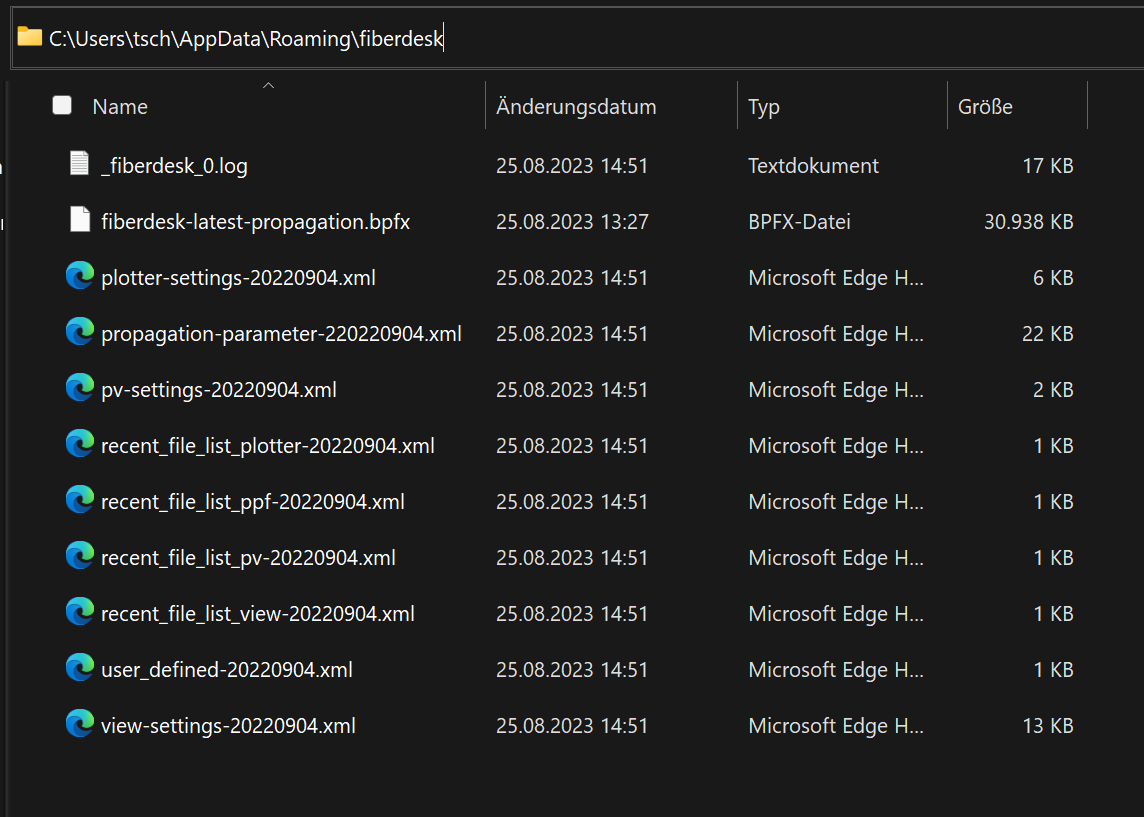
Alternatively, delete all files in:

C:\Users\%USER%\AppData\Roaming\fiberdesk
Running fiberdesk -reset from the command line

Simulation

Can fiberdesk be used for ns pulses or CW light?

In principle, the nonlinear Schrödinger equation permits propagation of long pulses. Brillouin scattering is not implemented; Raman scattering can be simulated. For CW light, set the repetition rate so that peak and average powers are equal. From fiberdesk 5 onward, the “Create pulse” dialog offers a cw option that equalises the repetition rate to the temporal window automatically.

Note: the spectral bandwidth is determined by the temporal resolution (time window / number of data points). Without the NLSE, ns and CW light can be used in rate-equation simulations.

Create pulse dialog with the cw option

USB licence key

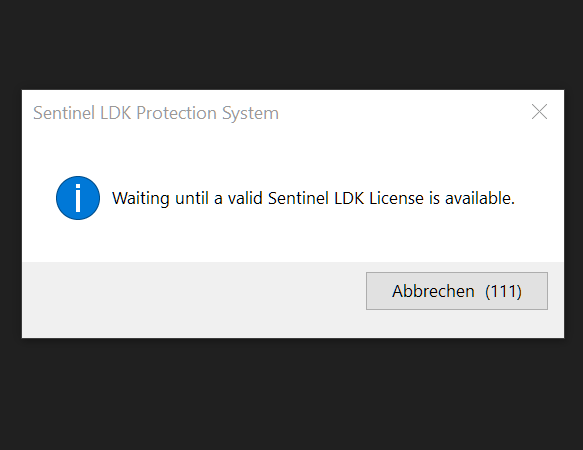
What should I do if the software does not start due to the USB protection key?

USB dongles shipped after 2020 require no driver — Windows installs it automatically. If you need to install the driver manually:

  1. Remove the USB stick and start Windows with administrator rights.
  2. Download and install the Sentinel HASP/LDK GUI runtime installer.
  3. Insert the USB stick and start fiberdesk.

If problems persist, open http://localhost:1947 in your browser and send the feature number or a screenshot to fiberdesk support.

Sentinel admin control center showing the fiberdesk key

USB licence key

You still get an error message?

Open http://localhost:1947 in your browser and send a screenshot or the feature number to fiberdesk support. If that URL is not accessible, install the HASP driver as described under USB key prevents start.

Example of a licence error message

Startup

fiberdesk does not start even though the USB dongle is working. What can I do?

Check the log file:

C:\Users\%USER%\AppData\Roaming\fiberdesk\_fiberdesk_0.log

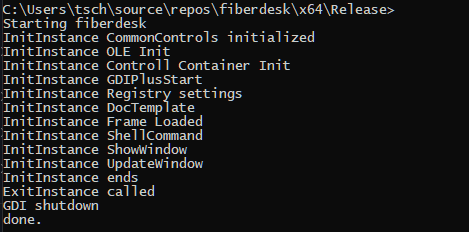
Send that file to support. Also start fiberdesk from the command line and send a screenshot of its output.

fiberdesk started from the command line

Updates

Which version is running?

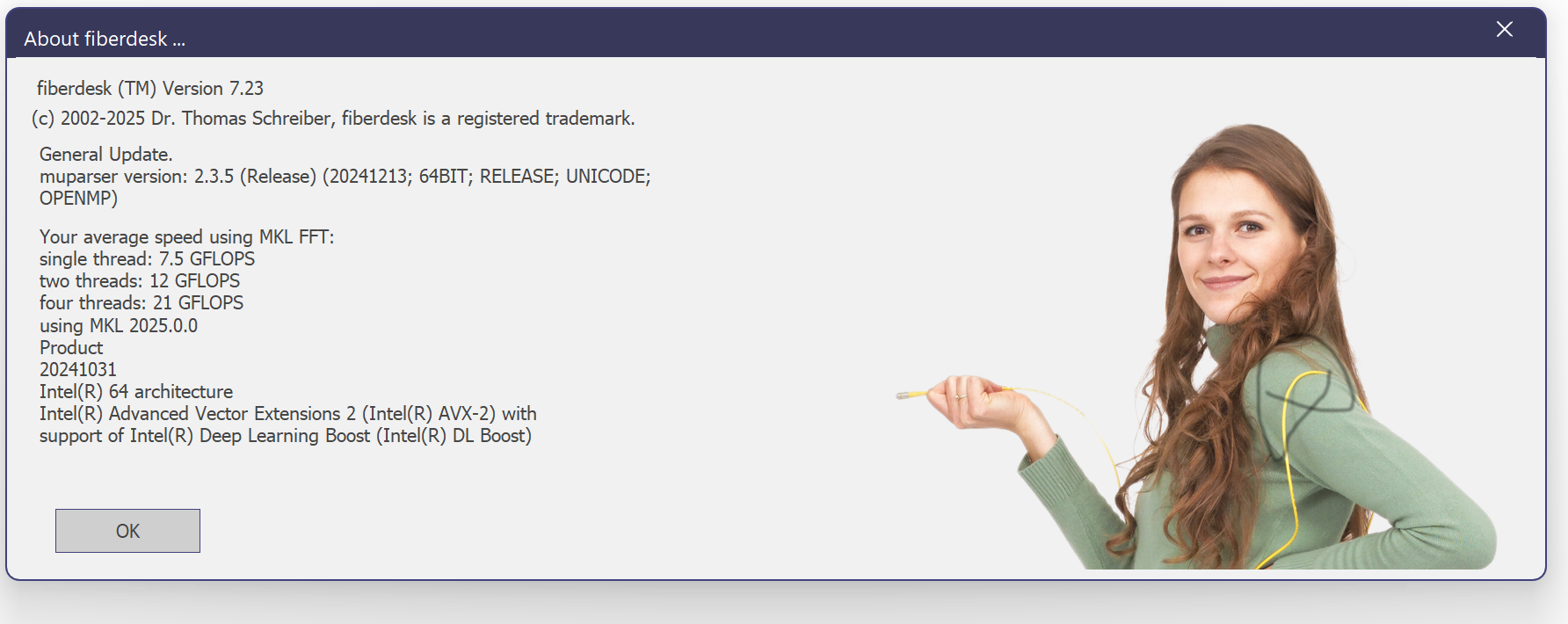
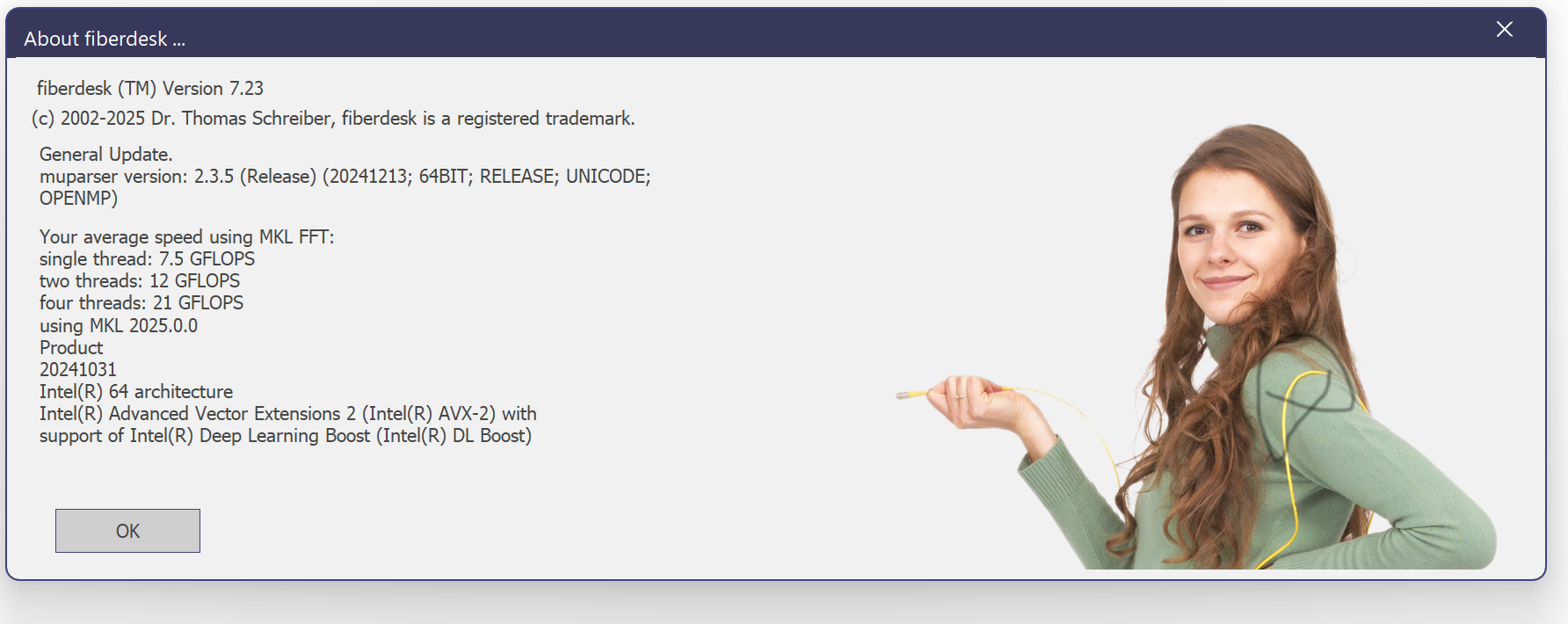
The Message Output docking window shows the version on its first line. You can also press the info button (•) in the top-right of the main window.

If your local version is older than the one on this website, an update button will appear on the main ribbon — or grab the latest package from Download.

News & updates

News & updates

Blog.

51 posts since 2005 — product updates, tutorials and news by Dr. Thomas Schreiber.

  1. Update 7.33–7.36 and preview to Version 8 (2027)
  2. Update 7.30–7.32
  3. Update News for 7.25–7.29
  4. Update Log to 7.24
  5. Late New Years Post 2025
  6. September release with first tutorial project file
  7. Before LASER World of PHOTONICS Update
  8. June Update
  9. Happy New Year, 2023
  10. Happy Birthday: 20 years of fiberdesk
  11. Summer Update – with C++ feedback
  12. fiberdesk 7 published
  13. Performance and Update
  14. Update and Preview
  15. Update
  16. More elements ...
  17. A tiny python script, update on fiberdesk 5 & 6 and tutorial
  18. Processor speed 2020
  19. Last Christmas – update
  20. update – fiberdesk has to keep up with the times
  21. Windows Fonts
  22. Update for Version 6
  23. initial fiberdesk 6 launch and update
  24. Update
  25. Update and tutorial
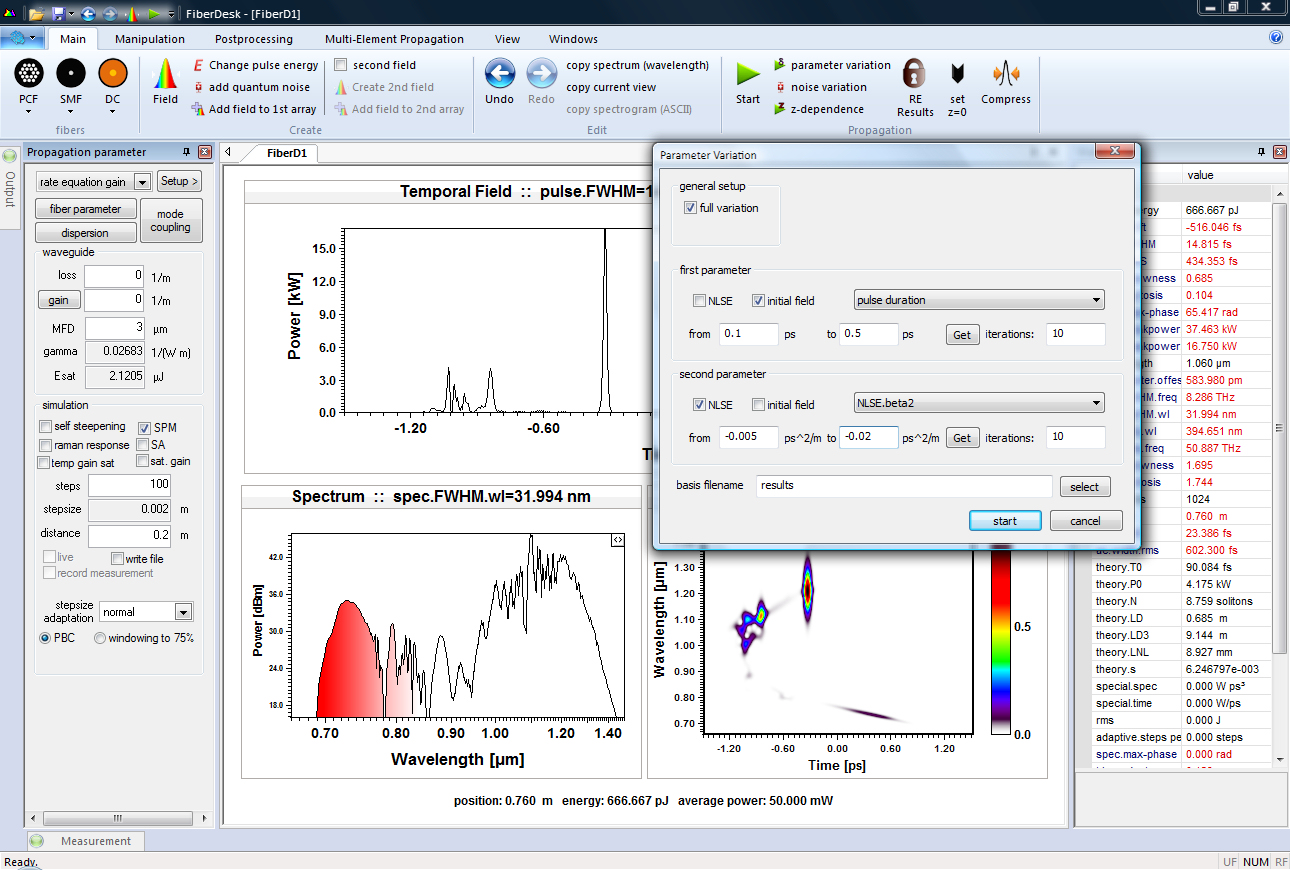
  26. Rate Equation and Parameter Variation
  27. Tutorial update
  28. Older CPUs and the instruction set dilema
  29. Update
  30. BUG Fix
  31. BUG Fix
  32. BUG Fix
  33. BUG Fix and 32 bit version
  34. New features added
  35. Features added
  36. Feature update
  37. Beta becomes Release - fd5
  38. Threading
  39. new homepage
  40. Visual Studio Community Ed.
  41. fiberdesk 5 annoucement
  42. toward fiberdesk 5
  43. status of fiberdesk 5
  44. feature added
  45. toward fiberdesk 4
  46. benchmark 2008
  47. fiberdesk on MS Win Vista
  48. fiberdesk 3.0
  49. fiberdesk 2.0
  50. fiberdesk 1.0
  51. first

Update 7.33–7.36 and preview to Version 8 (2027)

  • selection and zoom bug on stacked 2D plots resolved
  • Optimized internal nonlinear operator and MKL threading usage for speedup
  • improved thread safety to prevent race condititons
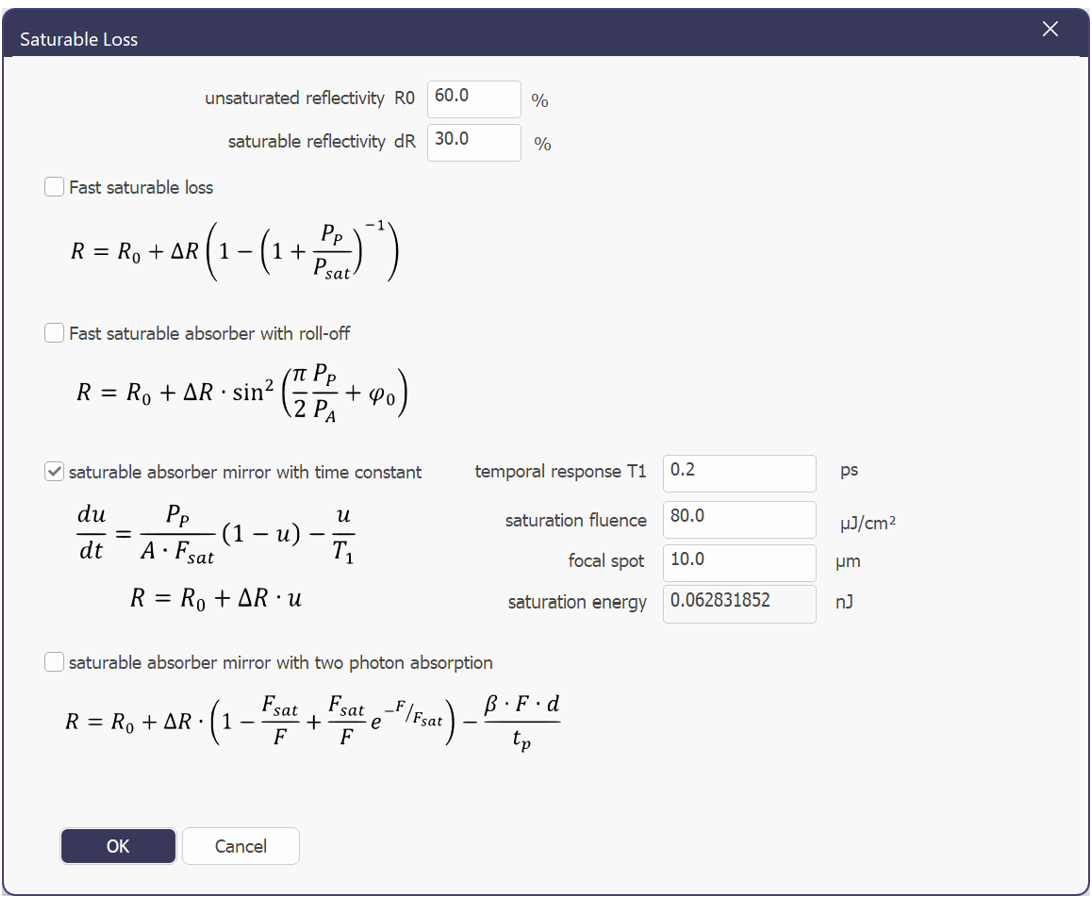
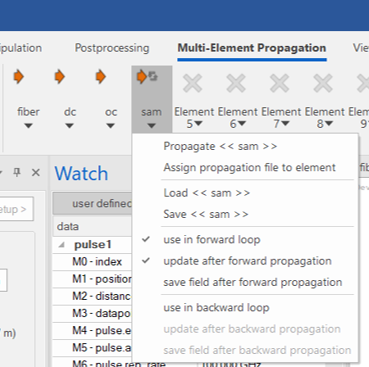
  • Corrected SAM reflectivity settings
  • Add unique filenames for each NOLM element and direction
  • distance reset bug corrected
  • filename bug corrected for backward propagation, new XML file creation bug resolved
  • expanded user defined measures to 10 values
  • improved ASCII clipboad copy to represent the actual fiberdesk graph
  • improved file and directory handling as well as error messages
  • Measured graph changed to show the actual datapoints
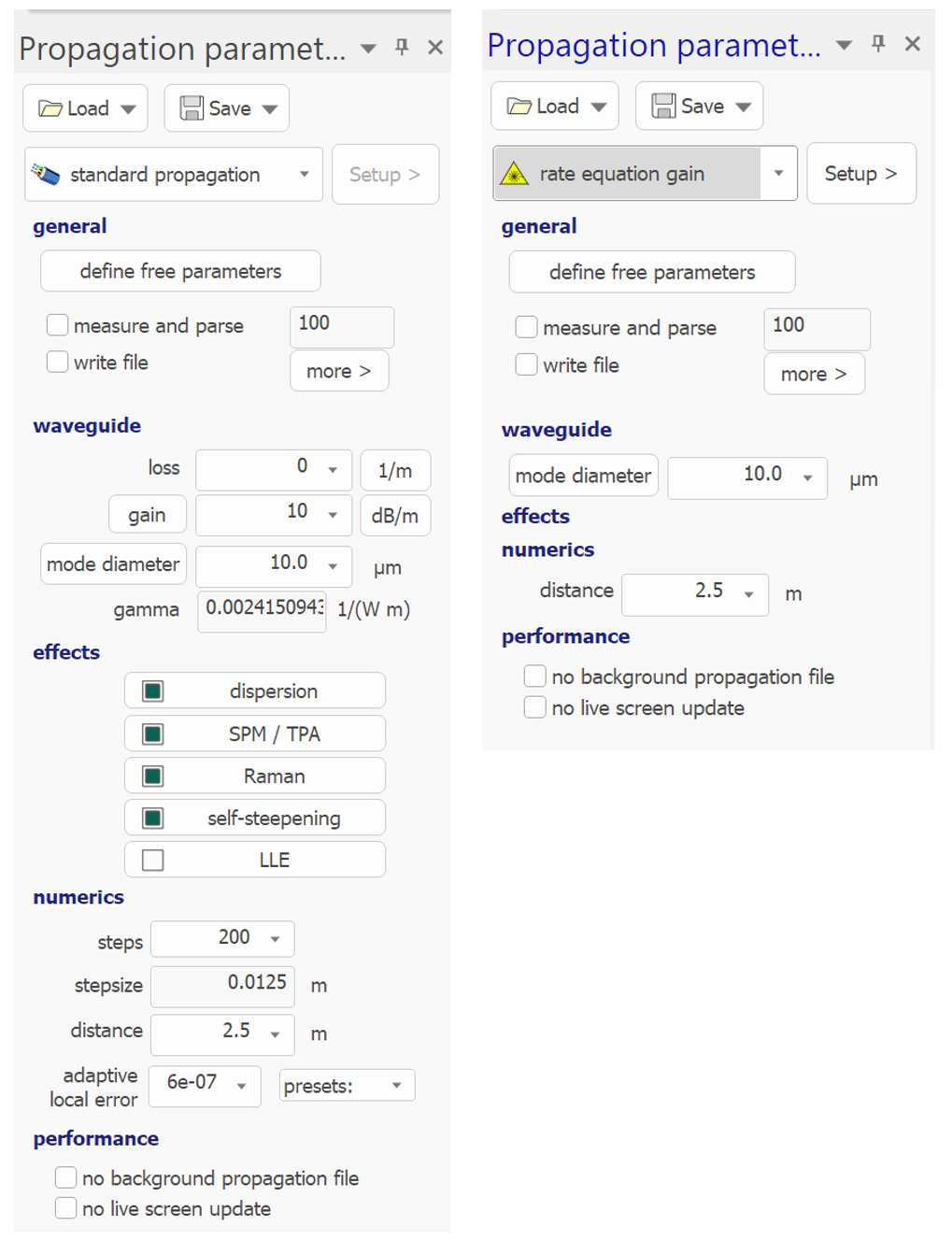
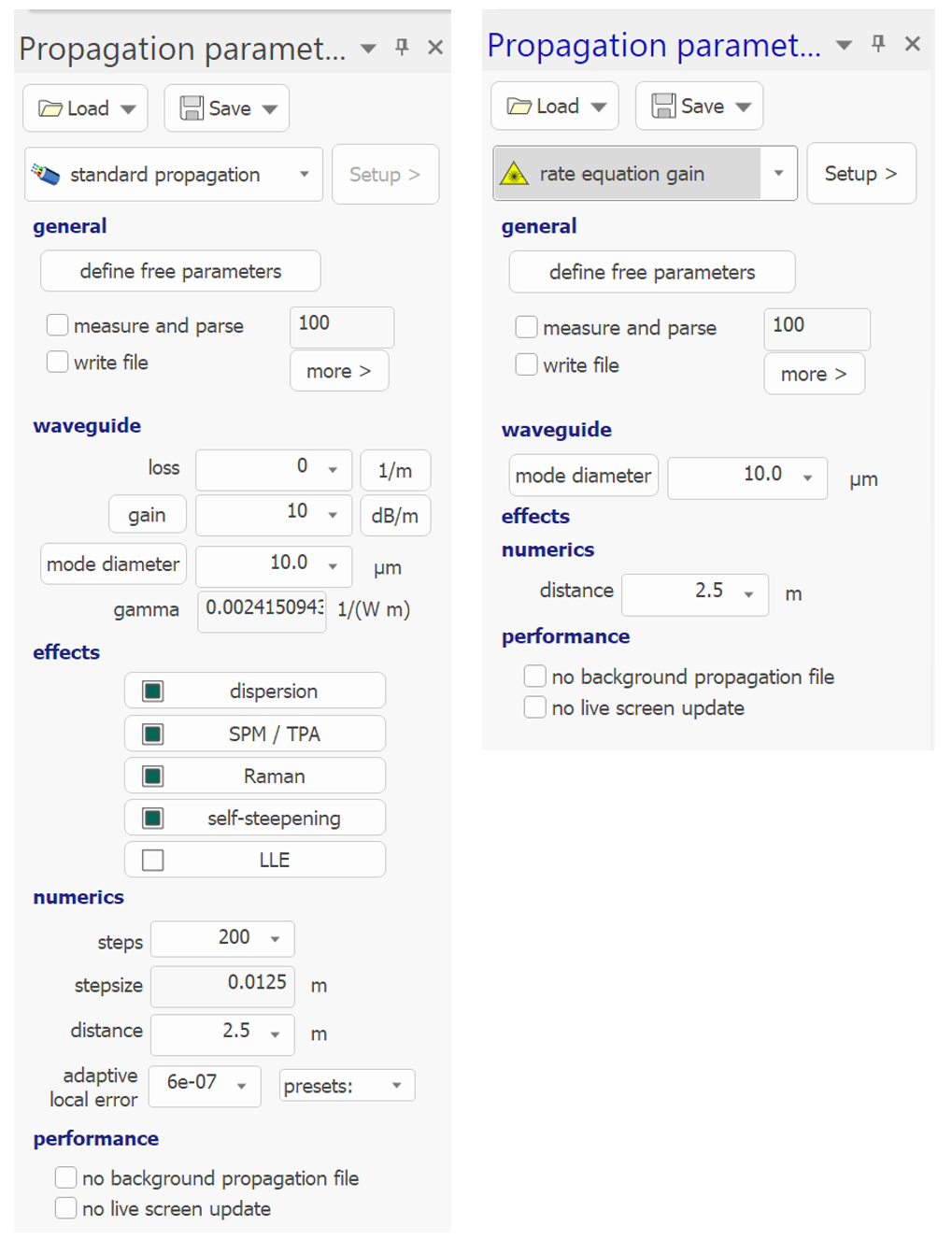
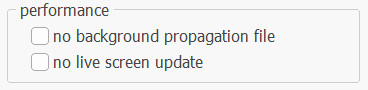
  • Parameter Windows has a desing update: larger colorful bold
  • headlines and auto-collapsing to necessary controls
  • image colors in dialogs follow color themes
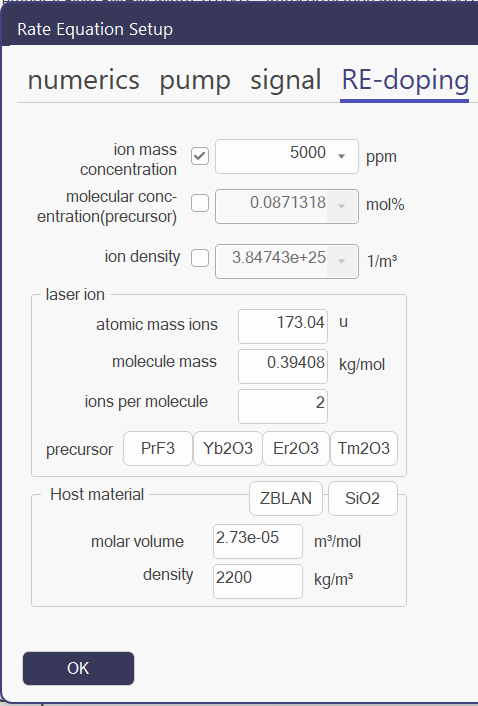
  • new images in rate equation dialogs,

Preview to Version 8:

  • multi-value parameter setup (e.g. for complex field logistic)
  • transient rate equations
  • simple 3 level Thulium rate equations
  • multi layer mirror calulation
  • fiber modes and dispersion calculations
  • temperature evaluation

Update 7.30–7.32

This first Update of 2026 brings the following changes:

  • Rate Equation solver has been improved
  • Adaptive Under-Relaxiation now used for solver
  • Screen Updates only for result
  • Frame numbering updated, see manual
  • Doping variables updated for non RE2O3 precursors like PrF3 in ZBLAN
  • Added more control to speed of propagation
  • project loading bug removed

Update News for 7.25–7.29

fiberdesk has been updated to customers in the recent month. Here is a summary of the changes:

  • autocorrelation not copied to clipboard - corrected
  • parameter for adaptive steps not measured - corrected
  • GDI breakdown after very long propagation - corrected
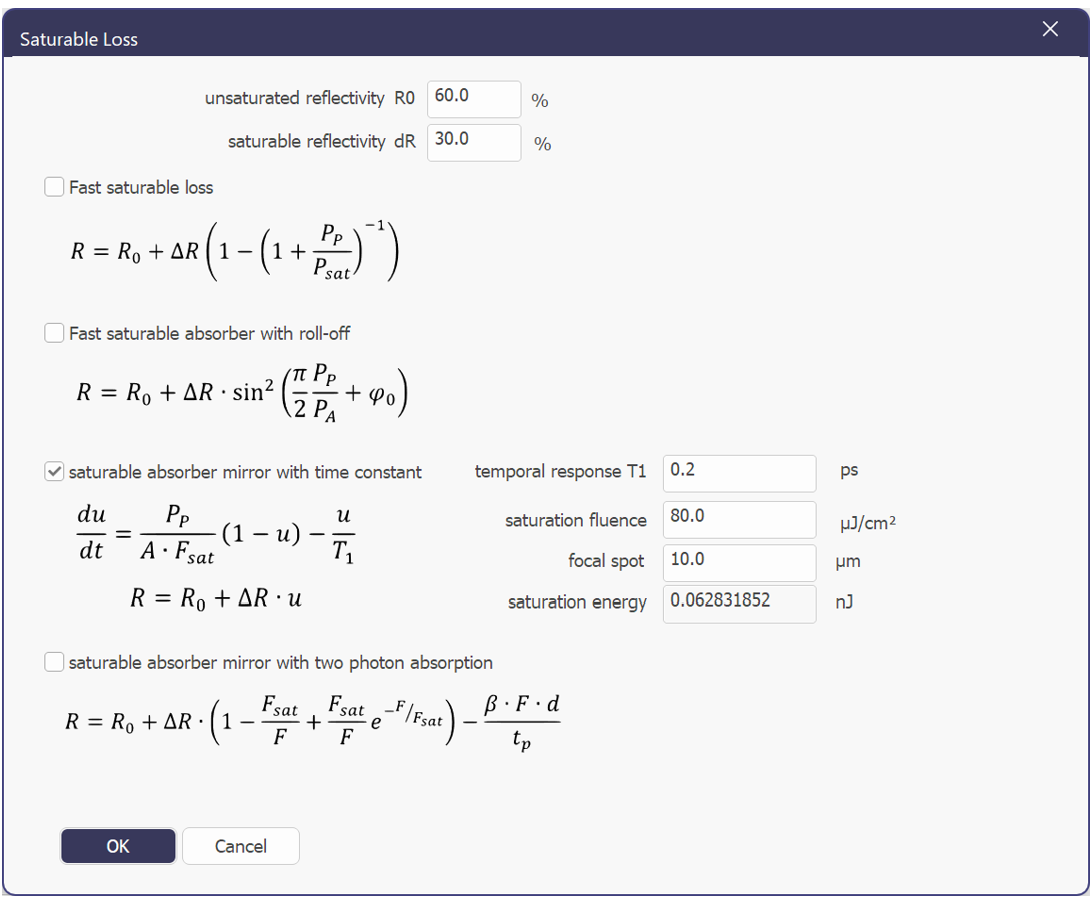
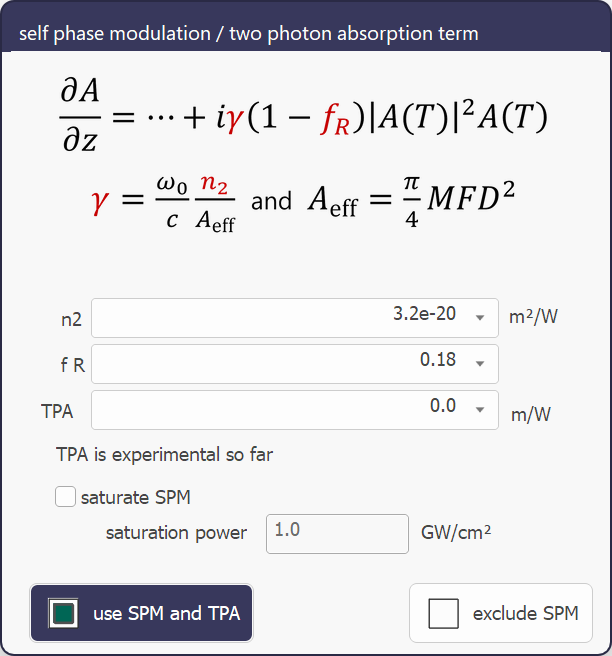
  • added new saturable absorber (BATOP) including two photon absorption
  • No-Shock Paradox
  • Nonlinear propagation gave different results if the field was not centered in the data array - corrected
  • There is a different behaviour for propagations with and without shock term.
  • See Tutorial 2
  • beta 4 was added for parameter variation, but was not correctly saved to a project - corrected

Nonlinear Optical Loop Mirror now allows to select clock-wise propagation or counter clock-wise propagation to be selected. This allows non-reciprocal loops.

Tutorials updated.

Update Log to 7.24

The following improvements have been done:

  • fiberdesk py-tools have been enhanced and corrected. For example, the access to the complex field information is demonstrated.
  • The propagation file (BPFX) was excessively large for rate equation propagation. After fixing a bug, the file size is now correct, and the file operation is significantly quicker.
  • Crashes during rate equation propagation have been fixed. They were caused by a race condition between the live drawing and the solver thread.
  • The view setup is now saved. For some unforseen reason, the propagation file was saved in previous versions instead.
  • The ability to toggle "measure and parse" is now available in the user-defined measurement setup dialog, where it is clearly visible and contextually relevant.
  • PCF dialog has scriptable edit boxes.
  • beta 4 is now a parameter that can be varied.
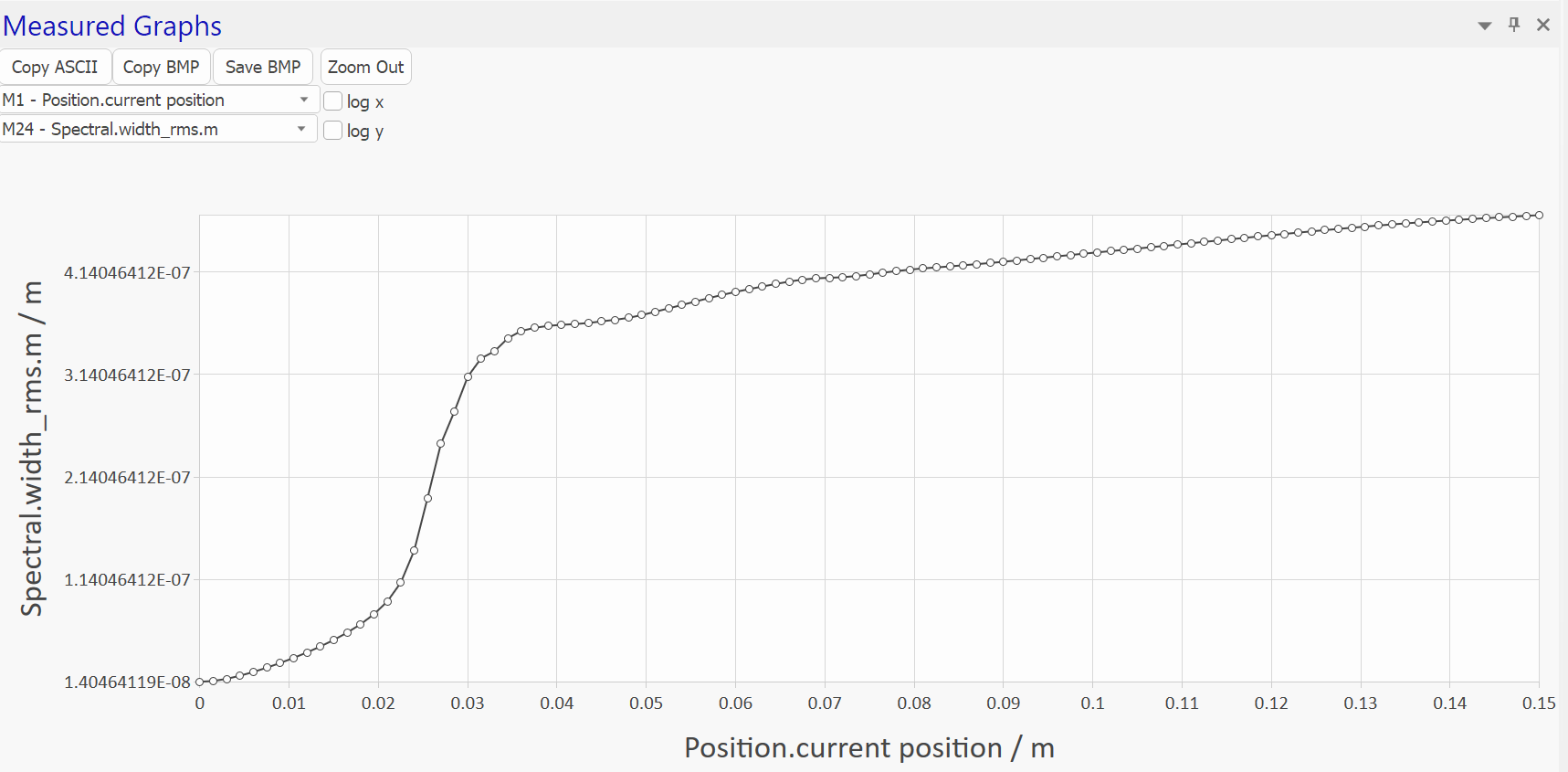
  • Sample graph from fiberdesk verison 7.24.

Late New Years Post 2025

This blog highlights the changes in 2024 with the updates from fiberdesk 7.17 to 7.23.

Intel (R) Core(TM) Ultra 5 125H 3.6 GHz

The following bugs have been corrected:

  • dispersion parameters have not been updated when loaded in the dispersion dialog
  • the field saved to memory did not show autocorrelation if selected
  • if multiple results needed to be shown on the parameter variation at the same time, it was not possible to copy it to the clipboard
  • 2D parameter variation results are now correctly copied to clipboard
  • the measured parameters, like average power, were inconsistent with the rate equation result window
  • evaluation of numerical value got wrong, for instance, 1e-09 was evaluated to 1e-08: muparser updated
  • dispersion for PCF did not work
  • temporal FWHM did not give good results, if first and last datapoints of width evaluation were equal
  • BPM always started with flat phase
  • measurments on BPM now results in equal BPM_beam_diameter and Mode-Field-Diameter set to the NLSE as a parameter, as it should be. Just the units are different, MFD is in µm, beam diameter is in m.
  • if the propagation should be written into a file but no filename is given, no propagation was done. Now a fallback filename is taken.

Other changes are as follows:

  • Loss got a button to choose its unit in dB/m or 1/m.
  • From 7.18 on, parameter variation setups are saved, but previous ones can not be used anymore due to internal conflicts.
  • You can now reload an already opened project.
  • beta 4, PCF pitch and diameter are now a parameters, which can be varied.
  • gain dialog: gain saturation move to this dialog and elements activate on status settings
  • latest MKL & muparser libs used.

September release with first tutorial project file

In the tutorial, you will find now project files, that can be loaded with the current version 7. The first is the gain managed nonlinear amplification.

Furthermore, the current release 7.17 has some bugs removed and features added:

  • The latest Intel Math Kernel Libary has been linked, MKL 2023.0.2
  • The Plotter's setup is now saved and updated correctly
  • In general, the precision of double and RGB values saved to fiberdesk's XML files is improved
  • A new Euler stepper function is added to the parser to enable Euler integration in the measured values along the propagation (enables simple coupled differential equations)
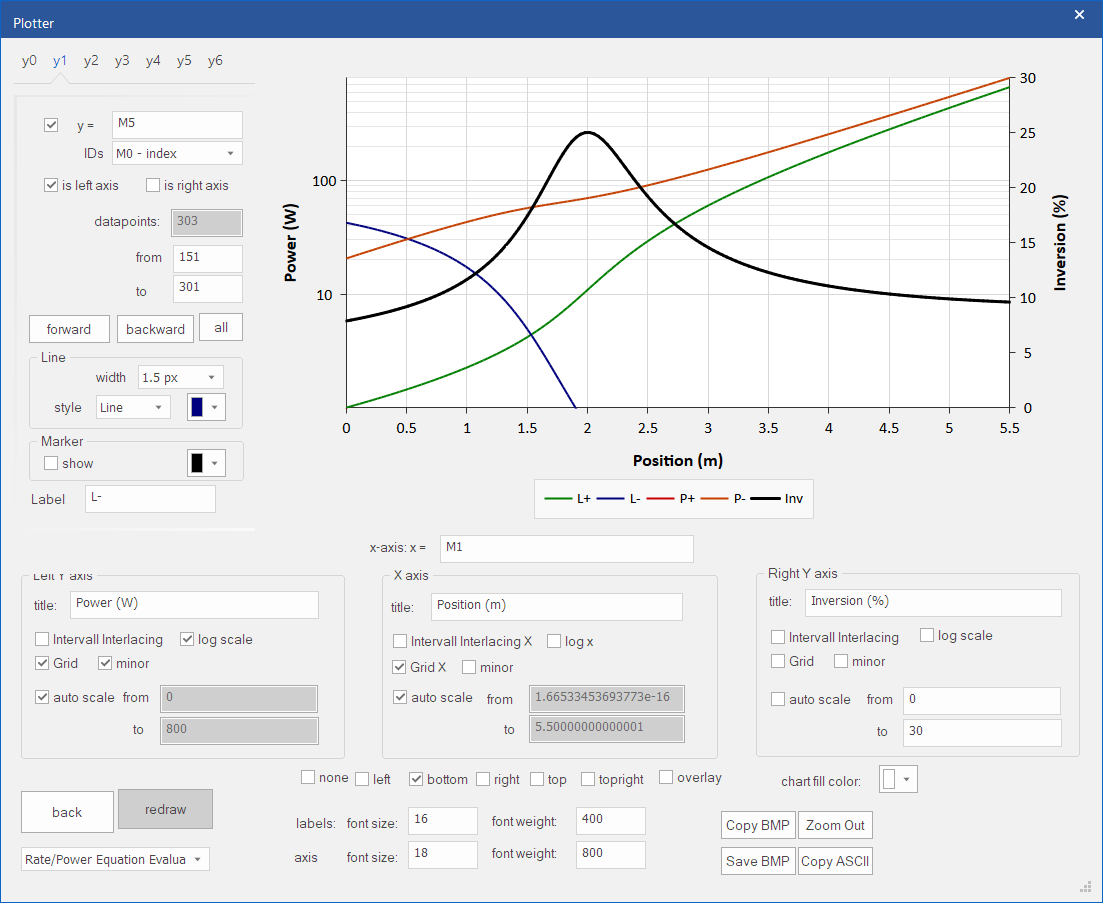
  • A new measurement has been added: the inversion slope, so the change of inversion with increasing signal power, dn/dP .. interesting for transverse mode instability (TMI)
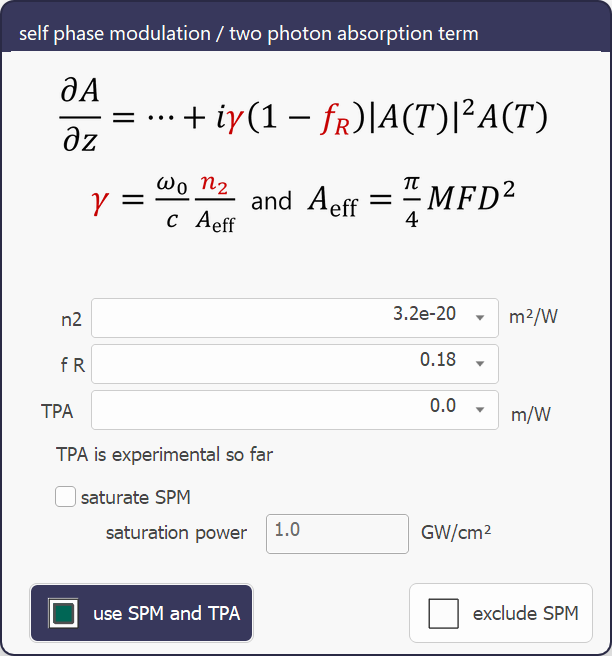
  • The fractional contribution of Raman, f_R, is now active on every selected nonlinear effect combination. That means, even without the Raman term, if you have a non-zero value, SPM will be reduced for example.
  • If you selected a predefined Raman response function, the parameter f_r changes accordingly to the values best fitting that modell.
  • The FAQ section now contains help for reseting fiberdesk to it's original state (either windows or all dialog settings).
  • The unit of the saturated nonlinear coefficient is corrected.
  • Parameter variations of the wavelength did not work correctly - fixed.
  • Parameter variation values did not get updated after loading - fixed.

Before LASER World of PHOTONICS Update

Some changes and bug fixes have been made:

  • The Kerr nonlinearity is now saturable, just check the option and specify the saturation power
  • The measured values and parameters of the propagation have a description if you select an item
  • The manipulation dialog is enhanced.
  • Changing pulse parameter after creating enhanced.

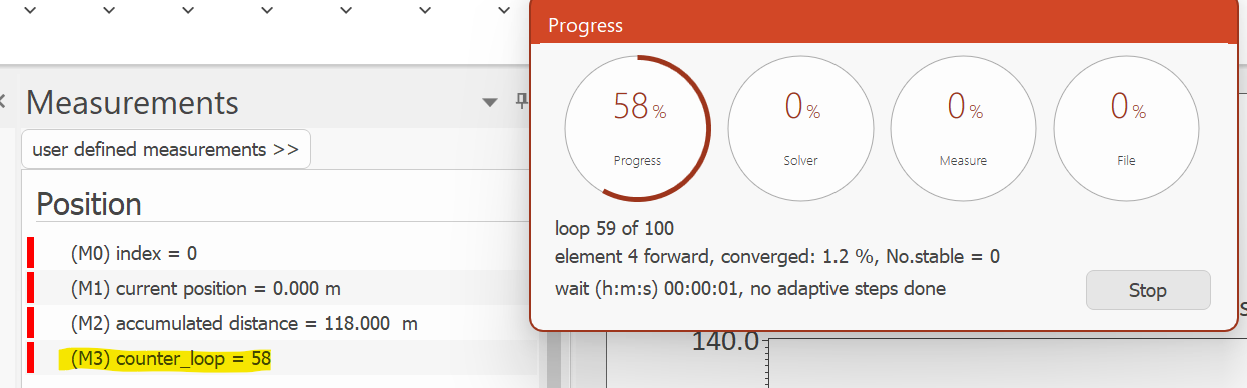
The multi-element loop has become a new measured item, the loop counter. Different to the progress dialog, this value show the roundtrips already finished and not the current one.

To use this counter in a user defined scripted equation, one might need a way to select only each 5th loop. This can be done by using two existing features of the parser, the logical evaluation and the modulus function. The logical evaluation has the C++ form, e.g boolean evaluation ? result on true : result on false. As the modulus function is the rest of a division, a zero can indicated each 5th loop. In the following example the multiplication is done by 1 but each 5th loop by 0.1 (and the sqrt(0.5)), with the variable M3 as the counter loop:

Bugs that have been removed:

  • flickering of the measured value list and corrupt drawing then not topping the list
  • progress bar in multi-element propagation not updating

June Update

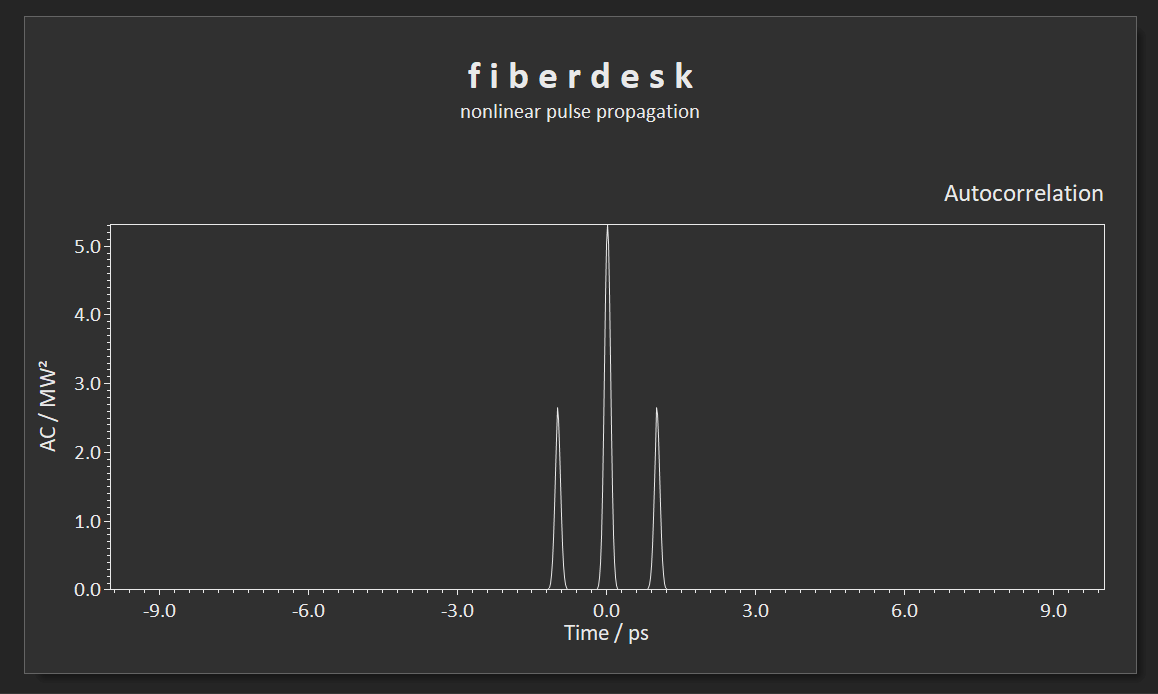
Here are the minor changes with todays update:

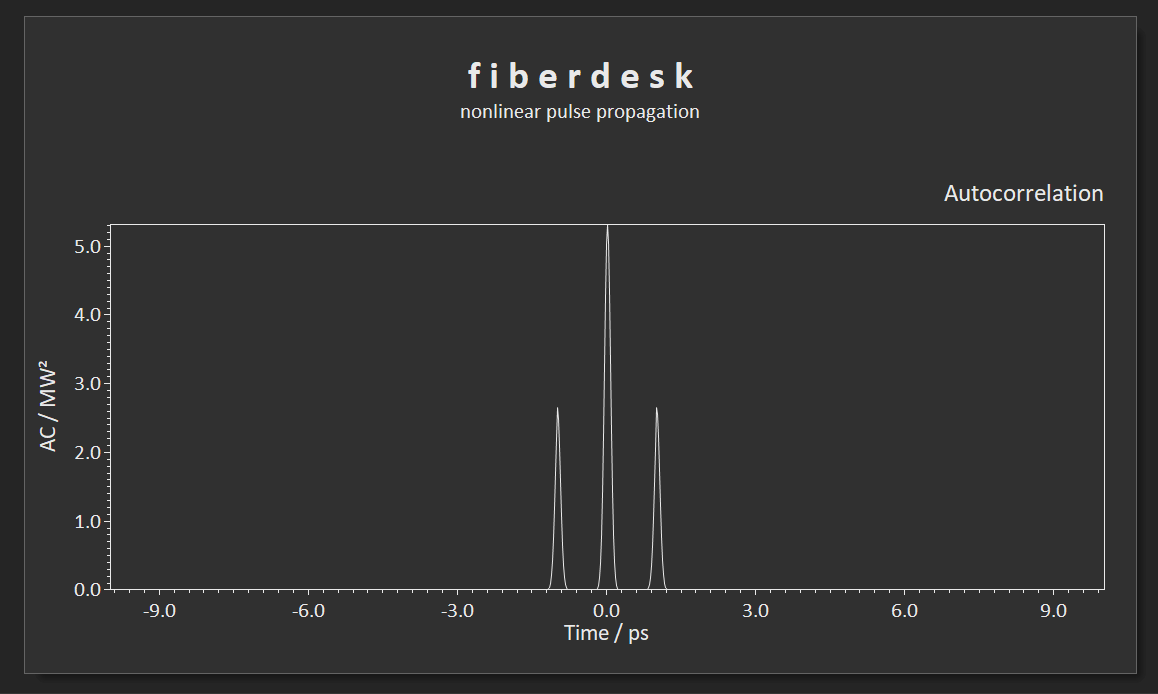
  • included the autocorrelation view (had been in before)
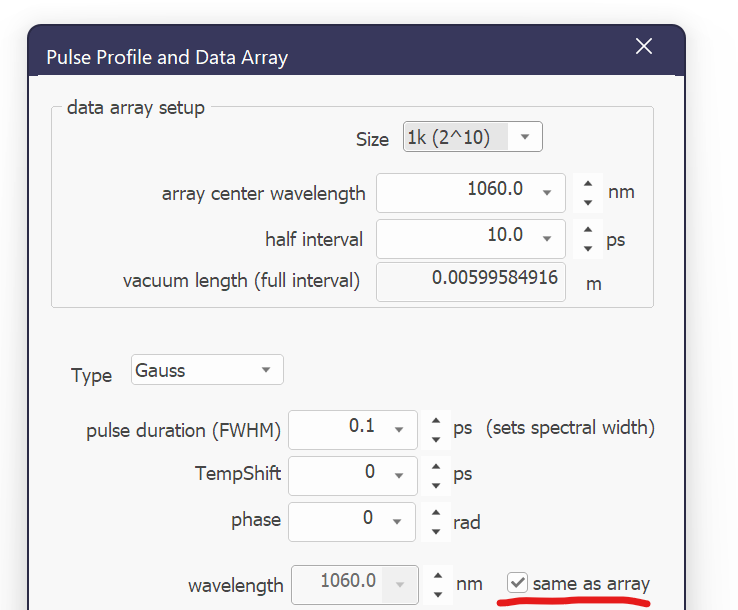
  • the creation of the pulse has now a check box to force the wavelength of the field to be the same as the array center
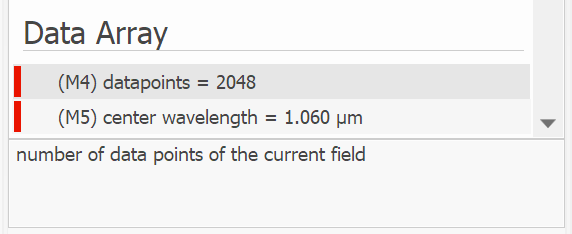
  • progress bar update did not update if the process was too fast
  • icons on multi element showed up despite the assosicated file was missing

Happy New Year, 2023

Happy New Year, 2023
  • Updated: Jan 3, 2023
  • fiberdesk update

The following changes have been made in the current version 7.12 (7.13 on 3rd of Jan):

  • all post-processing tools are updated to the new file format "bpfx"

load and save is available (again) for the field alone. This file format (*.fieldx) can be used for creating a pulse (choose Type: from file) or injecting it.

  • injecting or coherent addition of a pulse now works for field different in datasize and spectral center
  • a bug regarding the "save single loop" has been removed
  • The "noise" simulation has been removed. It can simply be done by the parameter variation tool.
  • a bug regarding unicode names for projects has been removed

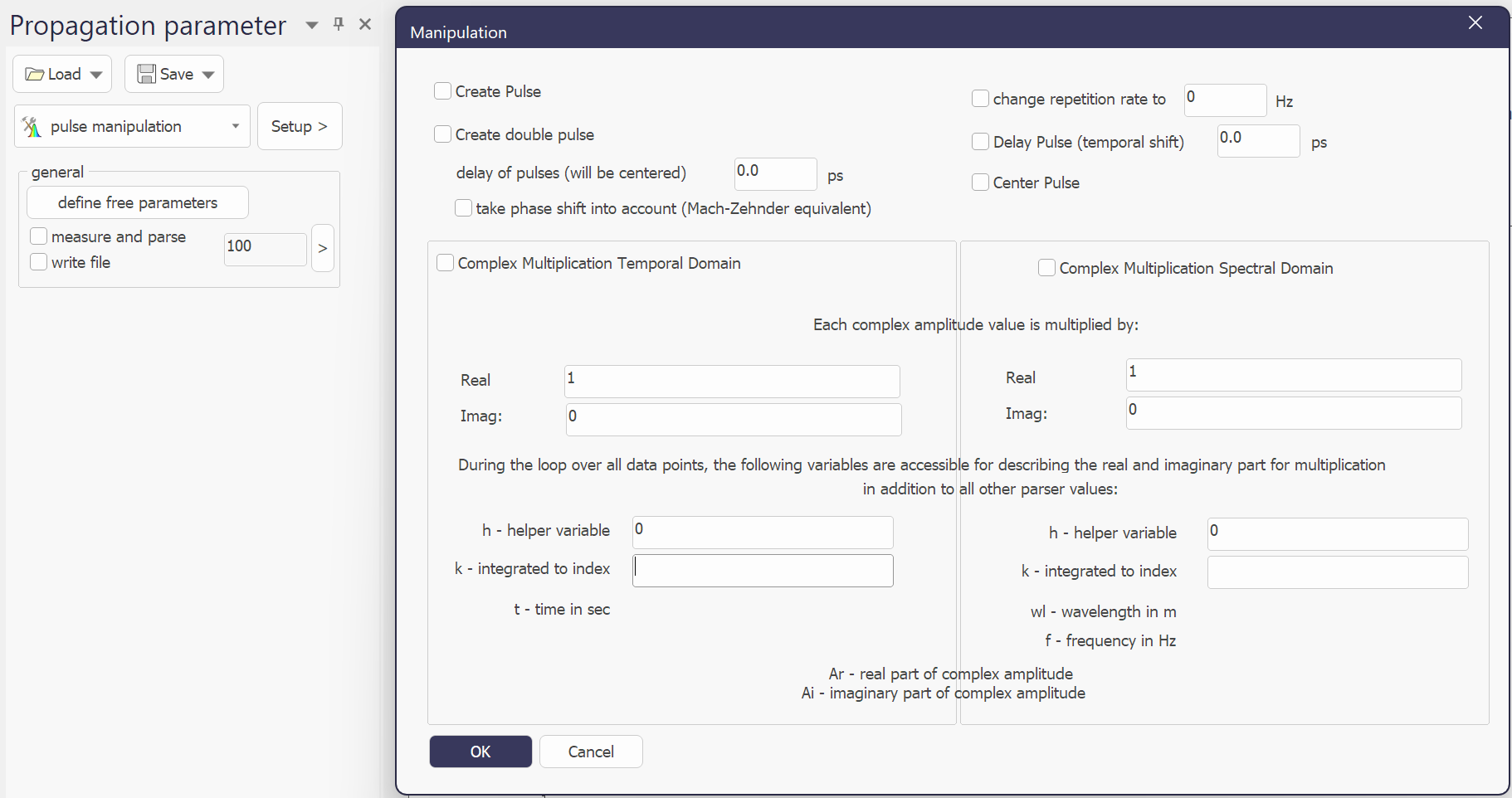
The "manipulation" tool now allows to calculate with a value named "k", which is an integration of the parsed values up to the current index. For instance, you could get the integrated energy and manipulate the current data with it. A tutorial will follow.

  • GitHub repository
  • https://github.com/TomFD/fiberdesk-pytools

fiberdesk has now its own public GitHub repository for the following actions via Python (Jupyter Notebooks):

  • fit a Taylor Series for dispersion to experimental data
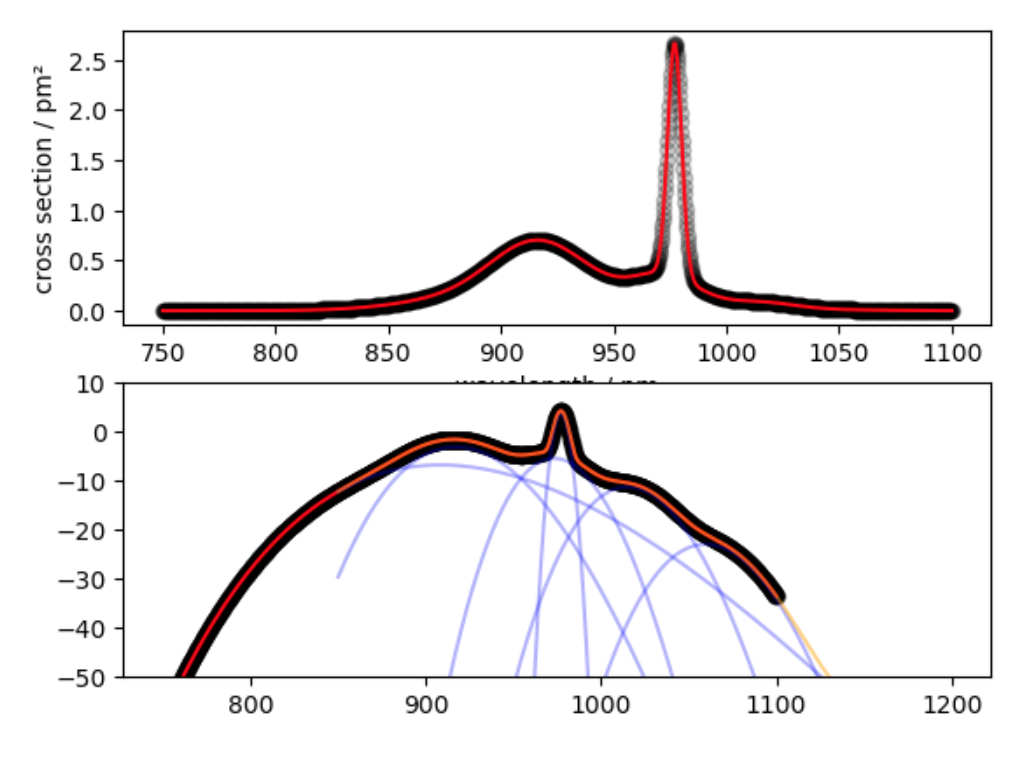
  • fit the fiberdesk cross section parameters to experimental data
  • reading old and new propagation files that fiberdesk saved

Happy Birthday: 20 years of fiberdesk

fiberdesk has a 20 year history.

There was also a time before fiberdesk, please check the youtube channel of fiberdesk for programms written back to 1994: a game (Boulder Cave), a sample editor (Imago Wave), another scientific software (NMRDesk).

https://www.youtube.com/user/fiberdesk

Here are the main changes of todays upload:

  • Office 2022 theme
  • improved icons
  • updated MKL
  • bug removed: copy on the output bar was not working
  • placement of panes corrected when fiberdesk is starting for the first time
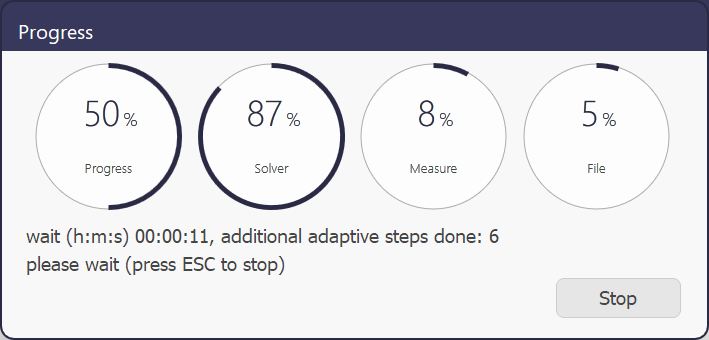
  • new theme for the progress bar, indicating the time required for the actual solver, the measurement of all data and the file operations

Summer Update – with C++ feedback

The python file reader for the new bpfx file format (xml based) is available in the package.

Some issues have been fixed in todays update:

  • unicode characters prevented saving an arbitary file name, and found a bug in VS

intellisens, not yet solved:

  • preprocessor definitions ignored in statically linked lib - Visual Studio Feedback
  • molecular mass was not changed when selecting ion in rate equation setup
  • parameter variation variables did not have a parser help button (but still worked as such)
  • internal convergence improved for rate equation, which failed before in some cases
  • copy ASCII to clipboard did not select comma or dot in the plotter dialog
  • copy to clipboard did not work for the field correctly
  • multiple results in the parameter variation now working correctly
  • old BPF format still used in parameter variation
  • watch list jumped back to the initial view on pulse create, so that the parameter, where the

user scrolled, could see it anymore. No solution on the web, easy solution by the MS team:

  • MFC CListBox changing text without reseting scroll position - Visual Studio Feedback
  • loading a plotter setting did not update the plot correctly
  • Any further bug reports or suggestions welcome!
  • Additionally, guest comments can now be posted!

fiberdesk 7 published

Updated: Apr 1, 2022

The main features of the upgrade are:

  • compared to previous versions, where multiple documents were possible, but only contained the field information, fiberdesk 7 is now based on a single document architecture where every setup, the field and all parameter are combined to a project
  • features in the simualtions now contain:
  • LLE simulation
  • linear and nonlinear beam propagation (Gauss optics) e.g. for multi-pass cells
  • most dialogs and setup panes allow the loading and saving to files including a most recent file list
  • all files are xml file, despite there different extensions (bpfx, fdprx, view-xml etc.)
  • parameter variation, user defined measures and functions and the plotter is improved.
  • latest MathKernalLibary 2022 (Intel) is included for maximum speed.

Enjoy!

Performance and Update

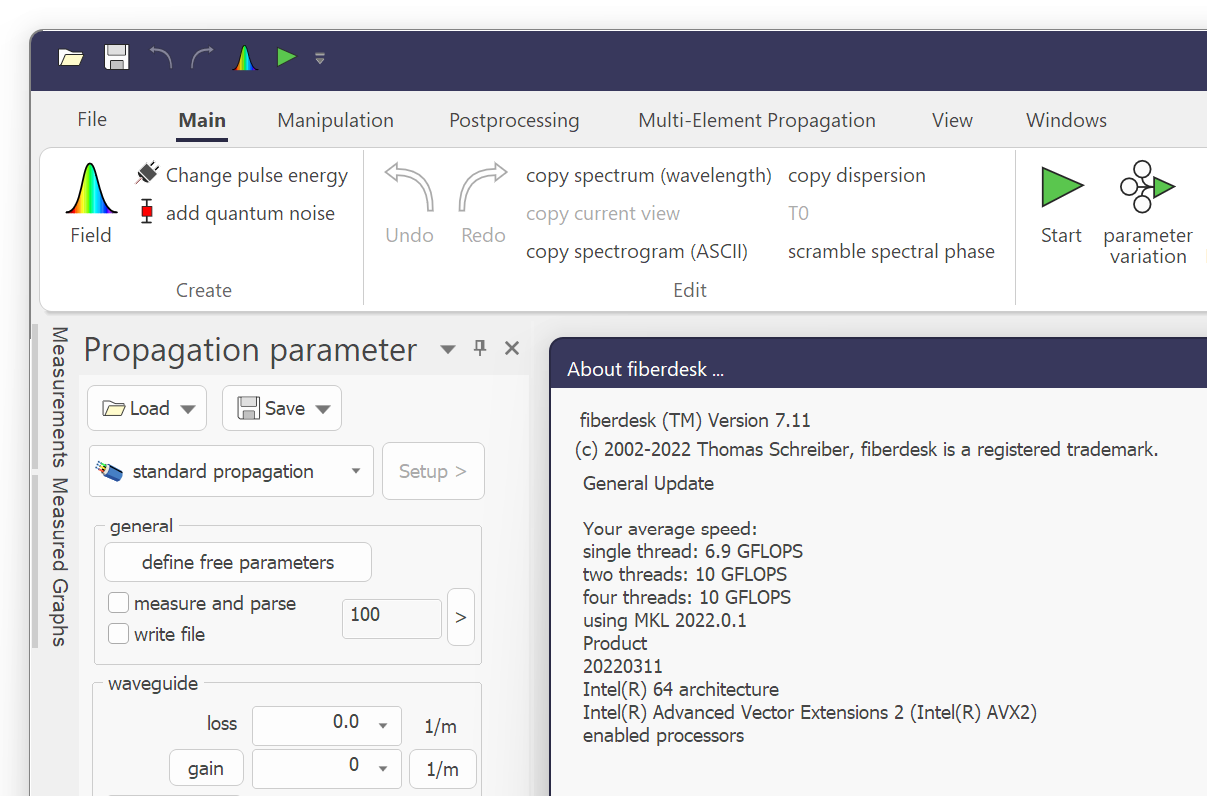
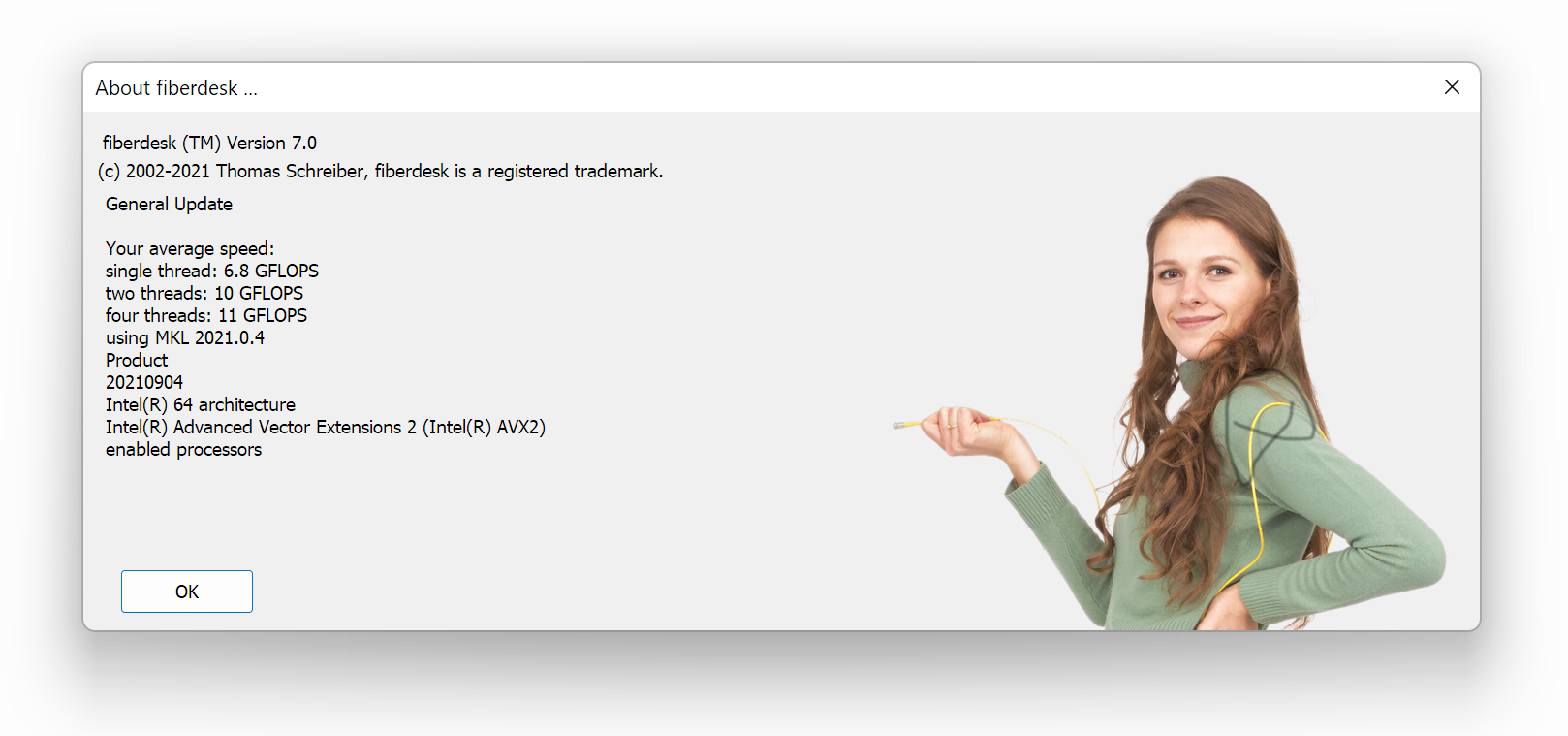
If you like to see the performance of fiberdesk in combination with your processor, hit the info button (dot) on the top right. fiberdesk is jsut updated to link to Intels oneAPI MKL.

These additional changes are implemented (depending on version):

  • conversion of rare earth doping concentration from ion density, mol % and mass ppm is now working
  • AVI recording working

measurements can be selected to display in main view (fiberdesk 7) - several other features known from previous version are adapted and will appear soon

ASE and nonlinear Schrödinger equation further improved

Update and Preview

Updated: Jul 5, 2021

The following bugs and issues have been adressed:

  • ASE content corrected and rate equation with and without NLSE show same results
  • parser's dependency on variables improved
  • group delay of hollow core gas filled fiber corrected
  • loading dipsersion ignored beta 2
  • pulse injected corrected
  • progress bar did not work correctly for multi elements
  • propagation file saved steps and two photon absorption incorrect: please check TPA settings

Additionally, fiberdesk's new version 7 is available for preview. It will be released in the beginning of 2022. All customers purchased since 2021 can alread test it.

Here is the new version running on the preview of Windows 11:

Update

  • Updated: Nov 13, 2020
  • An unimportant fact: in the last 10 years, fiberdesk's lines of code increased from 45356 to 71394.

A new update for all versions has been uploaded, correcting the following bugs or issues:

Two Photon Absorption only worked with SPM only, now should work in all cases and is under test (see e.g. Henrik Steffensen,* Christian Agger, and Ole Bang, "Influence of two-photon absorption on soliton self - frequency shift," J. Opt. Soc. Am. B / Vol. 29, No. 3 / March 2012)

The SaveSingeLoop dialog now remembers the settings for the current document and element container but is reset for any new document (or restart).

Some parameters, like the <array size> or <repetition rate> in the "Create Pulse Dialog" changed when loading an element from the element container.

  • fiberdesk crashed when an element was propagated directly from the menu.
  • The thrid option of the saturable absorber (sin-model) was not correctly saved and used.
  • Propagation of a field manipulation lead to a crash.

More elements ...

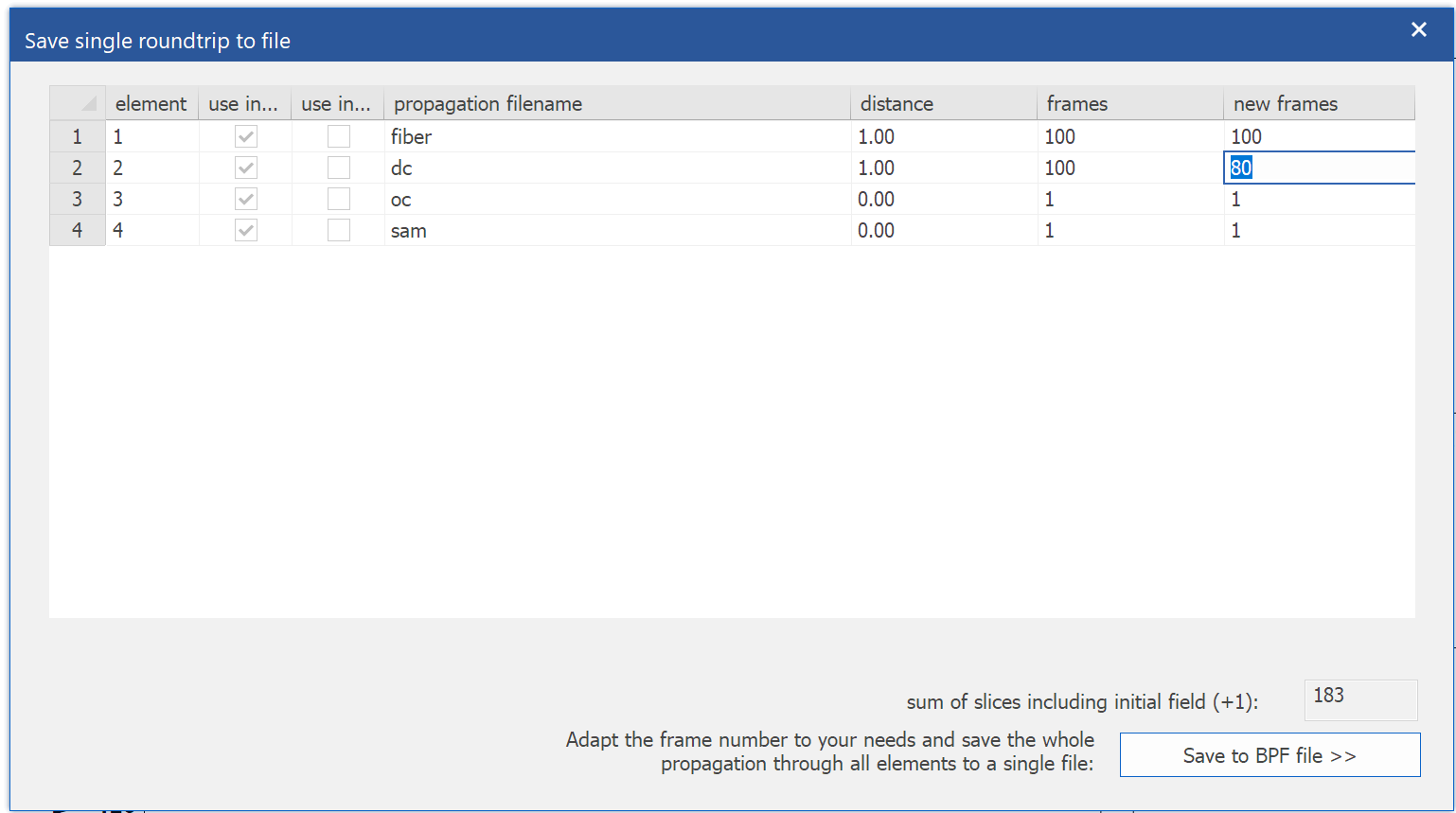
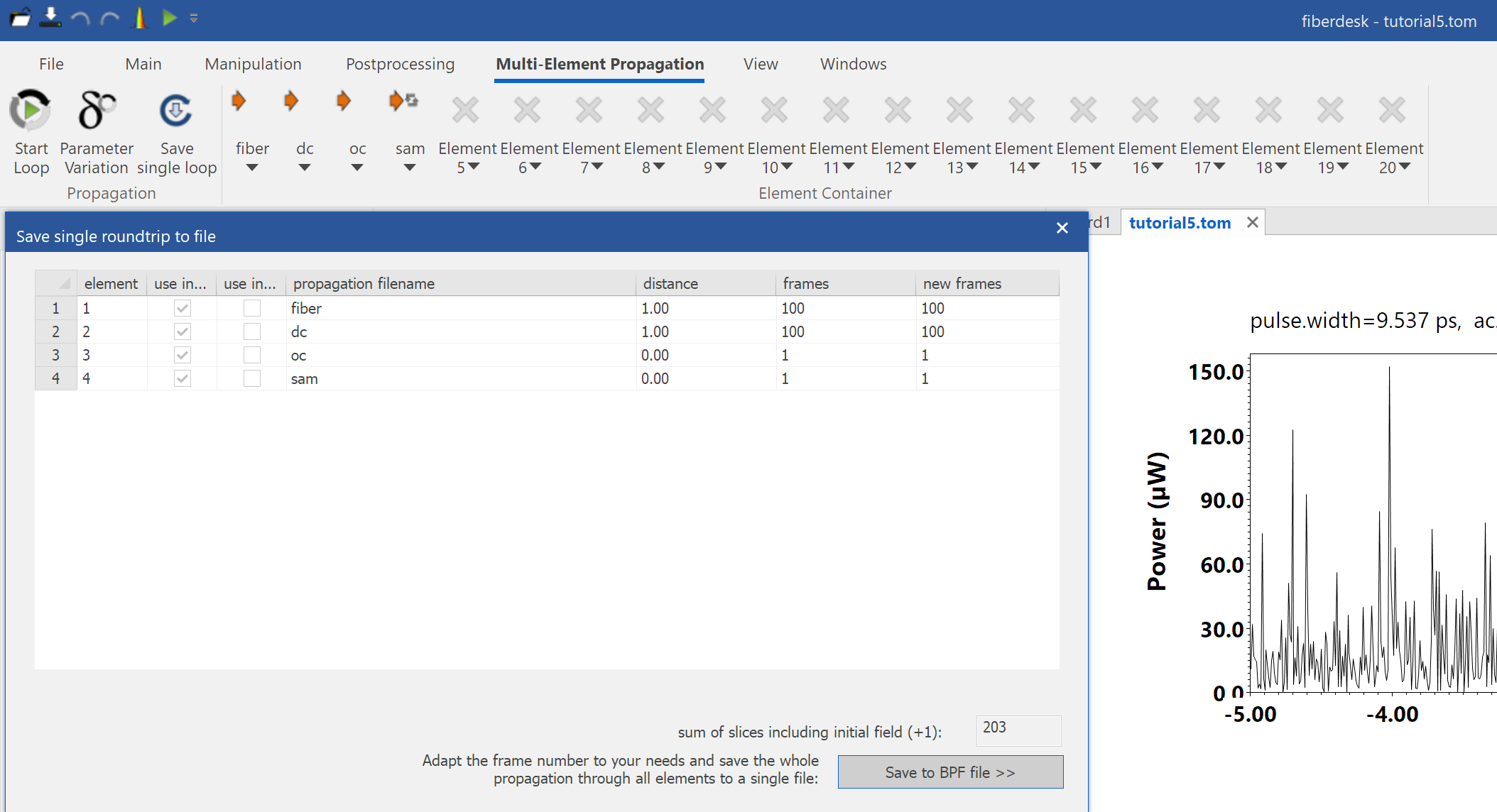
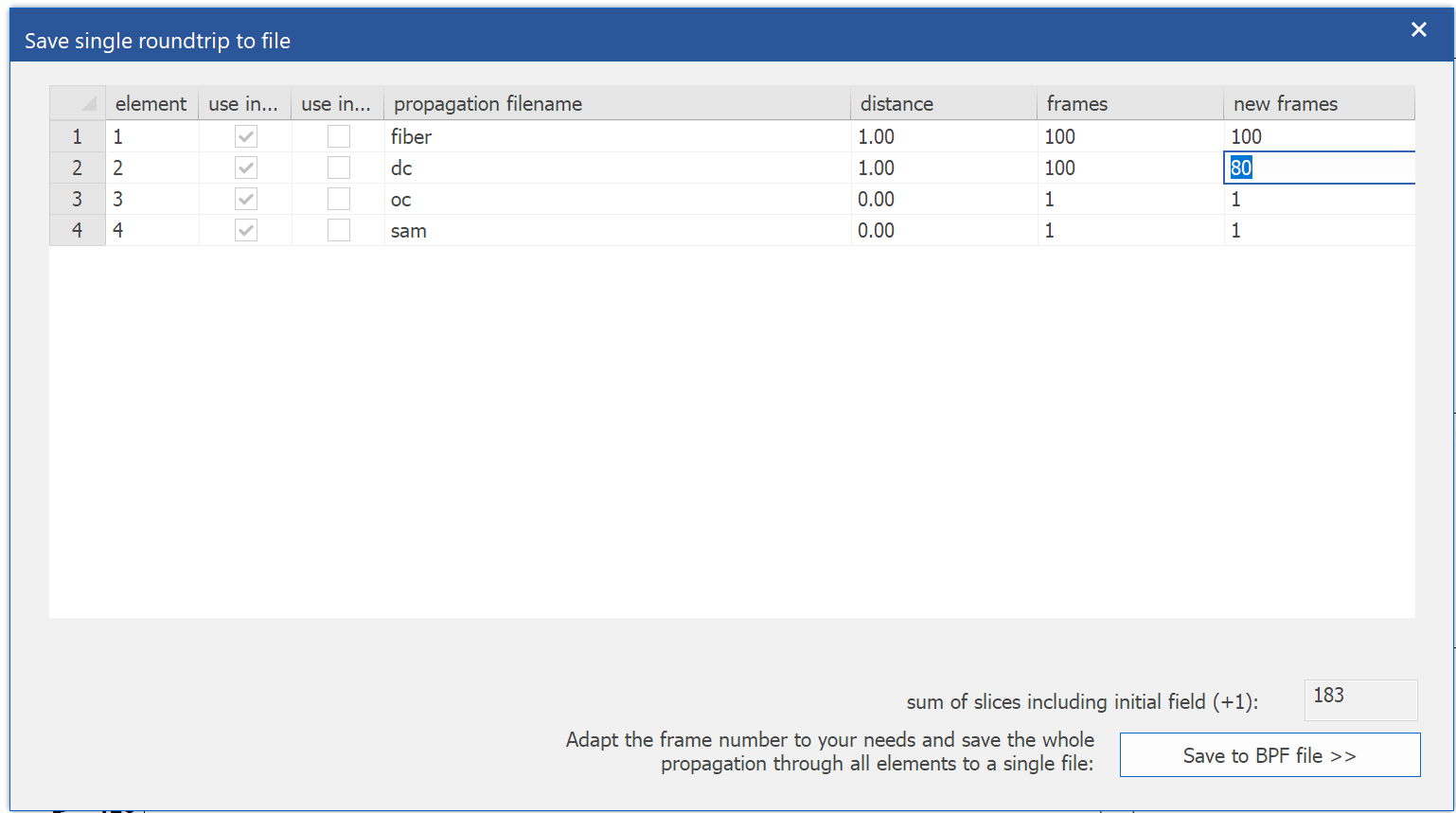
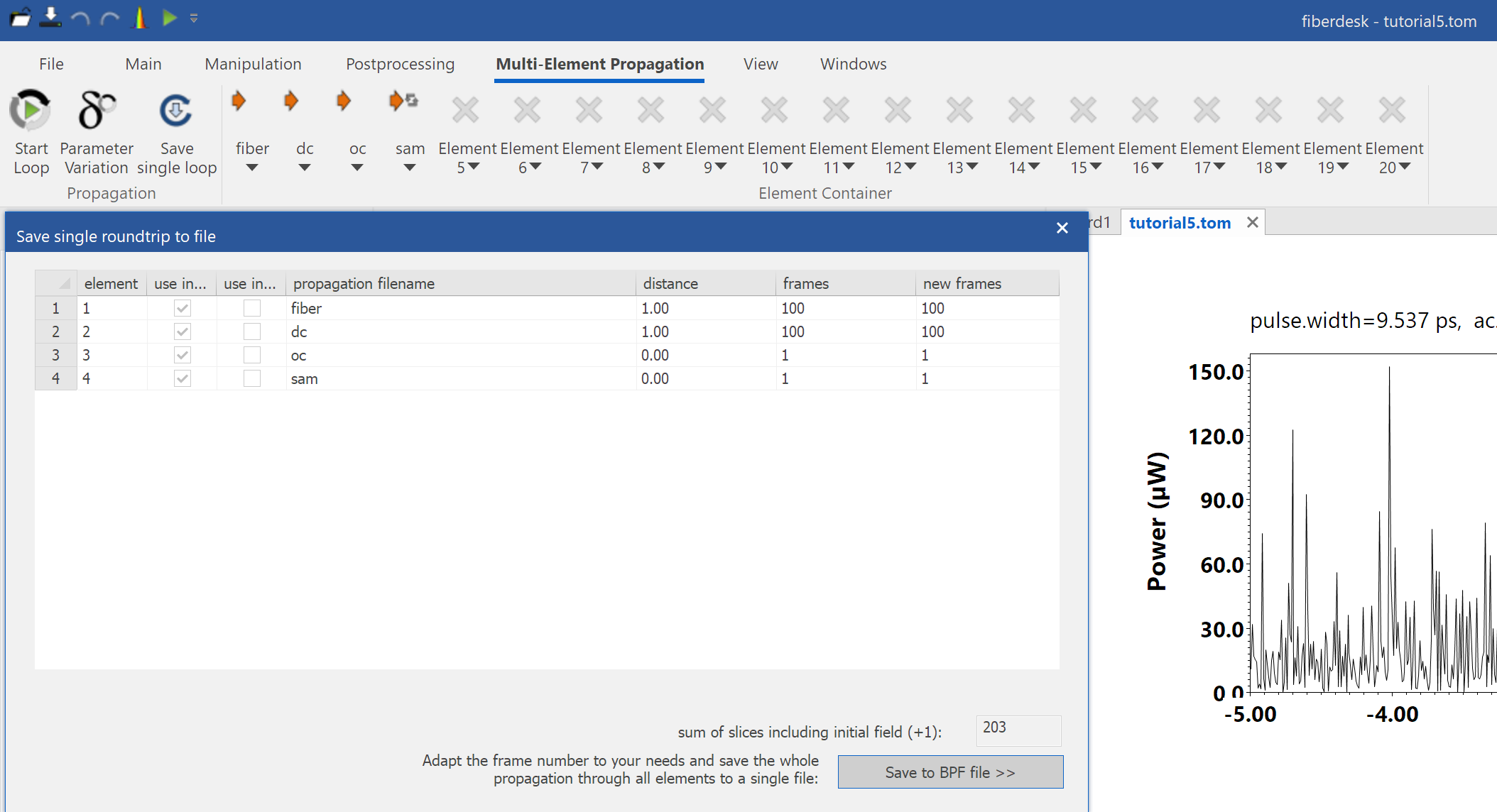
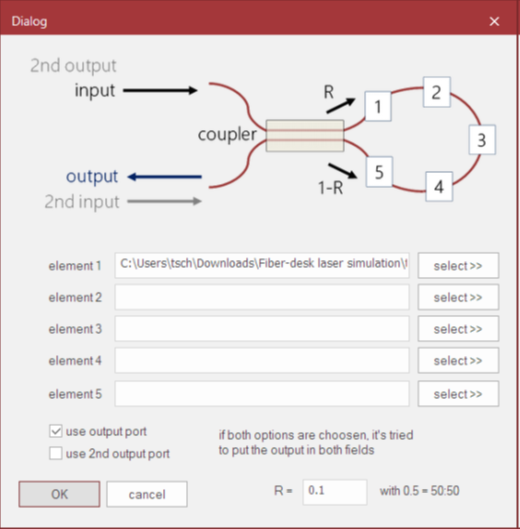
... have been requested by several customers. I doubled them for version 6 of fiberdesk and had to change a lot internally to be able to adapt it later to an even higher or arbitrary number. Here is how the dialog to save the elements propagation in one roundtrip to a single file looks like for the tutorial 5 elements:

  • Please download it from the BETA release for the moment.
  • Enjoy.

A tiny python script, update on fiberdesk 5 & 6 and tutorial

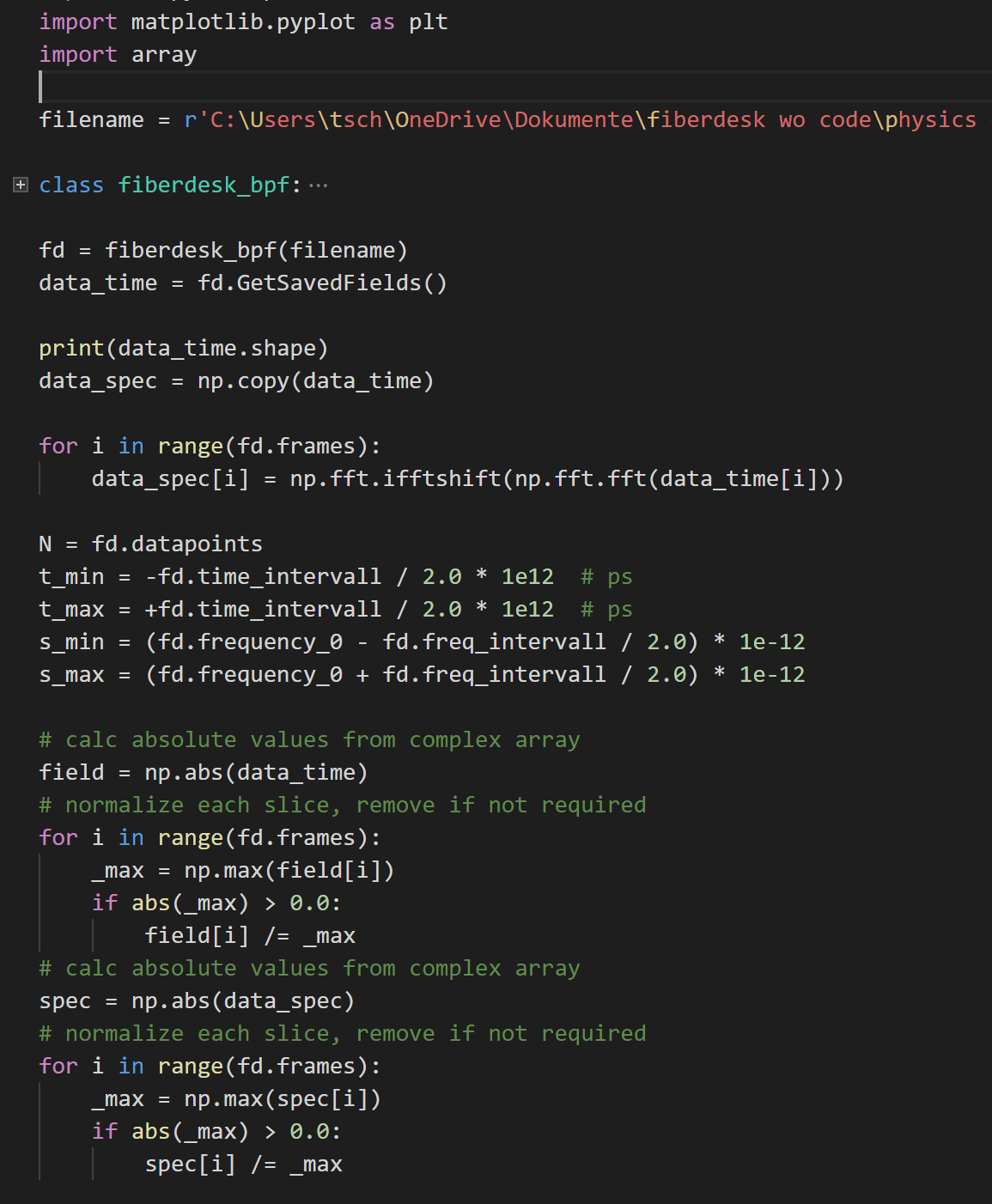
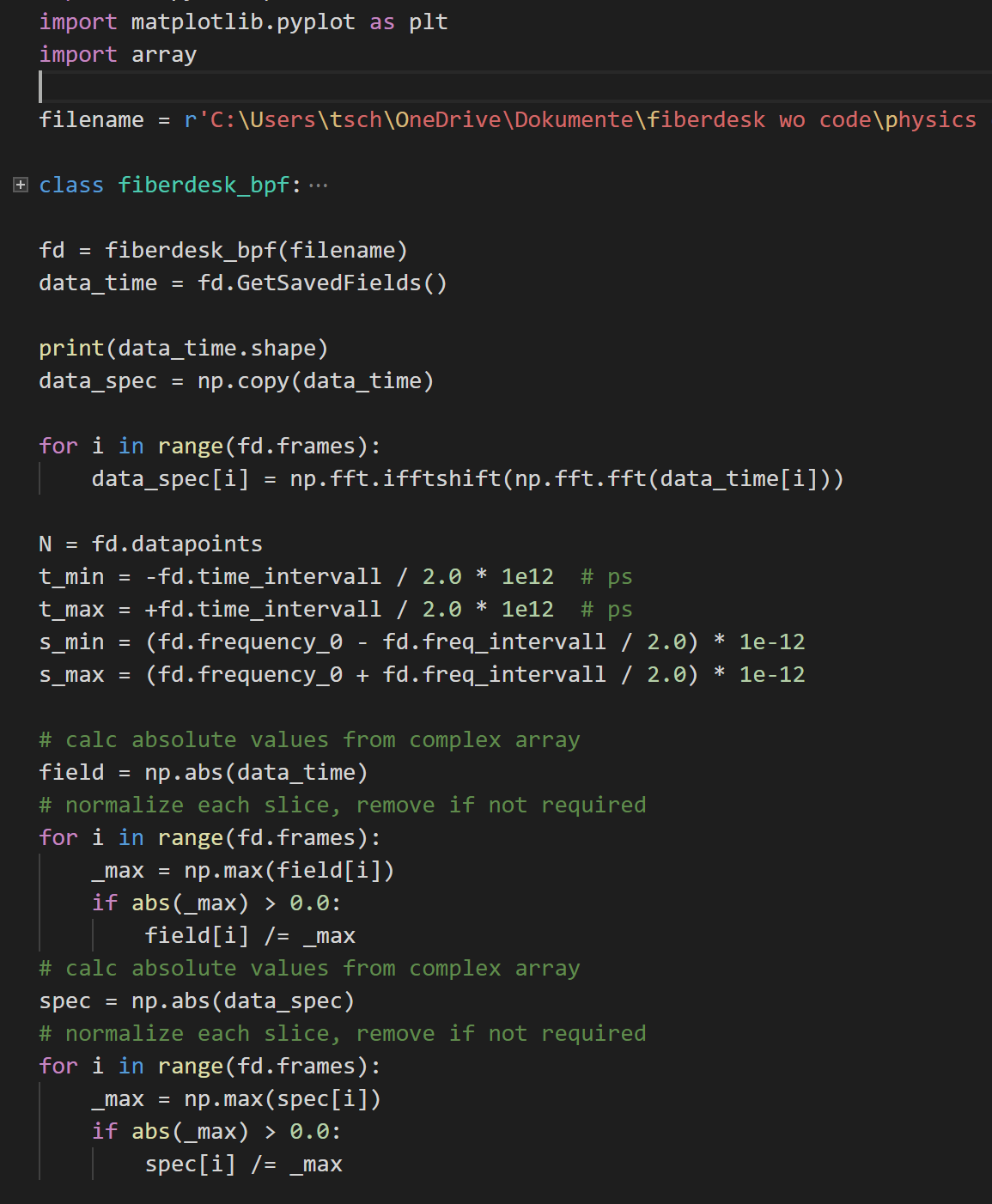
  • Python reader for BPF files saved by fiberdesk has been added to the download package.
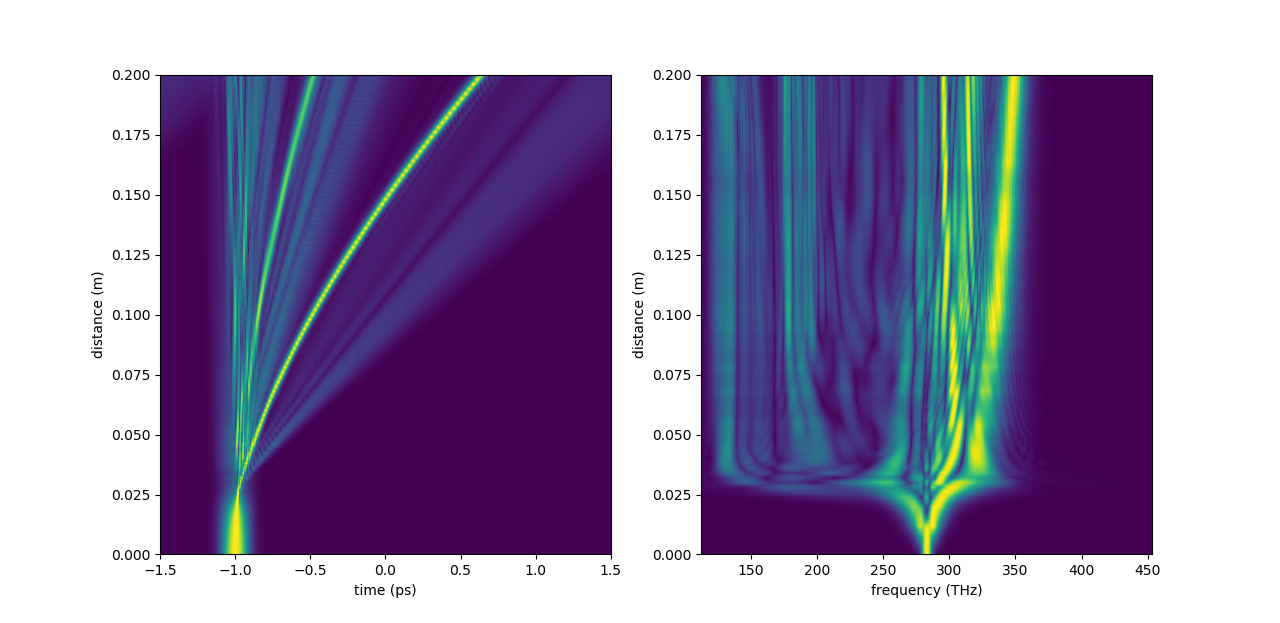
  • It reads a BPF file and displays the field and spectrum vs. propagation.
  • Tutorial 5 on a short pulse oscillator was enhanced with more details.

Some bugs have been removed:

  • the directory of files in a multi-element propagation was not recovered in some cases
  • menu elements of multi-element propagation did not work
  • rate equations unabsorbed pump power did not consider all pump wavelength

New version for fiberdesk 5 & 6 have been uploaded.

Processor speed 2020

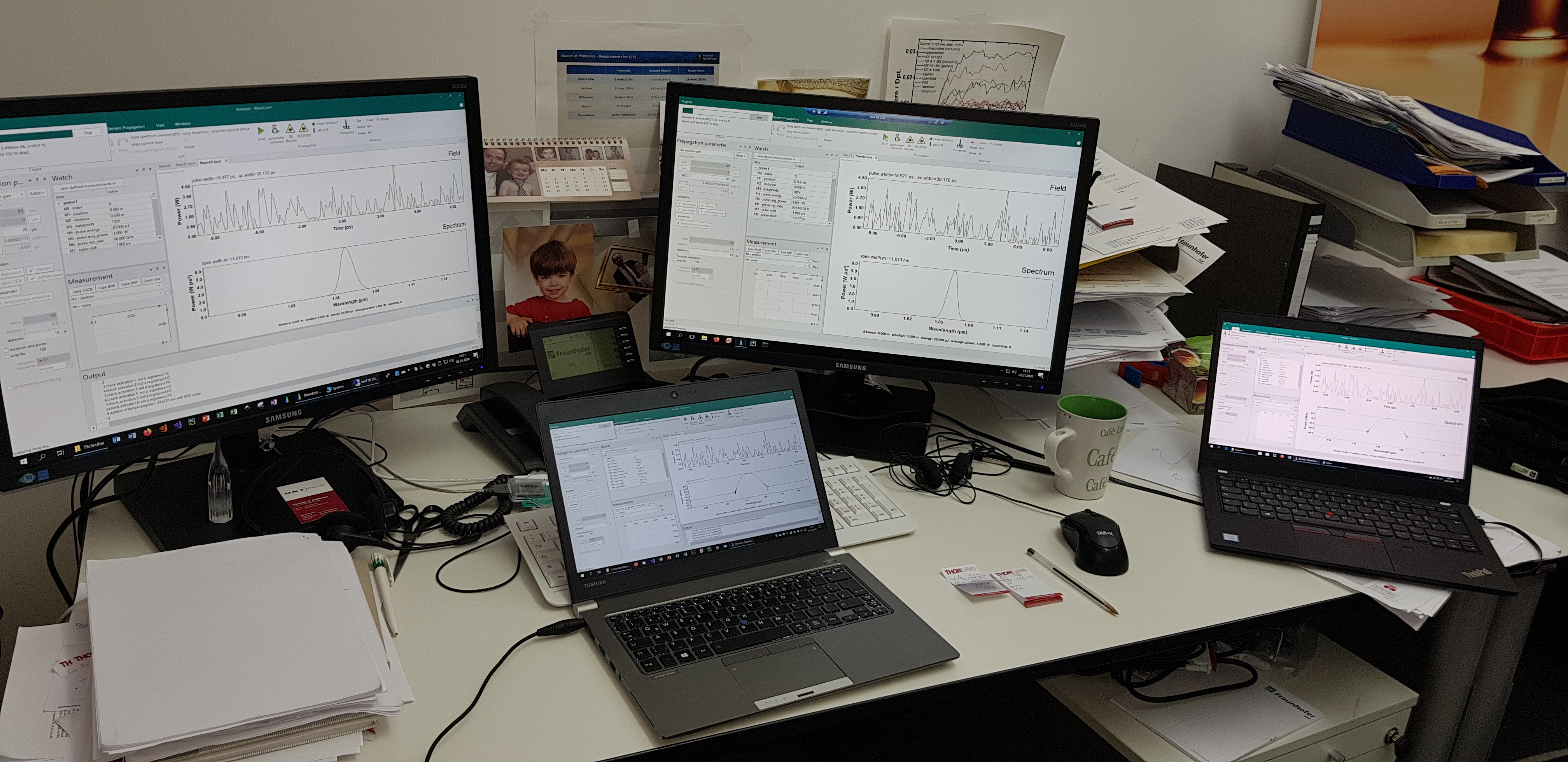
  • After work, it was time to check, if the speed of a new laptop is worth it.
  • I ran fiberdesk, which mainly used single-thread power for calculations despite being multi-threaded, in two different scenarios.

Rate Equation and SRS:

  • Intel i7-5500U 2.4 GHz: 454 sec
  • AMD EPYC 7551P 32 Core 2 GHz: 374 sec
  • Intel i7-7700 3.6 GHz: 209 sec
  • Intel i7-8565U 1.8 GHz: 206 sec

and nonlinear Schrödinger equation solver (Intel MKL based FFT):

  • Intel i7-5500U 2.4 GHz: 51.7 sec
  • AMD EPYC 7551P 32 Core 2 GHz: 54.7 sec
  • Intel i7-7700 3.6 GHz: 29.5 sec
  • Intel i7-8565U 1.8 GHz: 28.1 sec
  • So my current laptop is slowest and the new one is the fastest. Time to move to the new one!

Last Christmas – update

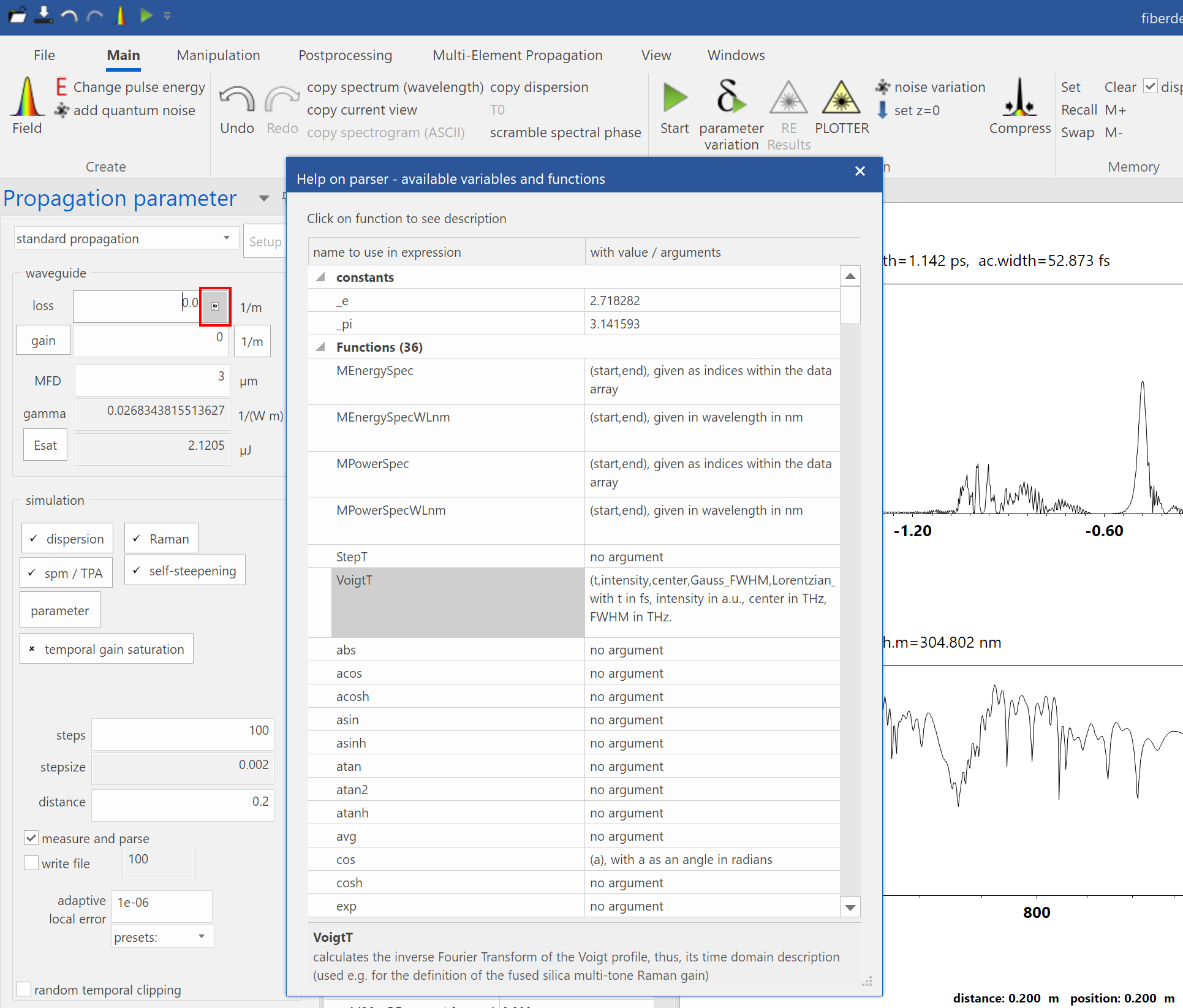
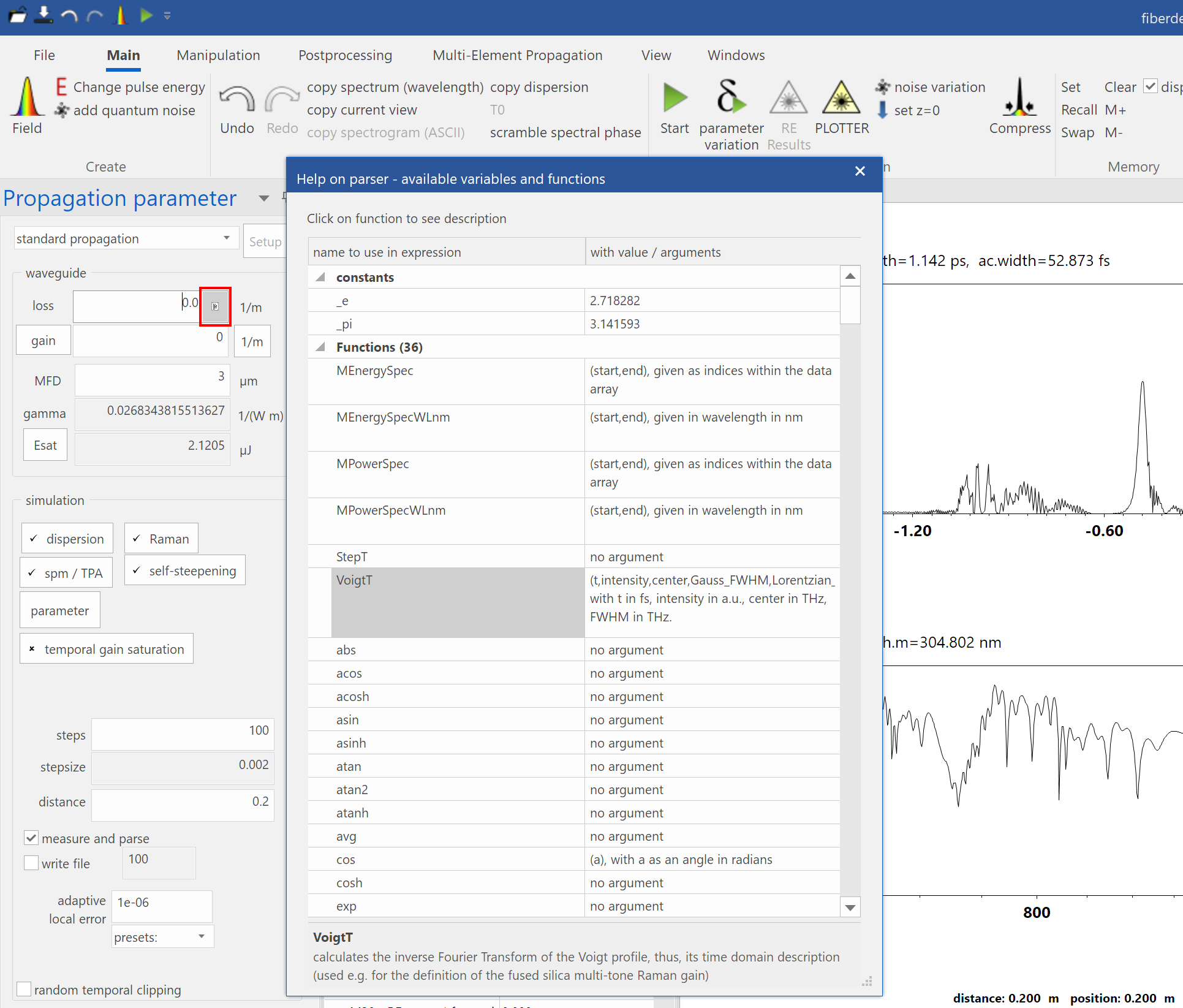
Finally a parser help was added to fiberdesk. Wherever you can script a variable, a small icon appears on the right side of the control (see red rectangle below). If you click on this icon, the help dialog (see screenshot) appears with the names of constants, functions and variables and their values or arguments. As you can see, I have to invest some hard work to fill in all the information. In the next update they will be added to all controls if necessary. So far it is implemented in some editing controls for testing.

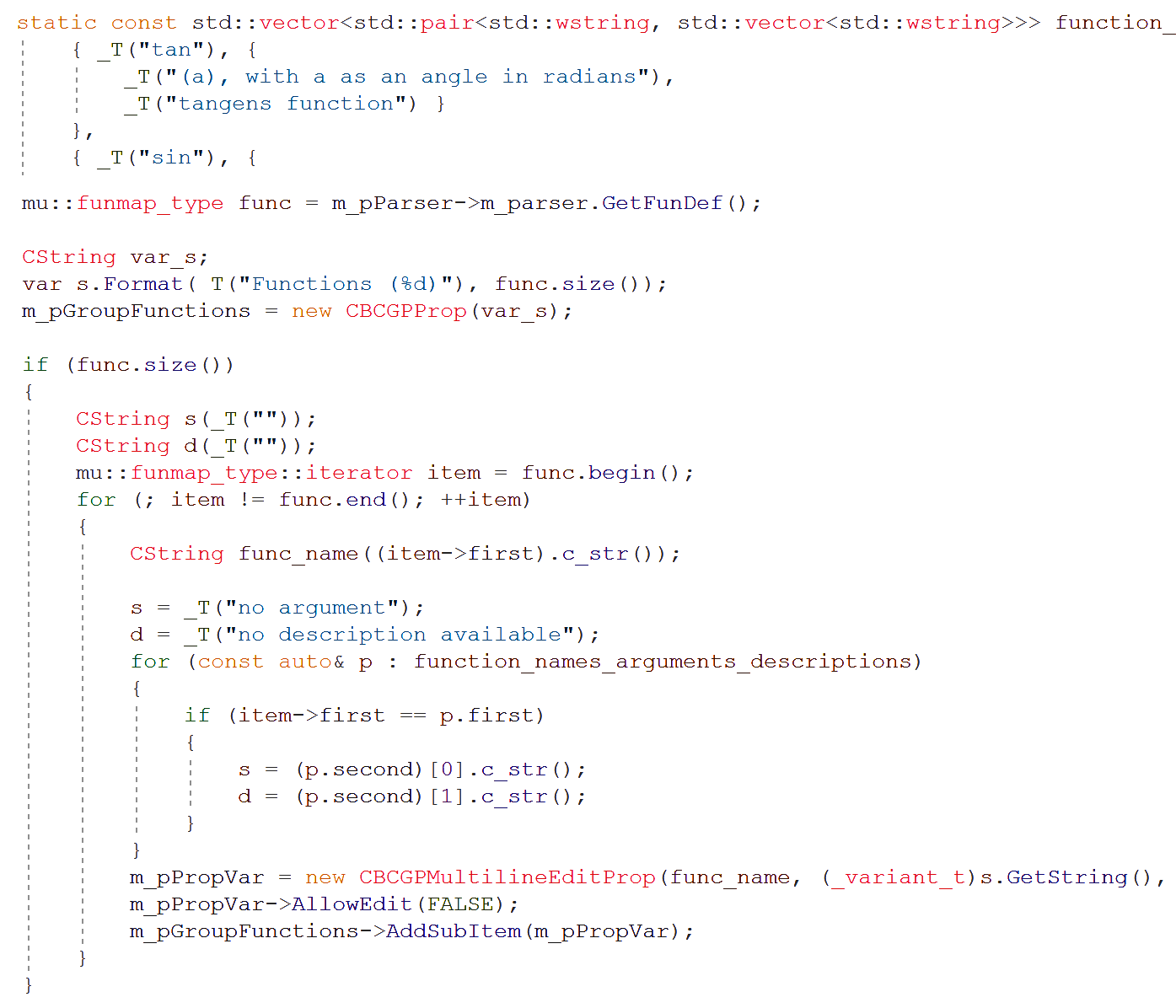
This feature has been enabled by muparser. Here is a look into the code implementation in fiberdesk for those of you that can speak C++.

With todays update, the following bugs have been remove:

  • fiberdesk was producing errors, if no document was opened.
  • the dialog for defining user measures did not open, if you switched back from one document to another.
  • selecting "average power" in the "create pulse" dialog crashed fiberdesk (assert).
  • Merry Christmas & Happy New Year

update – fiberdesk has to keep up with the times

Therefore, the smallest change in the current update is the ribbon bar that now uses the 2019 theme similar to the current microsoft office products. Also, dialog positions are now remembered.

Other changes are more relevant to your simulations:

  • A bug has been removed, where the rate equation measurements have not been done correctly especially during parameter variation.
  • The parameter variation also contained a bug preventing parsing of parameters from the pulse creating settings.

In the parameter variation, you might vary the parameter "a", which is connected to a pulse creation parameter. However, fiberdesk did not create a field in this scenario. Now you can force the field to be created with each parameter variation step.

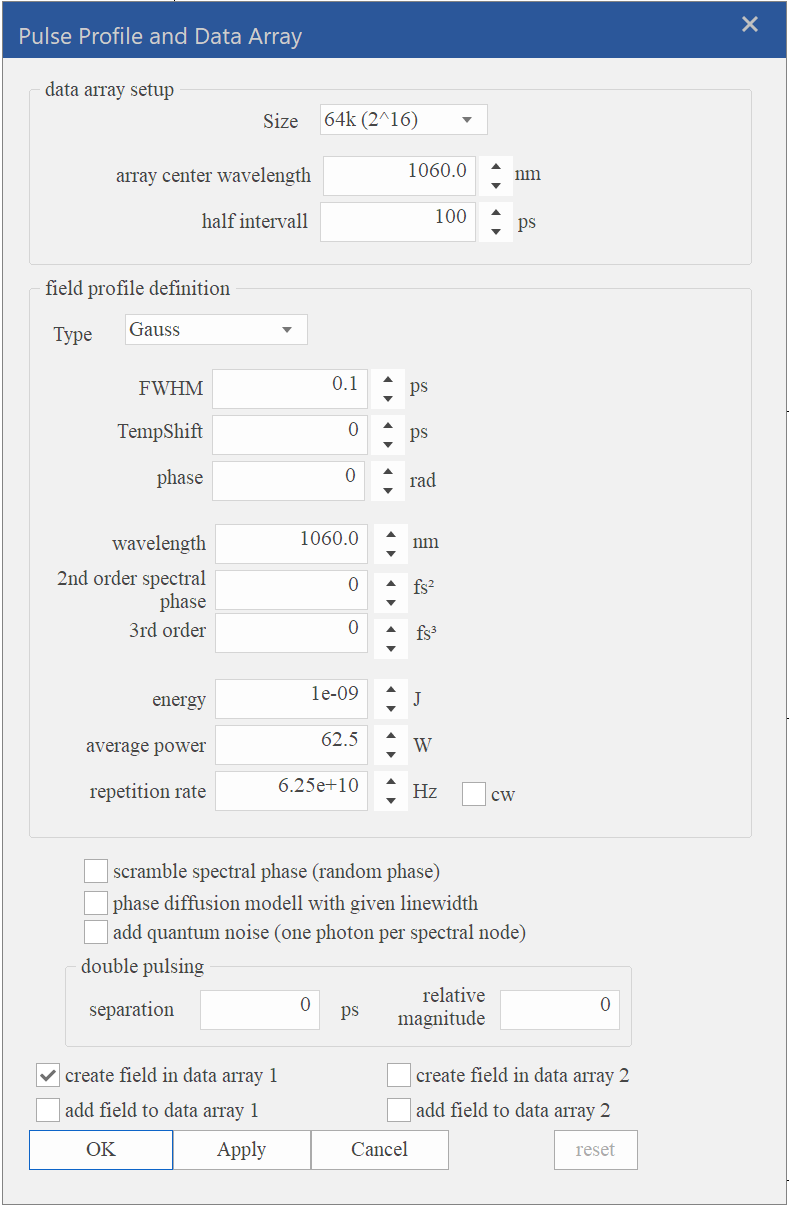
The definition of the pulse spectral windows and the spectral position of the field definition are now independent. Please see the two independent settings of "array center wavelength" and "wavelength" in the grouped field profile definition.

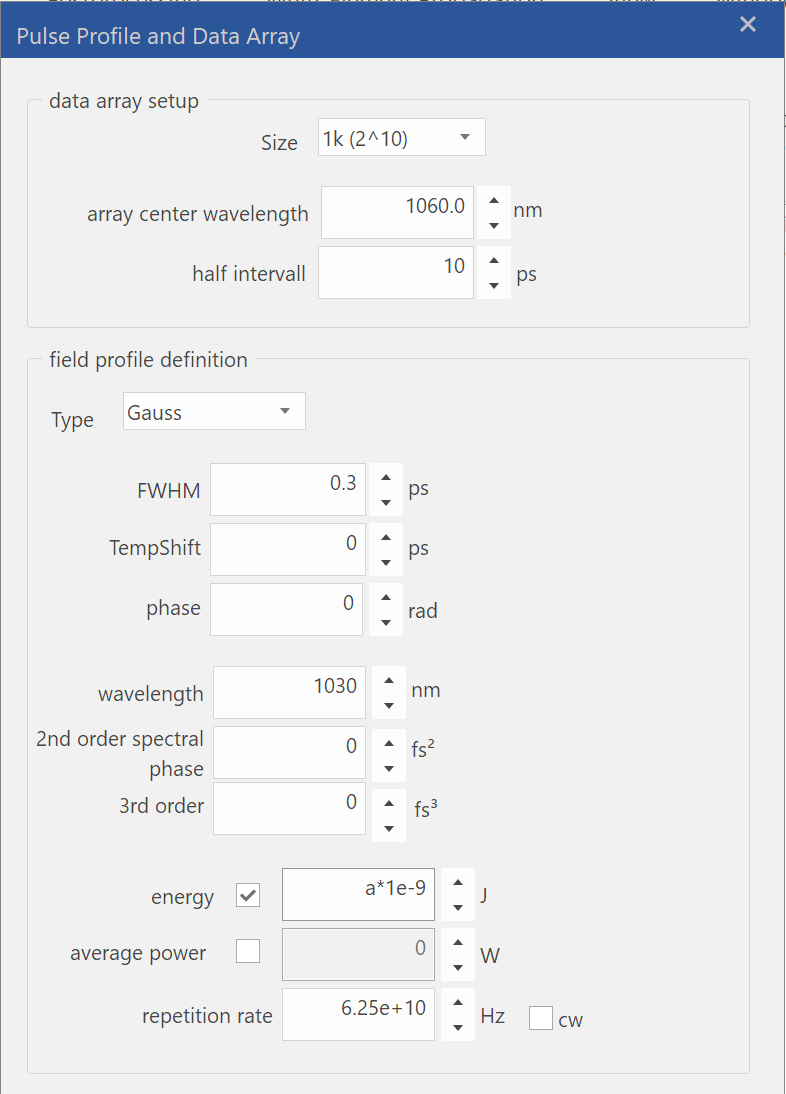
Furthermore, the energy and average power are connected by the repetition rate as usual, but you need to favour, from which one the other one is calculated. While this was done automatically before, the option of allowing a scripted input forces the depending one to be calculated to a real number. Pleas see screenshot, where the energy is depending on the parameter "a" (zero in this case).

Hint: as energy can depend on "a", the pulse duration might depend inversely on "a" in order to create a pulse that has the same peak power for any "a". That might be on interest for parameter variations.

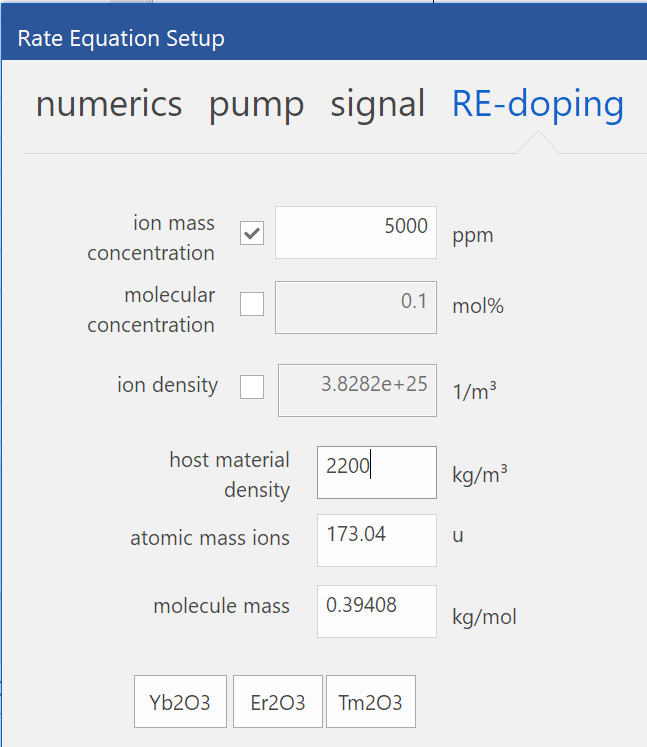
A similar dependency is included in the rate equation settings relating ion mass concentation, molecule molar concentration and ion density. The next update will include this functionality, currently, only ion mass concentration is supported.

  • Hint: These dependencies affect the parameter variation because only the selected parameter can be changed.
  • fiberdesk 5 and 6 have been uploaded to the package for download in its 64 bit versions.

Windows Fonts

Updated: Dec 19, 2019

I received a message from a customer that fiberdesks text in dialogs is too wide and parts of the text have been disappeared. It quickly became clear that this must be a Windows feature because fiberdesk does not change the font of dialogs.

It turned out that I needed to learn something about how Windows uses fonts in dialogs and controls, especially if it is a localized version with special characters from Japan, China, Greece, etc.

You can read about the background here:

  • https://docs.microsoft.com/en-us/windows/win32/intl/using-ms-shell-dlg-and-ms-shell-dlg-2

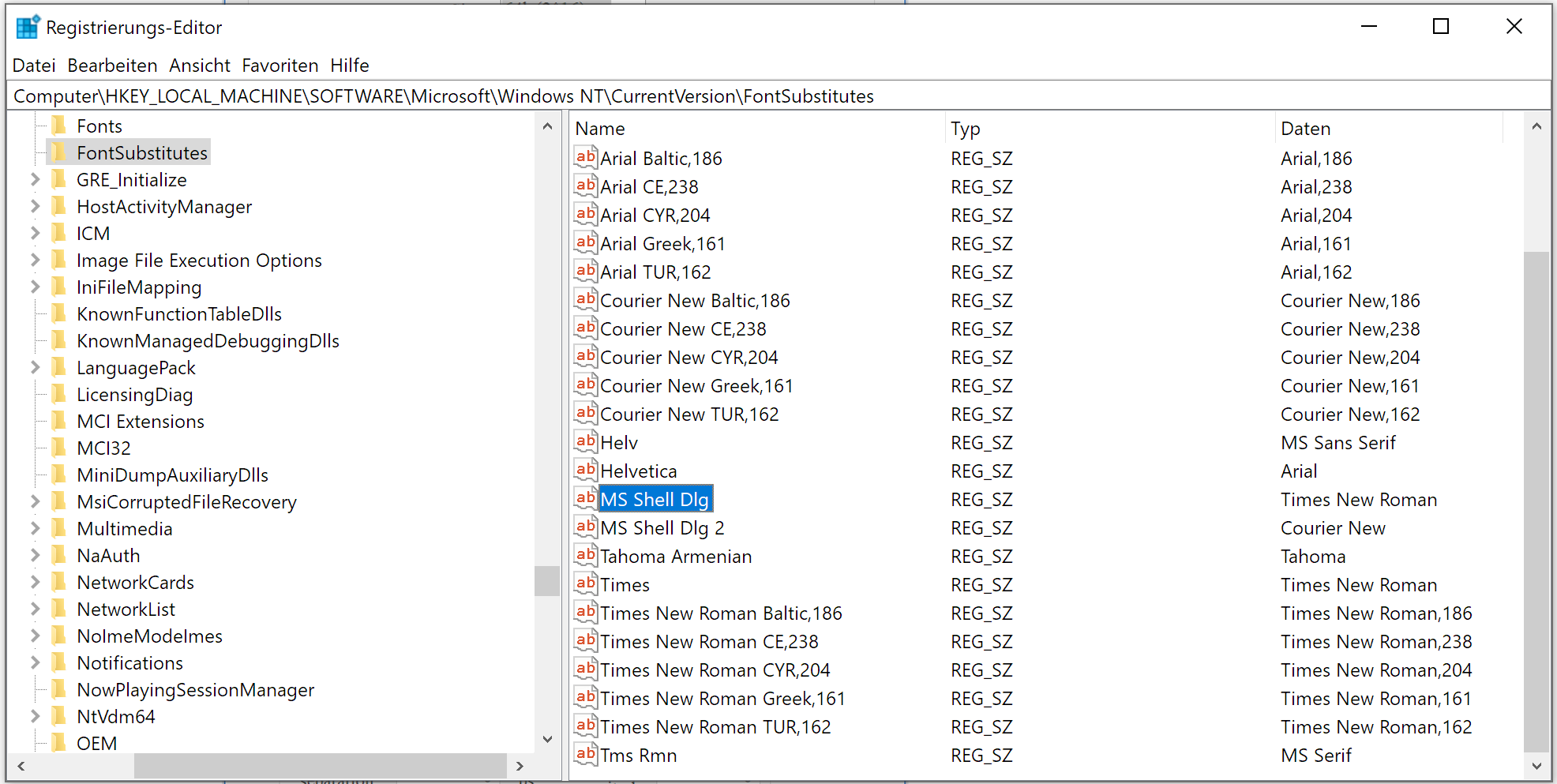
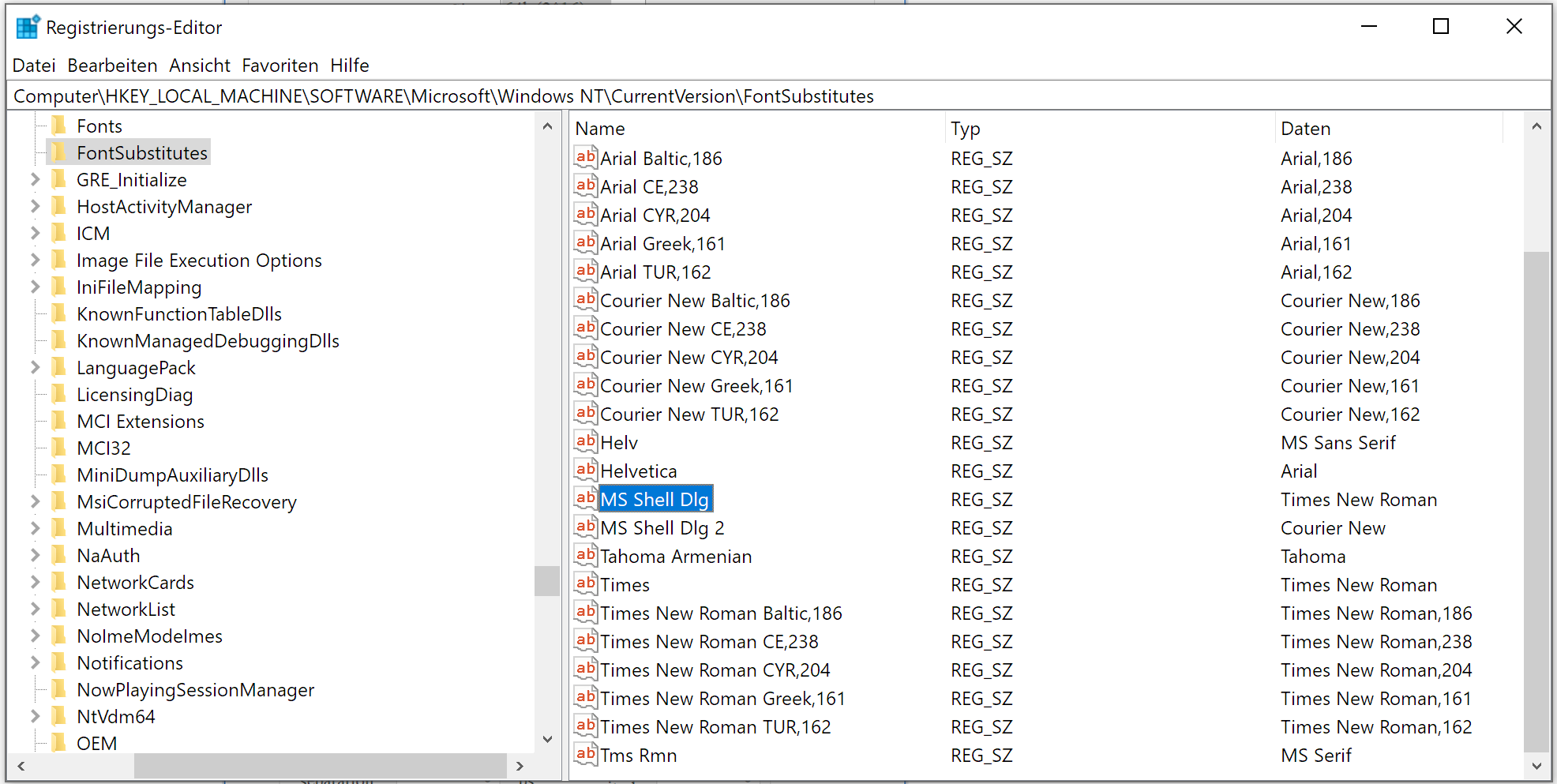
In summary, the default font for dialogs and controls is "MS Shell Dlg" since the early versions of Windows and "MS Shell Dlg 2" since Windows 7 or so. These fonts are not real fonts, but are substituted by other fonts. Most of the time you won't notice this, because by definition it could be Tahoma. However, it turned out that the customers's font substitut was Courier New, a much wider font.

If you have problems with the appearance of fiberdesk (or any other software), you can easily change the substitute font by using regedit as shown here:

In my example, I changed it to Times New Roman, restart the PC and got the following dialog in fiberdesk:

  • Interesting ...
  • Finally, I changed both font substitutes back to Sergeo UI on my Win 10 system.
  • 4,398 views

Update for Version 6

Version 6 was not starting on various computers. This is now corrected.

Additionally, the following improvement have been made:

The pulse profile creation now separates between the data array center wavelength and the wavelength of the profile. Thus, if for instance, the wavelength of a profile is varied during a parameter variation, the data array can be kept unchanged.

A previous error that did not allow to load a BPF file was corrected.

initial fiberdesk 6 launch and update

All new customers get dongles without the need to install windows drivers.

Today, the package contains the newly published fiberdesk 6 as a 64 bit version (fd6_x64.exe). Throughout the year, additional features will be added to this new version.

Currently, some new features are:

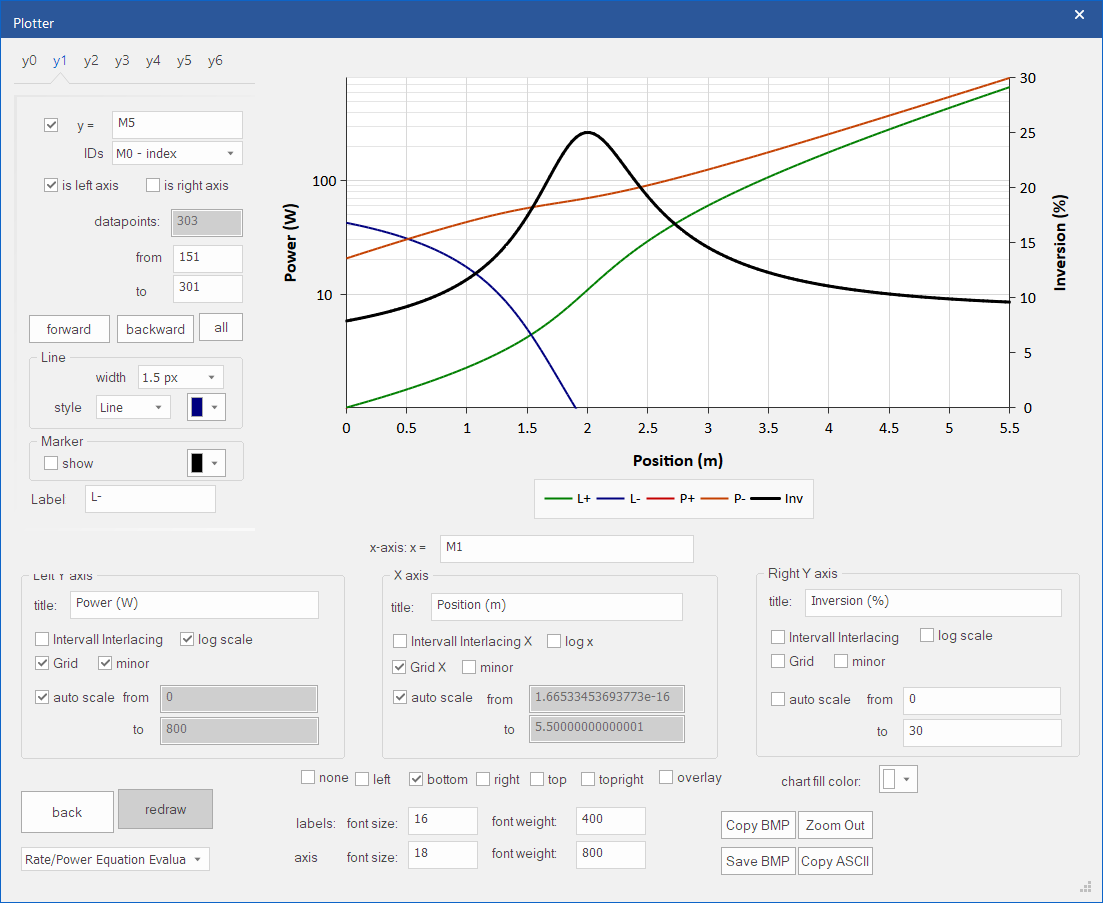
  • The Plotter: make customized and beautiful graphics from your results.

A new propagation element: nonlinear optical loop mirror (see tutorial 8):

With this update, all 64 bit versions are updated and the following bugs are removed:

  • Parameter variation or simple propagations crashed fiberdesk in an unreproducable way. reason found to be an internal race condition problem. Please report, if such problems still occur.
  • Rate equation did not start in parameter variation
  • adaptive stepsize control zeros field after initial step
  • colorbar fader produced missing color
  • odeint crashed rate equation solver unpredictable (library conflict)
  • infinite loop at zero propagation length

some improvements have been done:

  • parameter variation allows cross referencing of x and y
  • forward and backward fields are saved separately in multi-element propagation (and no empty files are saved anymore)

Update

Package updated with minor fixes.

Update and tutorial

fiberdesk has been updated to correct issues:

  • 2D parameter variation bug when creating new pulses
  • Raman response function scaling corrected and tested
  • adaptive algorithm improved
  • faster computation when only self-steepening is involved
  • coherence and average spectrum calculations updated to comply with parameter variation, see tutorial 2, which has been updated as well

Rate Equation and Parameter Variation

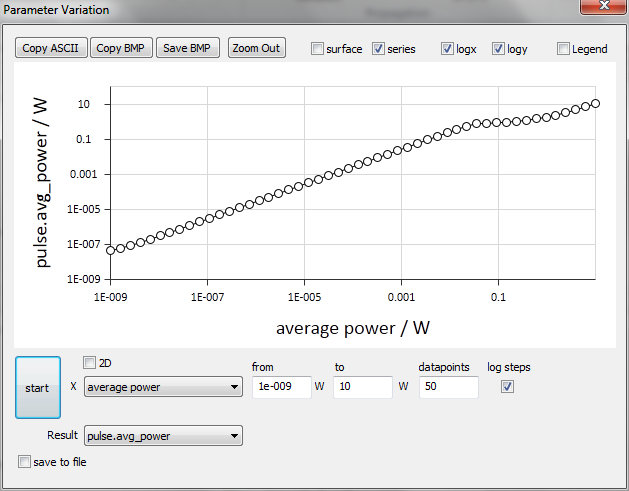
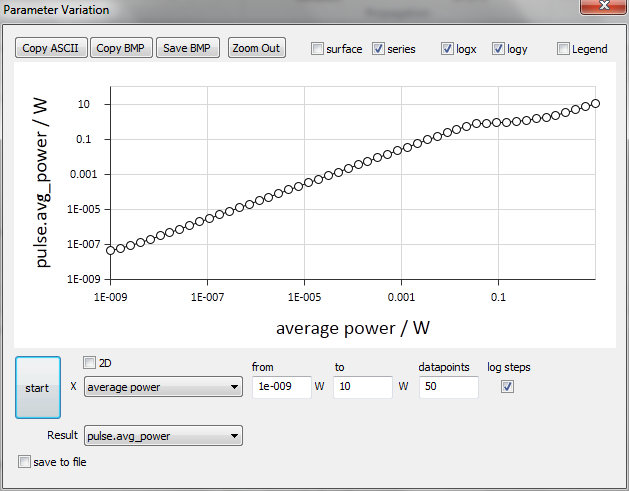
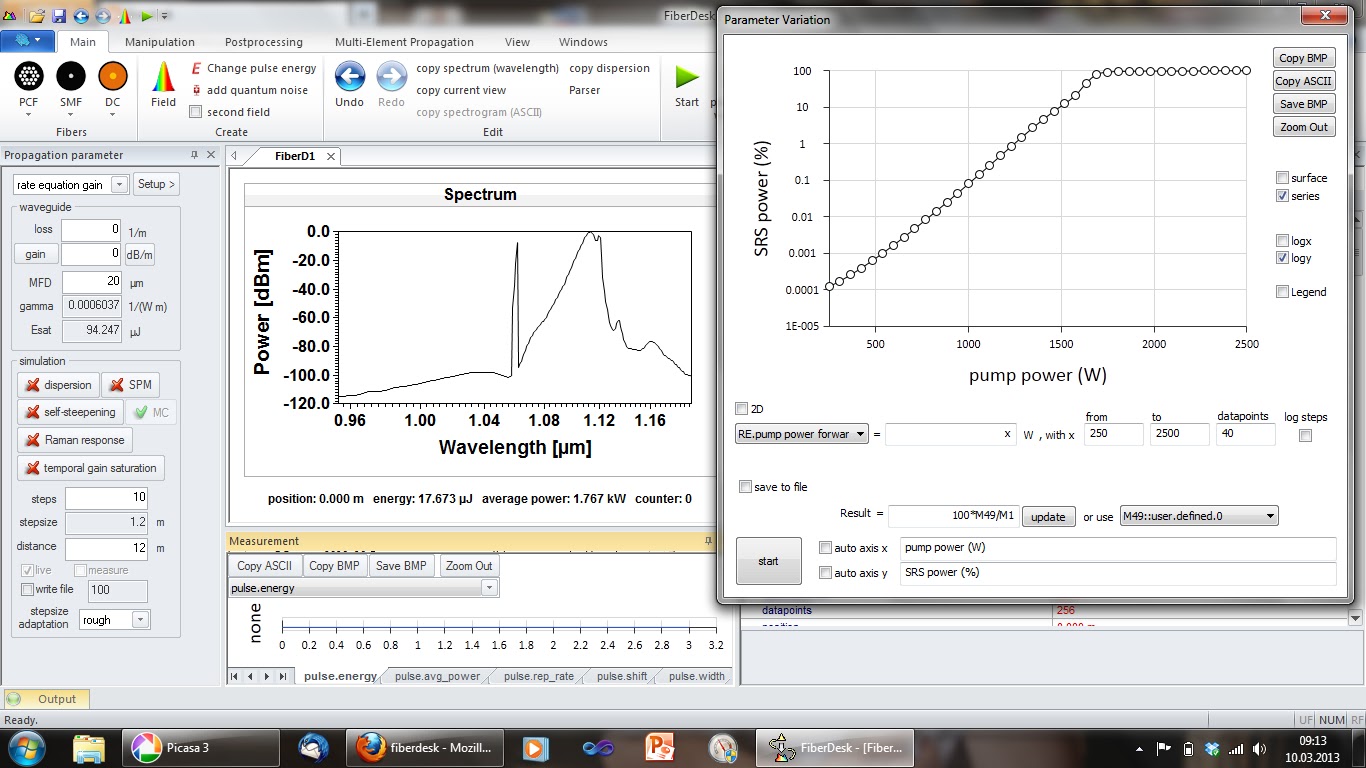
fiberdesk ignored the "add quantum noise" option during parameter variation. This bug is removed now. Below you see the variation of the input power in a fiber amplifier (1 W pump, rate equation without ASE) and the output power as a measurement result. Up to ~10 mW the amplifier gives the full small signal gain then saturuates and finally increases linearly because the output power is in the same order of magnitude as the input power.

However, if you perform the simulation again including ASE, the total output power is dominated by ASE (in the example 13 mW) in the range below some µW of seed power.

Tutorial update

The tutorial is switched back to PDF files. Some are updated, some added.

Older CPUs and the instruction set dilema

The speed up of numerical code by advanced instructions sets provided by a CPU can be essential. However, not every customer might have the latest CPU, so the software either needs different branches and provide multiple options for download, or one neglegts the speed-up.

Recently I compiled with AVX2 instruction set and realized that fiberdesk is crashing on older systems. Originally, I thought it is a Windows 7 bug, however, it just only correlated with Win7 as all these PCs also had an older CPU.

I just uploaded a new version of fiberdesk, which should now work with every CPU again.

Update

Several bugs have been removed with todays upload:

  • Raman gain in the "raman response dialog" now shows correct unit m/W. Convolution with current spectrum is not yet working but the propagation code does.
  • crash issue solved for parameter variation in multi element propagation
  • propagtion parameter file saved empty files - solved

BUG Fix

  • parser bug in multi element propagation fixed
  • no. of frames to save bug fixed
  • new 64 bit version uploaded

BUG Fix

  • multi-element propagation crash bug fixed and new fiberdesk 5 64 bit uploaded

BUG Fix

  • measurement and position update: new fiberdesk 5 and 5 lite for 64 bit uploaded

BUG Fix and 32 bit version

  • repetition rate / average power measurement
  • 32 bit version for download added for Win XP systems or similar

New features added

  • multi-element container: filename display and saved options
  • 64 bit version for fiberdesk 5 due to memory limitations at 1M sized fields
  • additional error fixes for measurements

Features added

  • measurement of average power
  • save/load of dispersion
  • comma vs. dot copy to clipboard

Feature update

all packages have been updated to the latest version:

  • adaptive rate equation solver included
  • up to 15 cross sections peaks for fitting
  • cross section width changed to FWHM

Beta becomes Release - fd5

  • Beta Version moved to official version fiberdesk 5
  • known issue: inversion display for rate equation

Threading

Improved progress bar handling and main calculations moved to separated thread. Allows to stop propagation by mouse or ESC key without freezing.

new homepage

fiberdesk's homepage has a new layout and new tutorials as a diashow. Please take a look at www.fiberdesk.com

Visual Studio Community Ed.

Took me several hours to get fiberdesk compiled with the latest Visual Studio Community 2013. All libaries and the Win SDK needed to be synchronized. Seems that the libaries have not yet been prepared for this release so it was a lot of manual tweeking ...

fiberdesk 5 annoucement

fiberdesk 5 comes with an improved adaptive algorithm, equation parser and new options.

For all customers using version 4, the updates are provided via fiberdesk 5 (lite), where some new features are disabled. Nevertheless they will benefit from bug fixes and other updates.

The GUI is modern Win 8 style.

toward fiberdesk 5

... these are the final fixes until the new release. There has been a complete rewritten core code with parsing and improved adaptive control. Here is a nice new video showing multi order stimulated Raman scattering (broadband) via the Nonlinear Schrödinger Equation.

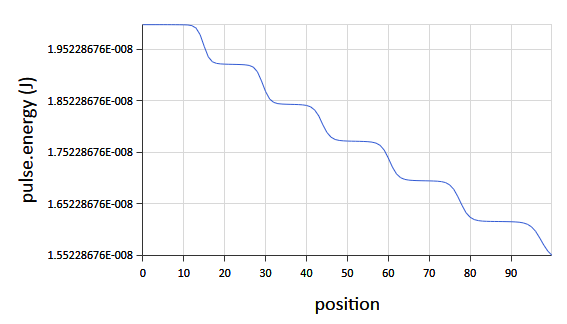
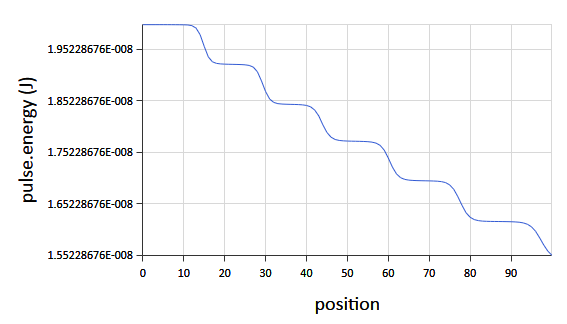
At each point of conversion, the energy drops due to quantum defect as shown in the measurement window:

Additionally, free parameters have been added. This allows simultaneous variation of other parameters by assignment while only the free parameter is changed. For instance: parameter "a" is set as the central wavelength for the high reflecting and low reflecting mirror and the resulting cavity simulation will show the behaviour for different wavelength in a one-dimensional parameter variation of "a".

status of fiberdesk 5

fiberdesk 5 - the next major release - will have the following features:

  • parser
  • custom measures via parser
  • enhanced parameter variation
  • enhanced plotting
  • cw-SRS

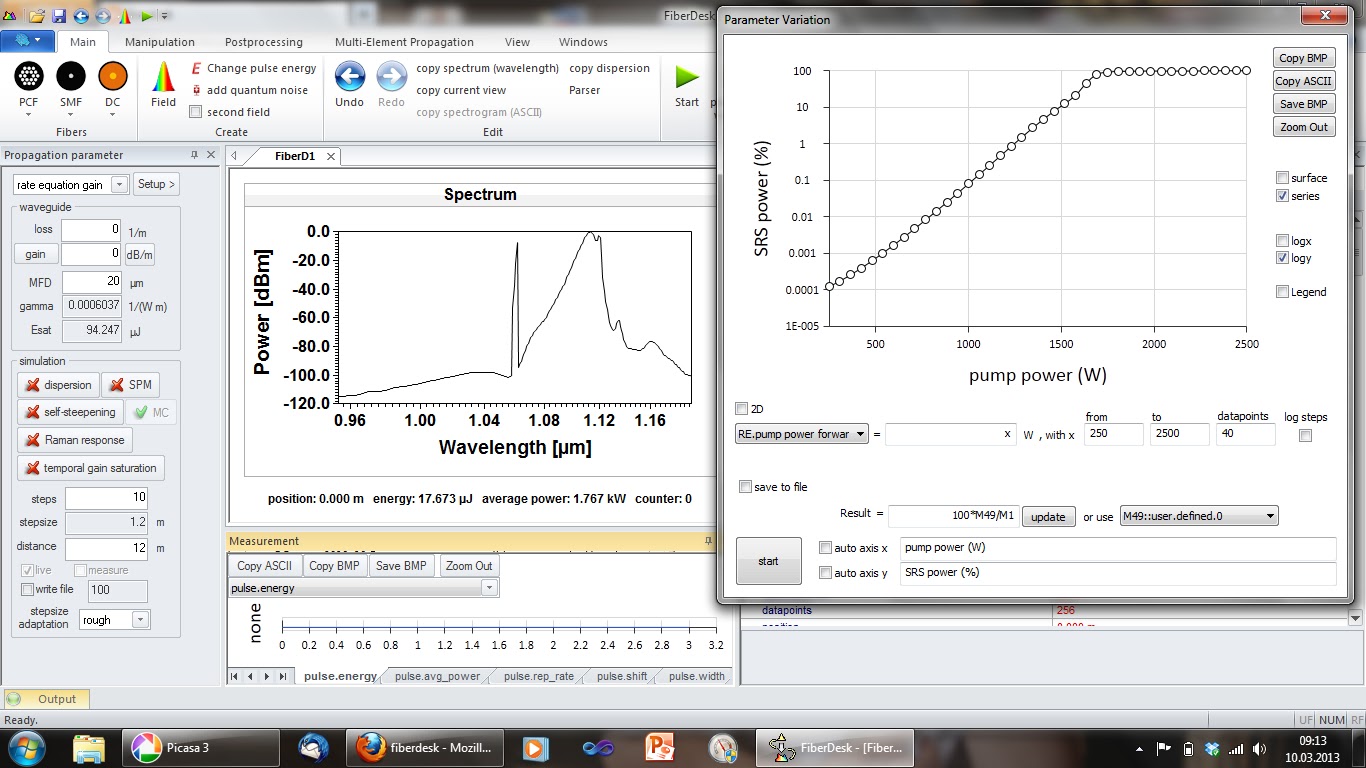
Here is a first view on the new parameter variation dialog, where the custom measure M49 is evaluating the power from 1100-1200 nm, M1 is the average power so the result is "100*M49/M1" by parsing - the relative power content of Raman scattering. The modell is a cw fiber laser cavity and the pump power is varied.

feature added

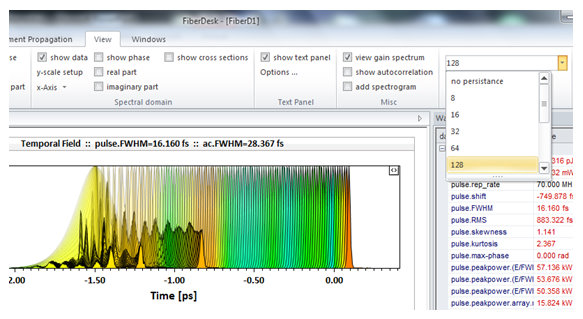
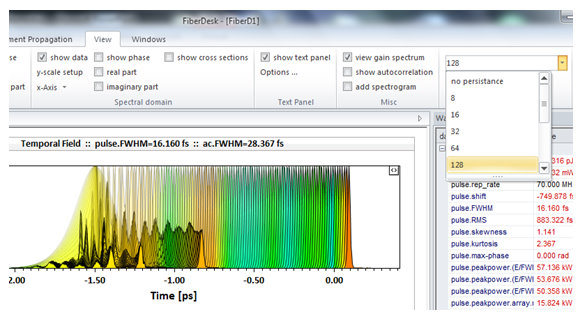
Persistance has been added. However, currently each view itself is normalized and chirp and colored wavlength visualization does not work correctly with it.

toward fiberdesk 4

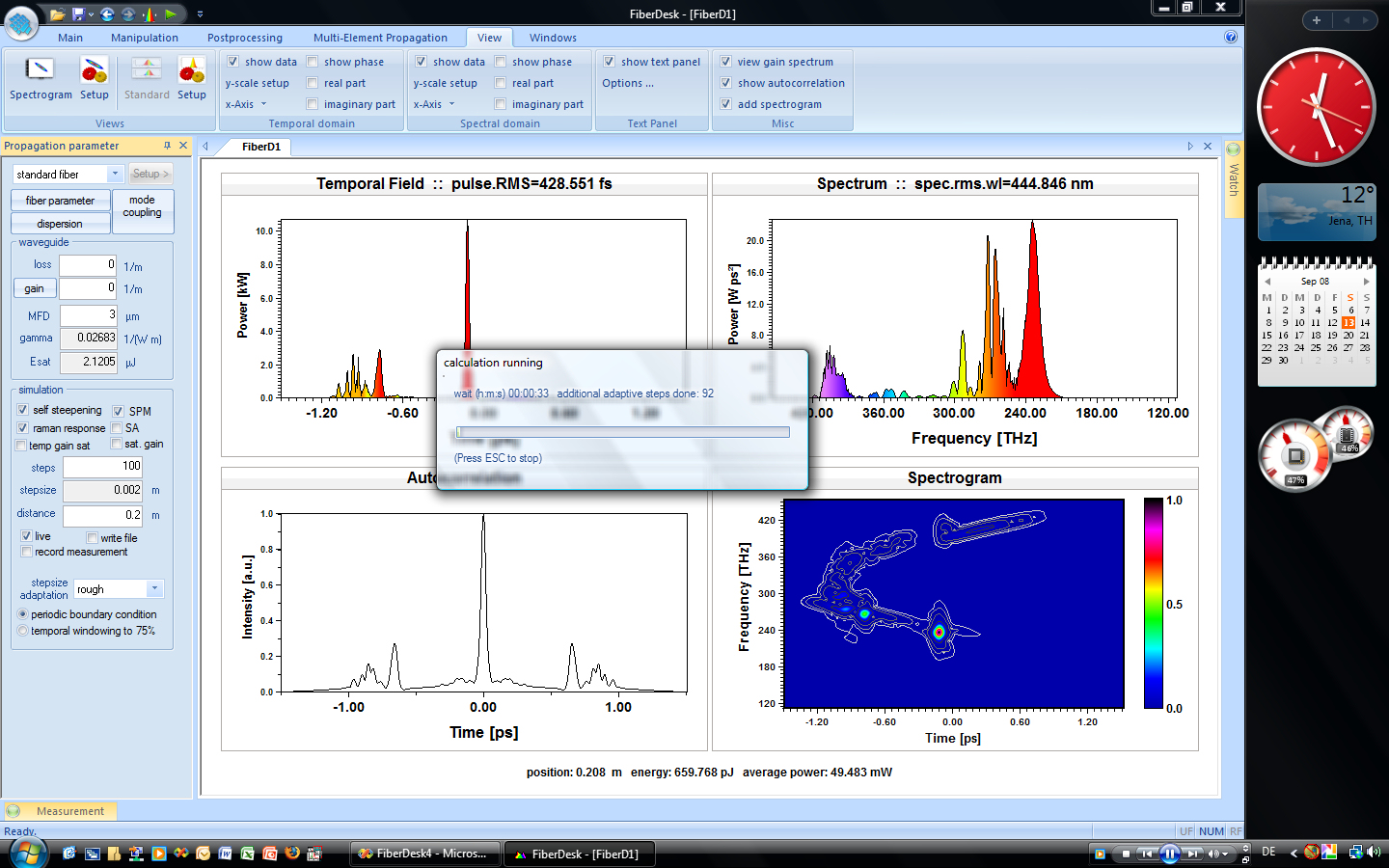
Here is a new screenshot of the Windows 7 Scenic ribbon bar now included in the software.

In the upcoming new version you can:

  • select predefined fibers
  • do parameter variations for the initial field parameters and any parameter of the propagation
  • rate equation evaluation also in combination with the NLSE
  • z-dependent parameter changes

benchmark 2008

The year is almost over. Here is a benchmark of compilers and FFTs tested recently for supercontinuum generation on a Intel(R) Core(TM)2 CPU @ 2.66 GHz:

  • 1024 data points
  • Microsoft Compiler VS2008, no optimization, Numerical Recipes FFT: 68 sec
  • Microsoft Compiler VS2008, no optimization, template based FFT: 68 sec
  • Microsoft Compiler VS2008, no optimization, FFTW 2.1.3: 65 sec
  • Microsoft Compiler VS2008, no optimization, Intel MKL FFT: 57 sec
  • Microsoft Compiler VS2008, full optimization, Numerical Recipes FFT: 47 sec
  • Microsoft Compiler VS2008, full optimization, template based FFT: 46 sec
  • Microsoft Compiler VS2008, full optimization, FFTW 2.1.3: 44 sec
  • Microsoft Compiler VS2008, full optimization, Intel MKL FFT: 43 sec
  • Intel Compiler V11.0, Numerical Recipes FFT: 49 sec
  • Intel Compiler V11.0, FFTW 2.1.3: 42 sec
  • Intel Compiler V11.0, Intel MKL FFT: 42 sec
  • 16384 data points
  • Microsoft Compiler VS2008, intermediate optimization, Numerical Recipes FFT: 966 sec
  • Microsoft Compiler VS2008, intermediate optimization, template based FFT: 876 sec
  • Microsoft Compiler VS2008, intermediate optimization, FFTW 2.1.3: 803 sec
  • Microsoft Compiler VS2008, intermediate optimization, Intel MKL FFT: 830 sec
  • 16384 data points, memory aligned
  • Microsoft Compiler VS2008, intermediate optimization, FFTW 3.3alpha1: 801 sec
  • Microsoft Compiler VS2008, intermediate optimization, Intel MKL FFT: 793 sec

In the commercial or demo version, the MS Compiler is used with the template based FFT. It is not to bad, however, there seems to be some speed enhancement possible for the next version, probably Intels MKL.

(remark added: Intels MKL has later become the standard for fiberdesk)

fiberdesk on MS Win Vista

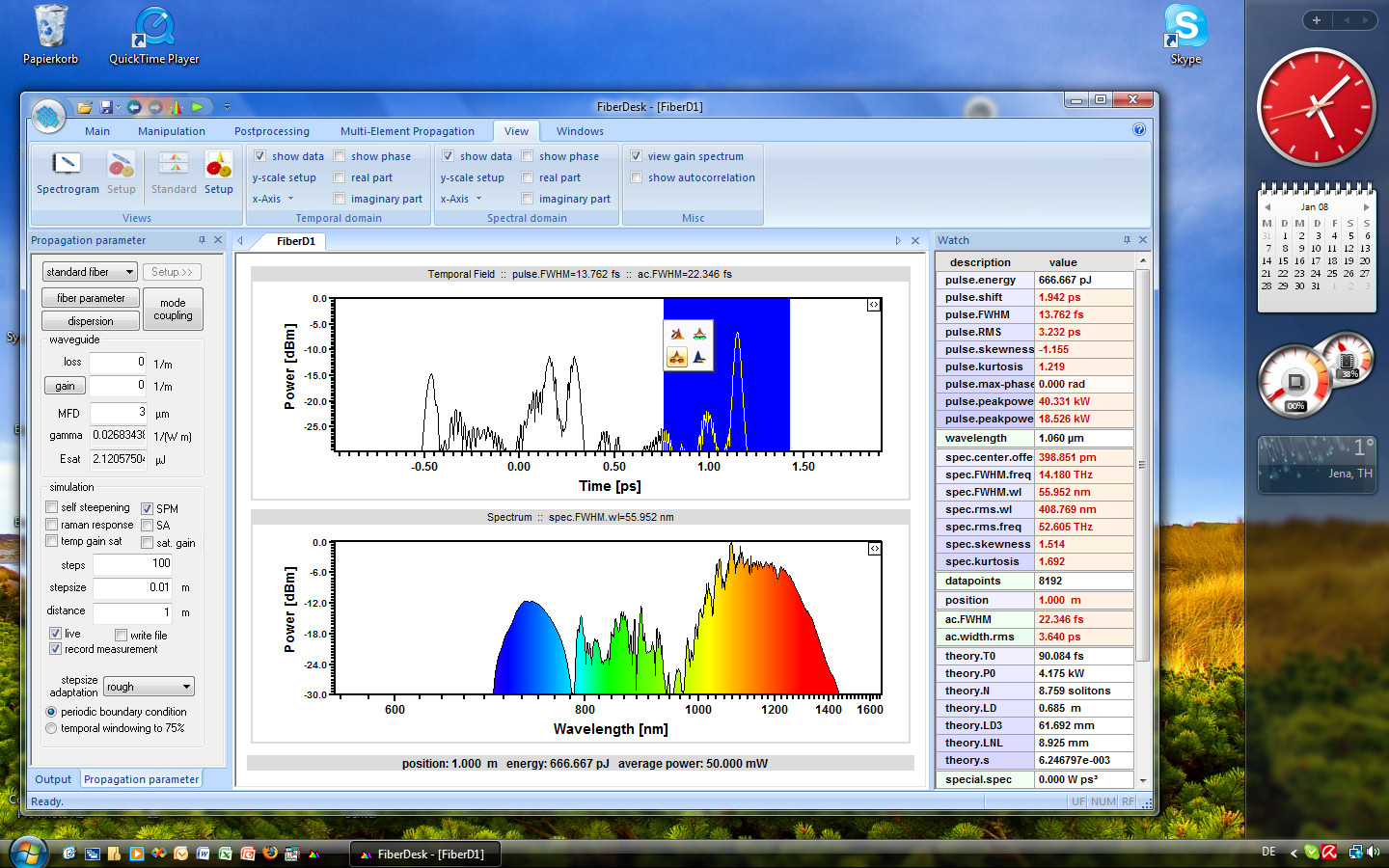
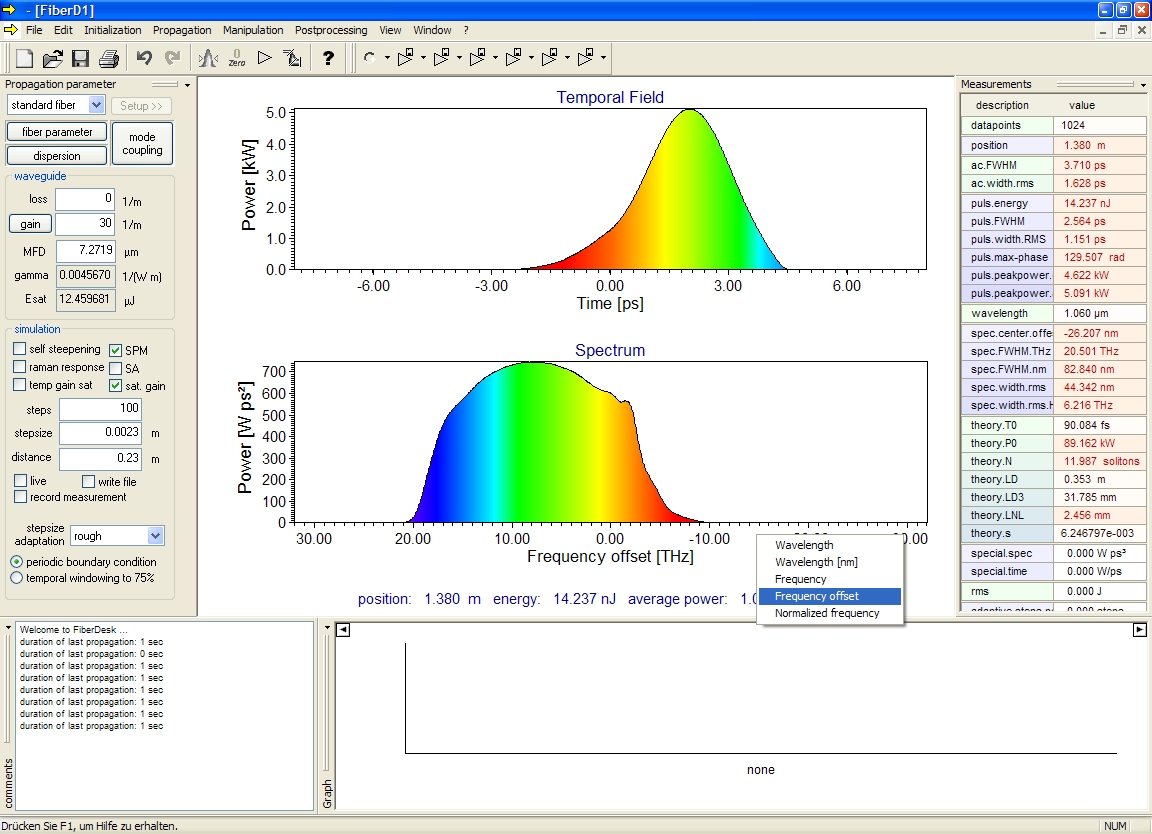
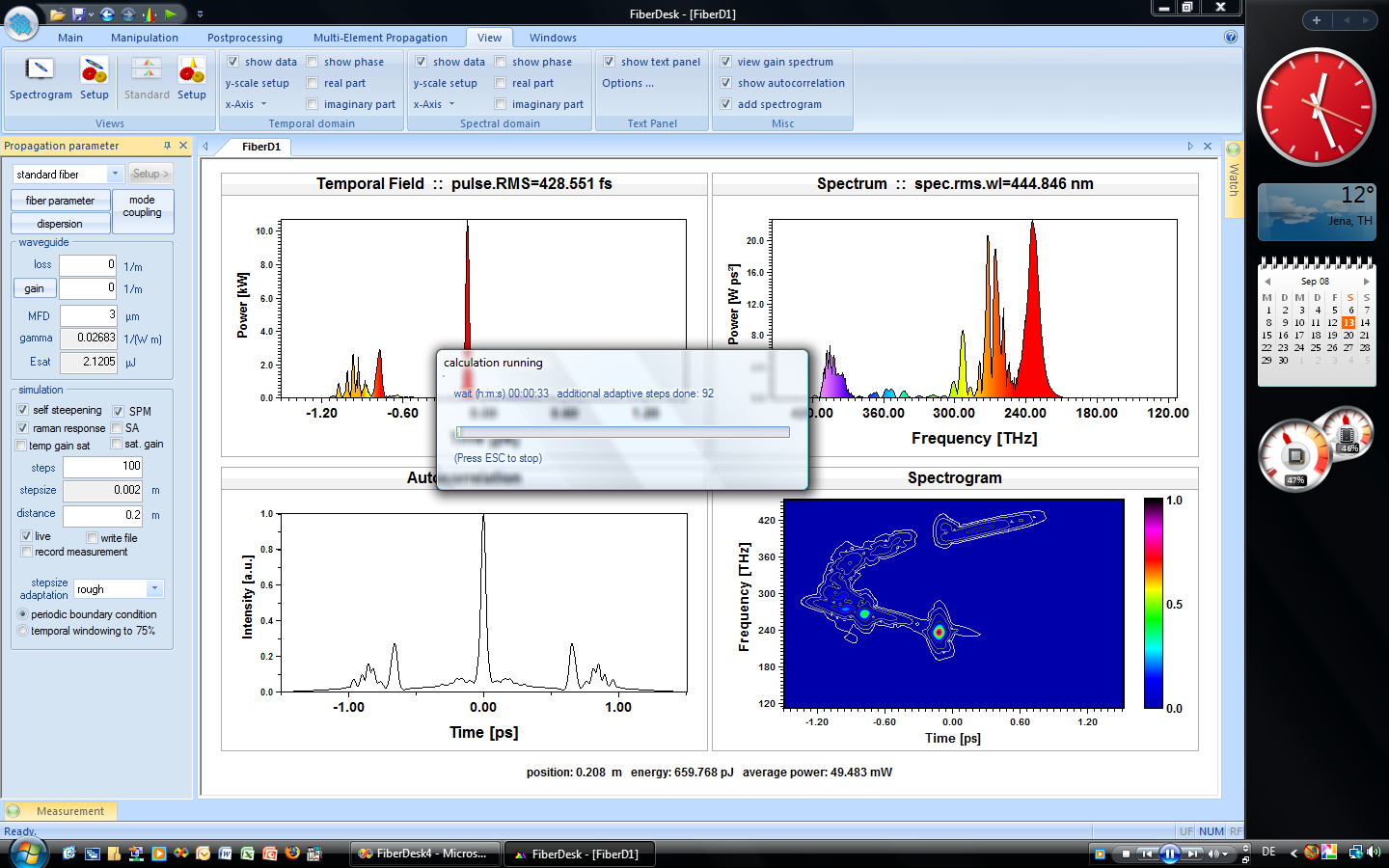
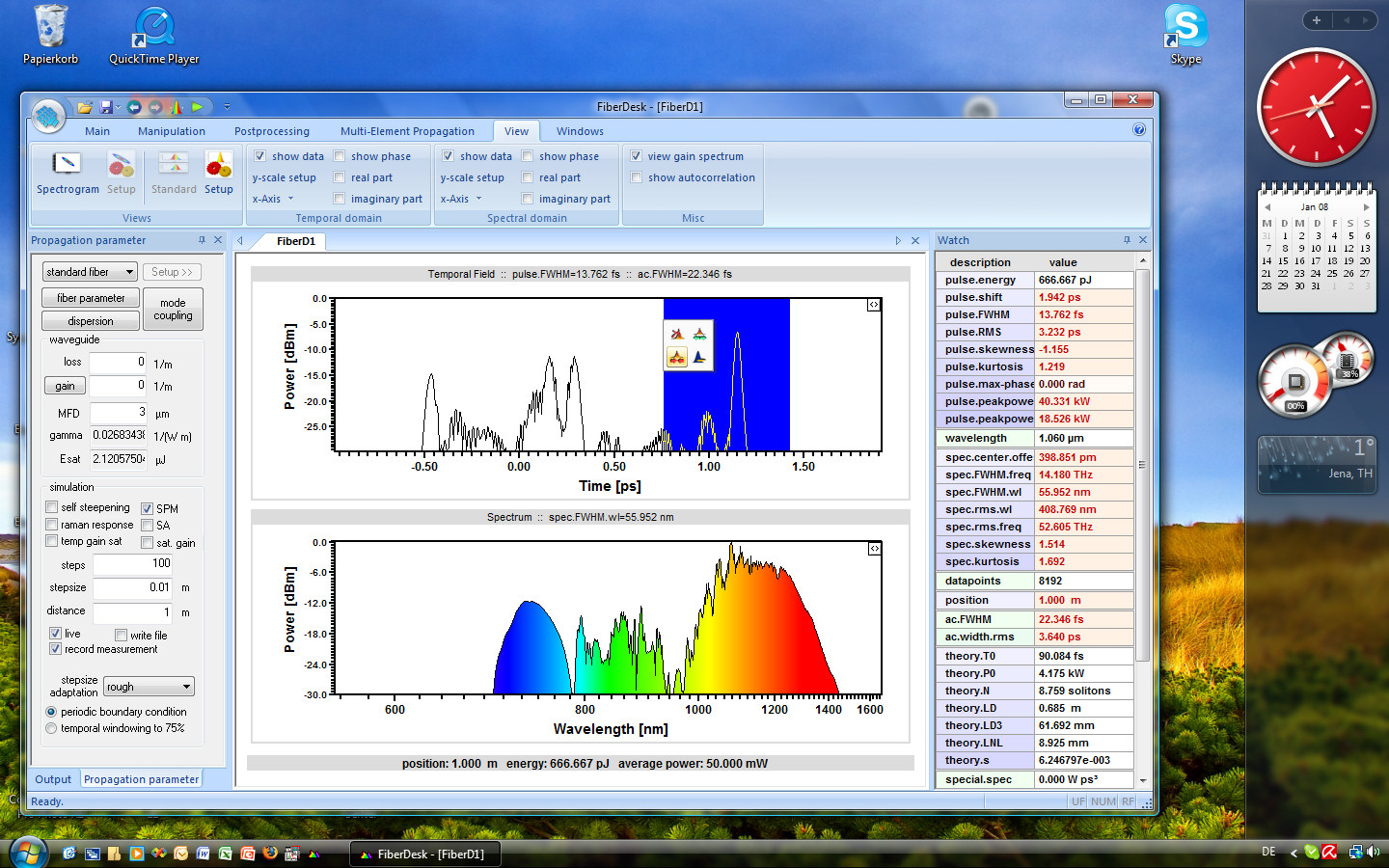
Vista screenshot of fiberdesk

fiberdesk 3.0

FiberDesk 3.0:

  • simulation of mode-locked lasers possible due to saturable absorber element (SAE)
  • SAE with instantaneous response (Kerr element) as well as saturable absorber mirror with two time constants
  • element of pulse creation (with jitter) added
  • bugs in control enviroment removed
  • bug fixes in propagation code
  • new colour schemes
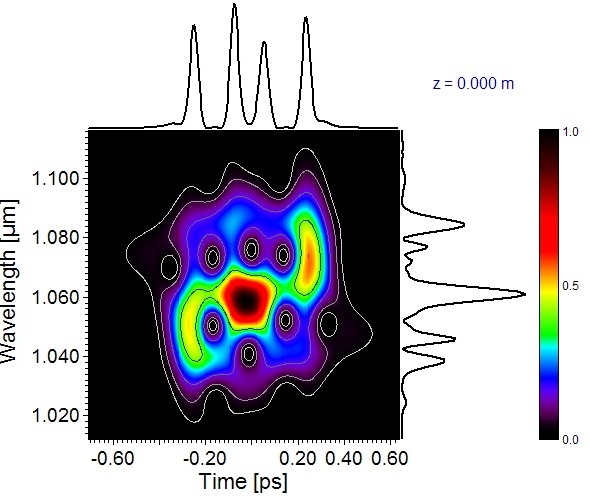
  • contour colors in spectrographic view
  • improved speed
  • New tutorials available!

fiberdesk 2.0

FiberDesk 2.0 available

fiberdesk 1.0

Version update:

  • new feature: visible wavelength visualized
  • pseudo colors for any wavelength visualized - corresponding time domain position (chirp) visualized
  • true color AVI support
  • additional setup in spectrogram view (co-moving frame etc.)

first

www.fiberdesk.com is now online. First Demo version available.

Back to top